
Architecting GCP FinOps Accountability: A Deterministic Cost Allocation Pipeline
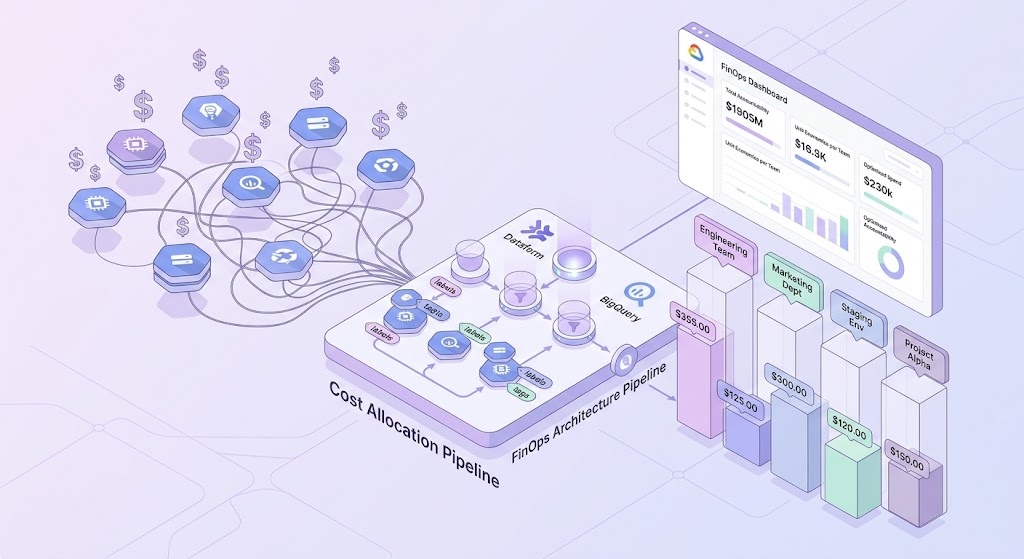
For a scaling mid-market company, migrating to Google Cloud is usually driven by the need for velocity. Engineering teams are granted the autonomy to spin up resources, test hypotheses, and deploy pipelines with zero friction. But as the engineering department grows, this architectural freedom inevitably collides with financial reality.
The symptom is always the same: at the end of the month, the CFO receives a single, aggregated Google Cloud invoice. The total cost is growing exponentially, yet financial visibility is entirely opaque. You know exactly how much you spent, but you have no deterministic way to answer who spent it and why.
Was the $5,000 spike caused by the Data team running unoptimized, full-scan JOIN operations in BigQuery? Or was it an orphaned Kubernetes (GKE) cluster left running by the DevOps team after a staging test?
When infrastructure scales, shared environments become a financial black hole. Standard billing dashboards fail because they operate on the level of cloud services (e.g., “Compute Engine costs”), not on the level of business value (e.g., “Recommendation Engine costs”). To fix this, we must stop treating cloud costs as an accounting problem and start treating them as a data engineering problem.
We need to shift from the paradigm of “IT pays for everything” to Chargeback / Showback—a model where every single cent is mathematically tied to a specific team, product, or environment.
To achieve this, we do not simply install a third-party FinOps tool. We build a deterministic pipeline.
The FinOps Cost Allocation Algorithm
Before writing a single line of Terraform code or SQL, we must define the FinOps accountability architecture as a strict, four-step algorithm. If any step in this sequence fails, the entire financial reporting system degrades into dynamic chaos.
Step 1: Strict Metadata Injection (The Gatekeeper) Accountability begins at the exact moment a resource is born. Every dataset, virtual machine, or Pub/Sub topic must be injected with structured metadata (labels or tags) defining its cost-center, owner, and environment. Algorithm logic: If a deployment request lacks mandatory labels, the infrastructure-as-code (IaC) pipeline must instantly reject it. No exceptions.
Step 2: Continuous Telemetry Extraction (Ingestion) Google Cloud generates massive arrays of billing data daily. This raw telemetry cannot sit in the standard billing console; it must be continuously routed into an analytical engine. Algorithm logic: Establish an automated, native export of raw, granular billing logs directly into a centralized BigQuery dataset.
Step 3: Deterministic Parsing (Transformation) The raw billing export is noisy. Labels are packed into nested JSON arrays, and shared resources (like a common Cloud SQL database) lack clear ownership. Algorithm logic: Deploy a transformation layer (e.g., dbt or Dataform) to unpack JSON structures, clean the data, and apply proportional math. If a shared cluster costs $1,000 and Team A uses 70% of the CPU, the algorithm allocates exactly $700 to Team A.
Step 4: Financial Allocation (Output) The final state of the algorithm. The processed data is aggregated into materialized views that feed directly into business intelligence dashboards. Algorithm logic: Convert raw GCP SKUs into strict Unit Economics (e.g., “Cost per transaction,” “Cost per active user”).
By treating FinOps as a mathematical pipeline, we eliminate human error and subjective cost allocation.
Architectural Approaches & Trade-offs: Evaluating FinOps Tooling
When a company realizes it has a cost allocation problem, engineering and finance teams typically evaluate three distinct architectural paths to regain control. Each approach carries specific operational trade-offs, and choosing the wrong one can lead to either massive technical debt or wasted budget on unnecessary software.
Approach 1: The Reactive Manual Audit (The Baseline)
This is the default state for most companies early in their cloud journey. Cost allocation is treated as a monthly administrative chore rather than an engineering process.
- How it works: Once a month, the finance team downloads a CSV file from the GCP Billing Console. They manually attempt to cross-reference resource IDs with engineering teams via Slack or Jira, relying on tribal knowledge to figure out who owns what.
- Advantages: Zero upfront engineering investment. No infrastructure to maintain.
- The Bottleneck: It is mathematically unscalable. As infrastructure becomes dynamic (e.g., auto-scaling nodes, ephemeral serverless functions), manual mapping becomes impossible. The process is prone to human error, resulting in delayed, inaccurate reports and creating friction between finance and engineering.
Approach 2: Third-Party SaaS FinOps Platforms
To escape manual audits, companies often turn to enterprise FinOps platforms (e.g., CloudZero, Apptio Cloudability, or Datadog FinOps).
- How it works: The organization grants a third-party vendor read-access to its GCP billing export and API. The SaaS platform ingests the telemetry, applies its proprietary algorithms, and provides out-of-the-box dashboards for cost allocation and anomaly detection.
- Advantages: Immediate time-to-value. Excellent UI/UX, built-in anomaly alerting, and multi-cloud support (useful if running GCP alongside AWS/Azure).
- The Bottleneck: High licensing costs, often charged as a percentage of your total cloud spend (effectively a “tax” on your infrastructure). Furthermore, you surrender control over the transformation logic. If your business requires highly custom allocation math (e.g., splitting a single BigQuery dataset’s cost across three departments based on custom query logs), standard SaaS tools often lack the flexibility to execute this logic deterministically.
Approach 3: Native GCP Data Pipeline (The Engineering Standard)
This approach treats billing data exactly like application telemetry, utilizing Google Cloud’s native analytical stack to build a custom FinOps engine.
- How it works: A strict architecture combining GCP Organization Policies (to enforce tagging), Cloud Billing Export to BigQuery (for raw ingestion), and dbt or Dataform (for SQL-based transformation and allocation logic).
- Advantages: Absolute control over the allocation math. You pay only for the storage and compute used by BigQuery, which is orders of magnitude cheaper than SaaS licensing. It seamlessly integrates with your existing DataOps workflows and BI tools (like Looker or Tableau).
- The Bottleneck: Requires upfront engineering effort to design, write the SQL transformations, and maintain the pipeline. It demands strict discipline in IaC deployment to ensure metadata integrity.
The Winning Setup for the Mid-Market
For a typical mid-market company operating entirely (or predominantly) within Google Cloud, Approach 3 (Native GCP Data Pipeline) is the undisputed winner.
Third-party SaaS tools are overkill unless you are managing a massive, complex multi-cloud environment. Conversely, manual audits are an unacceptable risk for any business trying to calculate accurate unit economics. By building a native pipeline, you leverage the very tools your data team already uses (BigQuery and Dataform) to create a transparent, scalable, and highly customizable Chargeback system without incurring ongoing vendor lock-in.
The next step is moving from theory to implementation and building this pipeline from the ground up.
Step-by-Step Implementation: Building the FinOps Pipeline
To transform the theoretical algorithm into a physical architecture, we must configure three distinct layers within Google Cloud: enforcement at the infrastructure level, continuous ingestion, and analytical transformation. This section breaks down the exact technical steps required to build a deterministic Chargeback system.
Phase 1: The Gatekeeper (Enforcing Metadata via IaC)
The most critical point of failure in any FinOps architecture is human negligence. If an engineer forgets to attach a cost-center label to a high-memory Compute Engine instance, that cost becomes an untrackable anomaly. To prevent this, we remove the human element.
We utilize GCP Organization Policies to create a hard constraint. If a resource is deployed without the mandatory labels, the Google Cloud API will deterministically reject the request, causing the Terraform pipeline to fail.
This is achieved by implementing a custom Organization Policy constraint for tag enforcement. Below is a foundational Terraform configuration that enforces the presence of a cost_center label on all newly created Compute instances:
Terraform
resource "google_org_policy_policy" "require_cost_center_label" {
  name   = "organizations/123456789012/policies/compute.requireLabels"
  parent = "organizations/123456789012"

  spec {
    rules {
      enforce = "TRUE"
      condition {
        title       = "Require cost_center label"
        description = "Deny instance creation if the cost_center label is missing."
        expression  = "!has(resource.labels['cost_center'])"
      }
    }
  }
}
Note: In a production environment, this logic is expanded across all major resource types (BigQuery datasets, Cloud Storage buckets, GKE clusters) and relies on GCP Resource Manager Tags for more granular IAM control.
Phase 2: Raw Telemetry Ingestion (Cloud Billing Export)
Once metadata integrity is mathematically guaranteed by the infrastructure layer, we configure the continuous data flow. Standard GCP billing dashboards are static; we need raw data.
The setup is straightforward but critical: enable Detailed Usage Cost Export within the Cloud Billing console and route it to an isolated BigQuery dataset (e.g., finops_billing_raw). This native integration exports highly granular telemetry—often generating millions of rows per day—detailing exact SKU usage, resource IDs, applied labels, and exact micro-cent costs.
Because this dataset becomes the single source of truth for the company’s financial operations, it must be protected by strict IAM policies. Only the automated data pipeline (and the lead FinOps architect) should have read access to this raw layer.
Phase 3: Deterministic Transformation (Dataform / dbt)
The raw billing data in BigQuery is unstructured and deeply nested. Labels arrive as arrays of key-value pairs (RECORD types). To make this actionable, we deploy a transformation engine like Dataform or dbt to unpack the JSON arrays and allocate costs deterministically.
The transformation pipeline runs daily, executing a series of SQL models. The foundational model extracts the mandatory labels and aggregates the total spend per cost center. Here is the core logic of that extraction process:
SQL
-- dbt/Dataform Model: stg_gcp_billing_allocated
WITH raw_billing AS (
  SELECT
    billing_account_id,
    service.description AS service_name,
    sku.description AS sku_name,
    usage_start_time,
    cost,
    labels
  FROM
    `prj-finops-core.finops_billing_raw.gcp_billing_export_v1_XXXX`
),

extracted_labels AS (
  SELECT
    *,
    (SELECT value FROM UNNEST(labels) WHERE key = 'cost_center') AS cost_center,
    (SELECT value FROM UNNEST(labels) WHERE key = 'environment') AS environment
  FROM
    raw_billing
)

SELECT
  DATE(usage_start_time) AS usage_date,
  COALESCE(cost_center, 'Unallocated') AS cost_center,
  COALESCE(environment, 'Unknown') AS environment,
  service_name,
  SUM(cost) AS total_daily_cost
FROM
  extracted_labels
GROUP BY
  1, 2, 3, 4
This model is just the baseline. In a mature pipeline, subsequent SQL models handle complex logic, such as proportionally splitting the cost of a shared Kubernetes cluster across multiple teams based on CPU utilization metrics pulled from Cloud Monitoring.
By executing this pipeline, the abstract cloud invoice is transformed into a clean, normalized, and mathematically proven dataset ready for business intelligence ingestion.
Business & Engineering Impact: The Shift to Chargeback
Implementing a deterministic FinOps pipeline fundamentally alters how a company operates, shifting the culture from infrastructure as a “sunk cost” to infrastructure as an engineered asset. The impact is immediately measurable across both financial and technical domains.
Financial Visibility (Unit Economics)
With costs mathematically allocated to specific cost_center and environment tags, the CFO no longer stares at a monolithic GCP invoice. Instead, the BI dashboard (Looker or Tableau) connected to the processed BigQuery data provides granular insights.
The business can now calculate strict Unit Economics. If the cost of the recommendation engine is known down to the cent, the company can accurately answer critical questions: What is our exact cloud infrastructure cost per active user this week? Does the revenue generated by the new ML feature justify the compute cost required to run it?
The Chargeback Culture
When engineering teams are presented with the true cost of their architectural decisions, behavior changes instantly. The implementation of a “Chargeback” model means that IT no longer subsidizes inefficiency. If Team A deploys a bloated data pipeline that burns $2,000 in BigQuery slots, that cost is deducted from Team A’s specific operational budget.
This accountability drives a new engineering discipline. Developers begin optimizing SQL queries, right-sizing virtual machines, and cleaning up ephemeral environments not because management demands it, but because their own team’s budget is on the line. FinOps becomes an integral part of system design, rather than an afterthought.
Conclusions & Actionable Recommendations
Cloud cost chaos is not a financial failure; it is an engineering failure. Treating the GCP invoice as an administrative problem guarantees continuous overspending. To regain control, a mid-market company must replace tribal knowledge and manual audits with a strict, automated data pipeline.
By enforcing metadata at the infrastructure level (Organization Policies), extracting raw telemetry (Cloud Billing Export), and modeling the data mathematically (BigQuery + Dataform), you build a scalable Chargeback engine that aligns engineering velocity with financial reality.
Practical Recommendations for CTOs and Engineering Leads:
- Define the Tagging Taxonomy Now: Do not overcomplicate the initial rollout. Agree on three mandatory labels (e.g.,
owner,cost_center,env). A simple taxonomy that is 100% enforced is infinitely more valuable than a complex taxonomy that engineers ignore. - Start with “Showback” Before “Chargeback”: Do not immediately start penalizing teams for high cloud bills. Run the pipeline for 60 days in a “Showback” mode—where teams simply see their allocated costs on a dashboard. This builds trust in the data and gives engineers time to optimize their architecture before financial accountability is enforced.
- Treat FinOps as Production Infrastructure: Your billing data pipeline should be managed with the same rigor as your customer-facing applications. Use version control for the SQL transformations, set up automated testing for the Dataform models, and establish strict SLA expectations for data freshness.
The cloud was built for infinite scale. Your financial architecture must be designed to match it.