
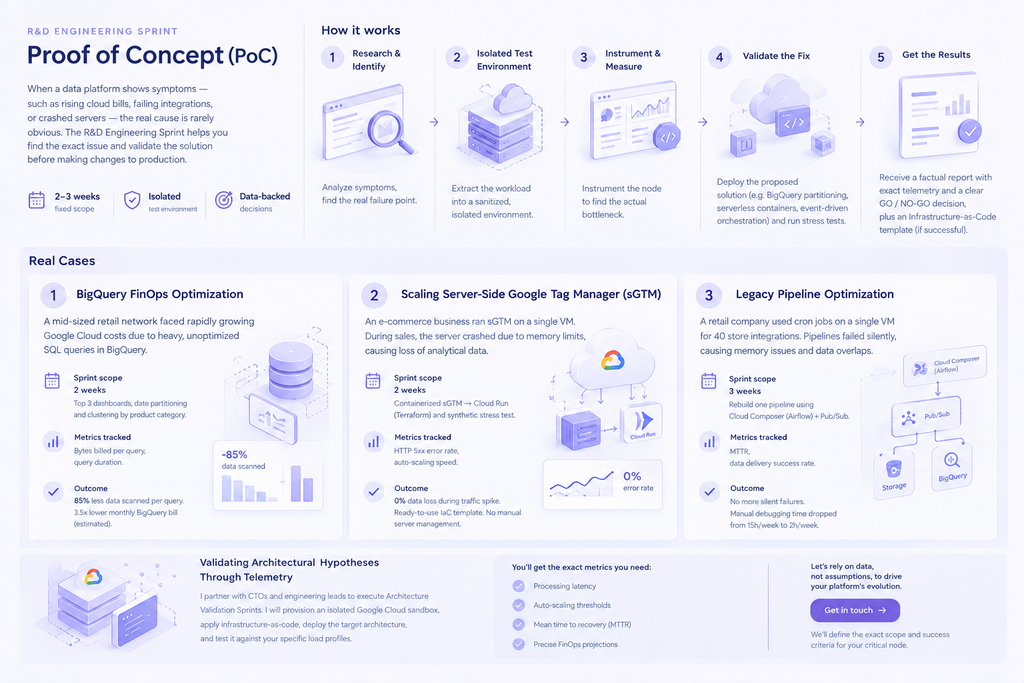
When a data platform exhibits symptoms—whether it is skyrocketing cloud bills, failing legacy integrations, or crashed servers during peak traffic—the root cause is rarely obvious on the surface. For engineering leaders, guessing the underlying issue and deploying unverified structural changes directly to production is a critical risk.
The R&D Engineering Sprint is a strictly scoped, 2-to-3-week engagement designed to eliminate this guesswork. The service operates on a two-step algorithmic principle: first, conducting research to pinpoint the exact failure point, and second, practically validating the solution.
Instead of theoretical discussions, the symptomatic workload is extracted into a sanitized, isolated test environment. The node is instrumented to identify the actual bottleneck. Once the true problem is mapped, the proposed engineering fix—such as BigQuery data partitioning, serverless containerization, or event-driven orchestration—is deployed and subjected to synthetic stress tests.
The outcome is a factual, data-backed engineering report. It delivers exact telemetry: processing latency, throughput limits, error rates, and FinOps unit economics. This provides absolute clarity: a proven Infrastructure-as-Code template (GO) or a documented rejection of the hypothesis (NO-GO). The result is factual evidence of both the problem and the cure, obtained before modifying any production systems.
Below are three practical cases where this research and validation approach proved its efficiency.
Case 1: BigQuery FinOps Optimization
- The Problem: A mid-sized retail network faced rapidly growing Google Cloud Billing costs due to heavy, unoptimized SQL queries in BigQuery.
- The Sprint Scope (2 weeks): We isolated the top 3 most expensive reporting dashboards. We created a shadow dataset using date partitioning and clustering by product category.
- Metrics Tracked: Bytes billed per query, query duration.
- The Outcome: The isolated test showed an 85% drop in scanned data per query. The mathematical model proved that applying this data structure to the entire data warehouse would reduce the monthly BigQuery bill by 3.5 times.
Case 2: Scaling Server-Side Google Tag Manager (sGTM)
- The Problem: An e-commerce business ran sGTM on a single Compute Engine virtual machine. During promotional sales, the server crashed due to memory limits, leading to the loss of valuable analytical data.
- The Sprint Scope (2 weeks): We packaged the sGTM configuration into a container and deployed it via Terraform to Cloud Run. We then ran a synthetic stress test to emulate a Black Friday traffic spike.
- Metrics Tracked: HTTP 5xx error rate, auto-scaling speed.
- The Outcome: Cloud Run auto-scaled new instances within seconds. The test processed massive traffic spikes with a 0% data loss rate. The client received a ready-to-use Infrastructure-as-Code template that requires no manual server management during future sales.
Case 3: Legacy Pipeline Optimization
- The Problem: A retail company ran data integration scripts from 40 physical stores on a single virtual machine using simple cron jobs. Pipelines failed silently, and data processing overlapped, causing regular memory issues.
- The Sprint Scope (3 weeks): We selected one failing pipeline (warehouse inventory sync) and rebuilt it using Cloud Composer (Airflow) for orchestration and Pub/Sub for message queuing.
- Metrics Tracked: Mean Time To Recovery (MTTR), data delivery success rate.
- The Outcome: The test environment provided clear monitoring and automated retries. Silent failures were completely eliminated. The metric analysis showed that the time engineers spent on manual debugging dropped from 15 hours a week to just 2 hours, easily justifying the operational cost of the new architecture.
Validating Architectural Hypotheses Through Telemetry
I partner with CTOs and engineering leads to execute these Architecture Validation Sprints. Bring me your most complex infrastructure constraint. I will provision an isolated Google Cloud sandbox, apply infrastructure-as-code principles to deploy the target architecture, and subject it to your specific load profiles.
I will provide you with the exact metrics needed—processing latency, auto-scaling thresholds, mean time to recovery, and precise FinOps projections. Let’s rely on data, not assumptions, to drive your platform’s evolution. Reach out, and we can define the exact scope and success criteria for your critical node.