
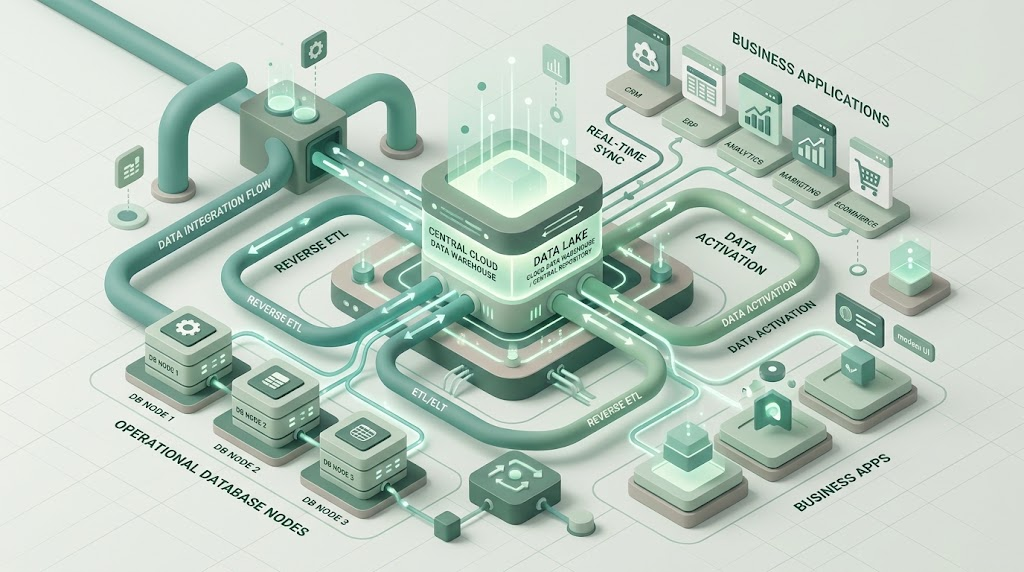
Raw transaction, behavioral, and ad spend data is a core business asset. The fragmentation of this asset across external platforms (CRMs, ERPs, ad accounts) and its transmission through third-party SaaS services creates security and compliance risks (GDPR) while increasing latency in decision-making.
The architectural solution to this is building a closed, two-way data exchange infrastructure within the company’s corporate cloud perimeter.
Solution Architecture:
- Airbyte Integration Core (Data Ingestion): The foundation of the architecture is deploying Airbyte technology within the corporate Google Cloud (GCP) project. This system ensures automated log extraction from mainstream platforms (Meta, Google, Shopify, Stripe) and localized systems (European ERPs, custom databases) without passing personally identifiable information (PII) through external SaaS platforms.
- Centralization: Structuring the ingested data within a single, secure data warehouse. This includes cleaning, deduplicating, and partitioning data arrays to minimize the compute costs of analytical queries.
- Reverse Data Flow: Setting up automated pipelines to transmit enriched data. This involves sending verified offline conversions, inventory statuses, net margin (COGS), or predictive LTV scores back to the bidding algorithms of ad platforms (Google Ads, Meta CAPI) and CRM systems.
Practical Case: Omnichannel Retailer (EU)
- Problem: A D2C brand with a network of physical stores was optimizing budgets based on primary online leads, ignoring returns and offline sales tracked in their local ERP. The use of third-party integration platforms was blocked by the security team due to strict data localization requirements.
- Solution:
- An automated data ingestion infrastructure based on the Airbyte stack was deployed within the corporate cloud perimeter (EU region).
- Connectors were set up for ad accounts, the e-commerce backend, and the local ERP system.
- A reverse pipeline was implemented: daily recalculation of customer lifetime value factoring in actual completed purchases, with automated routing of this data to Google Ads Offline Conversions.
- Result: The company achieved 100% data ownership within its own security perimeter. Operational costs were capped at the direct cost of cloud compute resources (eliminating vendor pricing based on row volume). Transitioning bidding algorithms to optimize for actual earned revenue (Profit on Ad Spend, or POAS) reduced the share of unprofitable campaigns by 22%.
Engagement & Implementation Scenarios
In practice, data management approaches boil down to two main scenarios, both requiring engineering intervention.
The first scenario is building the architecture from scratch. Business data lives in siloed spreadsheets, reporting is compiled manually, and ad systems rely on skewed web analytics. Implementing a proprietary integration infrastructure from day one allows the company to avoid vendor lock-in and dependency on expensive subscriptions for out-of-the-box ELT solutions. The architecture is inherently designed for scale.
The second scenario is migrating an existing stack. The infrastructure is already running on classic SaaS products (such as Fivetran or Stitch), but as the business scales, the monthly bills for Monthly Active Rows (MAR) spiral out of control. Concurrently, there is mounting pressure from regulators and internal security policies prohibiting the transfer of PII to external multi-tenant servers. The solution here is a seamless pipeline migration to an isolated open-source stack within the corporate cloud.
Key Advantages of the Infrastructure Approach:
- Total Sovereignty: Databases, pipelines, and logs never leave the company’s secure Google Cloud project.
- Predictable Total Cost of Ownership (FinOps): Payments are strictly tied to cloud compute usage. The budget remains flat whether the system processes one million or one billion rows.
- Two-Way Value Generation: The infrastructure doesn’t just stockpile dead-weight data for vanity dashboards. Reverse data flows turn the warehouse into an operational engine that automatically adjusts bids and manages media buying based on actual net profit.
To assess the viability of the project, a preliminary mapping is sufficient. This involves outlining a list of source systems (where data needs to be extracted from) and destination systems (where enriched data needs to be sent).
Based on these inputs, a transparent financial model is built—directly comparing GCP cloud compute costs against current or projected SaaS platform expenses. Following this, the single most business-critical route (e.g., ERP -> Data Warehouse -> Google Ads) is selected to launch a pilot data pipeline.