
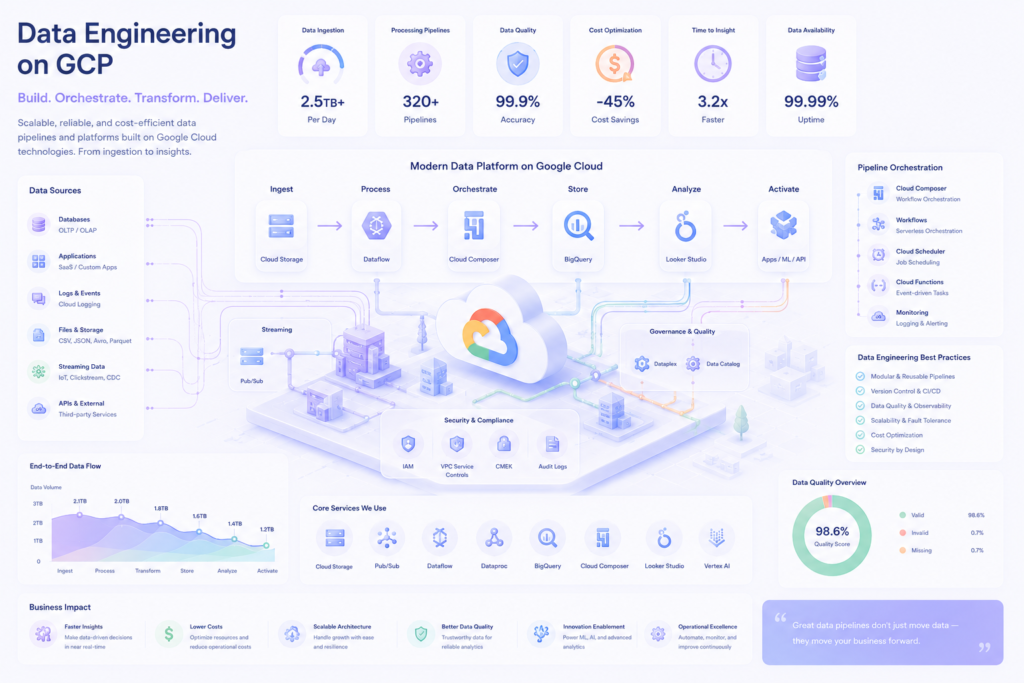
Building Serverless Infrastructure for Business Data Consolidation.
Direct technical evaluation. No sales pitches. You meet directly with an engineer. We discuss your architecture, bottlenecks, and methods for unifying fragmented data into a single source of truth.
Data Engineering is the process of architecting and building IT infrastructure designed to continuously extract raw data from isolated business systems and consolidate it into a unified cloud storage. Collecting web analytics from a site is just the tip of the iceberg. Comprehensive data engineering integrates internal databases (PostgreSQL), CRM systems (Salesforce, HubSpot), payment gateways (Stripe), and external advertising APIs.
My mission as a Google Cloud Solutions Architect is to free your business from dependency on third-party SaaS integrators and build a fully controllable ELT (Extract, Load, Transform) data pipeline based on native Google Cloud Platform (GCP) services.
Phase 0: Security, Compliance & Legal Status
Data engineering implies dealing with the core of your business. Ensuring complete transparency of our cooperation is critical:
- Legal Transparency: Tech Macro is the name of my engineering practice and quality standards. Legally, you do not work with a middleman agency. Contracts and NDAs are signed directly with me as an independent contractor (Private Entrepreneur Dmitry Zinoviev).
- Strictly Read-Only (during audit and integration): I am physically unable to delete or modify your source production databases.
- Zero PII Leakage: Pipeline architecture is initially designed with GDPR compliance in mind. Sensitive data is hashed “on-the-fly” before reaching analytical storage.
The Problem of Fragmented Data
When a company utilizes 5 to 10 independent systems, the absence of a unified engineering contour leads to critical distortions in unit economics:
- Data Silos: Marketing sees one CPA in Google Analytics. The CRM records a different conversion percentage into successful deals. Backend shows a third figure for actual revenue (accounting for refunds). Consolidating this in Excel across tens of thousands of rows is impossible — the business makes decisions blindly.
- Frontend Data Loss (20–30%): Built-in browser blockers (AdBlock, ITP in Safari) cut off analytical cookies. You physically lose visibility on up to a third of user actions.
- External API Limitations: Logistics partners often provide data in specific formats (nested JSON, XML) or send irregular Webhooks. BI systems cannot read such data directly.
- Financial Vendor Lock-in: Using out-of-the-box connectors (Fivetran, OWOX, Stitch) is billed per processed row. As the business grows, data transit costs increase exponentially.
My Solution: I build infrastructure on your side that pulls data via APIs, receives webhooks from CRM, and collects First-Party Data from the website into a single columnar database (BigQuery). You own 100% of your data and do not pay volume commissions to third-party services.
Technology Stack: Serverless on Google Cloud
Architecture is built exclusively on serverless GCP components. The business does not pay for renting or maintaining idle virtual machines. Billing is strictly based on compute milliseconds and disk storage volume.
- Cloud Run / Cloud Functions: Scalable compute nodes. They receive incoming Webhooks from CRM (e.g., order status changes) and parse complex responses from logistics APIs.
- Cloud Pub/Sub: Asynchronous message bus. Acts as a buffer. If an external ERP decides to offload 5 million rows in one minute, the database will not crash. Cloud Run drops the volume into a Pub/Sub queue, which feeds data into storage in controlled batches.
- BigQuery: Central Data Warehouse (DWH). Uses Storage Write API for streaming inserts of raw data. Physically separates storage and compute, making terabyte storage extremely cost-effective.
- Cloud Scheduler: Orchestrator. Runs scripts on a strict cron schedule to pull data from external APIs (e.g., nightly cost extracts from Meta Ads).
DataOps: The Second Half of the Ecosystem
Gathering data from a CRM, website, and partners into BigQuery is only the first step. Engineering handles byte logistics, but it is blind to business context. If analysts are let into a “raw” data warehouse, infrastructure quickly slides into chaos (changing column names, duplicate statuses).
The second, inseparable part of my approach is DataOps. This is an automated data quality control system deployed on top of BigQuery (via Dataform and CI/CD pipelines).
3 Real-World Scenarios Where DataOps Saves Business:
- Scenario 1: Partner API Degradation (Schema Drift). A logistics partner unexpectedly starts sending
order_idas text (“ID-1234”) instead of a number (1234). Without DataOps, the nightly SQL script crashes, leaving the morning dashboard empty. My solution: Automated Assertions in Dataform check data types. Upon mismatch, the pipeline stops, “dirty” data is quarantined, and engineers receive an alert. The dashboard continues showing yesterday’s correct data. - Scenario 2: Silent Product Analytics Failure (Data Quality). Developers roll out a bug in the mobile app — the “add card” event breaks. No server errors (5xx) occur, collection proceeds. Business loses money without knowing why. My solution: Anomaly triggers. Monitoring spots a 40% drop in event volume compared to historical norms and instantly raises an alarm.
- Scenario 3: Commercial Data Leak from CRM (SecOps). During CRM integration, passport and email data accidentally leak into BigQuery — a direct GDPR violation. My solution: PII Tracker (RegEx). The system asynchronously scans incoming data, finds email/phone patterns, and automatically applies hashing (SHA-256). Analysts see unique hashes for session stitching without accessing real personal data.
Architectural Guarantees (My Manifesto)
1. Infrastructure as Code (The “No Hostage” Architecture) Many projects fall into the trap of “ClickOps” — manually configuring infrastructure in the cloud console. This makes systems unscalable and reliant on tribal knowledge of a single contractor. I deploy the entire GCP pipeline exclusively via code (Terraform or Pulumi). Every function and IAM permission resides in your Git repository. Business value: absolute ownership. You are never held hostage by my consulting. Upon any failure, the system is redeployed from Git in minutes.
2. Deep Debugging: The Zero Blind Fixes Principle In complex pipelines, floating bugs inevitably occur — revenue discrepancies between CRM and data marts. The industry standard is a “blind fix”: simply hiding errors on the dashboard. I operate under the Zero Blind Fixes protocol. If data mutates, I build a Minimal Reproducible Example (MRE) on mock data and trace the complete Data Lineage — from frontend API to database. Fundamental architectural flaws are rooted out permanently.
Cost Estimation & Workflow
Data engineering cannot be sold in rigid standardized packages. Every business infrastructure is unique: some collect data from one website, while others must link 3 ERP systems, 5 ad accounts, and a mobile app.
Therefore, project work is structured in two stages:
- Stage 1: Architectural Audit (Discovery). Before writing code, I conduct a deep GCP Architecture Assessment. We map current data sources, identify bottlenecks, and compile a Modernization Roadmap (Technical Specification).
- Stage 2: Engineering & Implementation. Based on the approved spec, I estimate engineering workload. I do not work on an open-ended hourly billing model. Businesses need predictability, so pipeline implementation is evaluated on a Fixed Price model per specific milestones.
You pay for a mathematically validated data ecosystem, not programming hours.