
Early Disease Detection Using Data and Google Cloud
Quick Overview
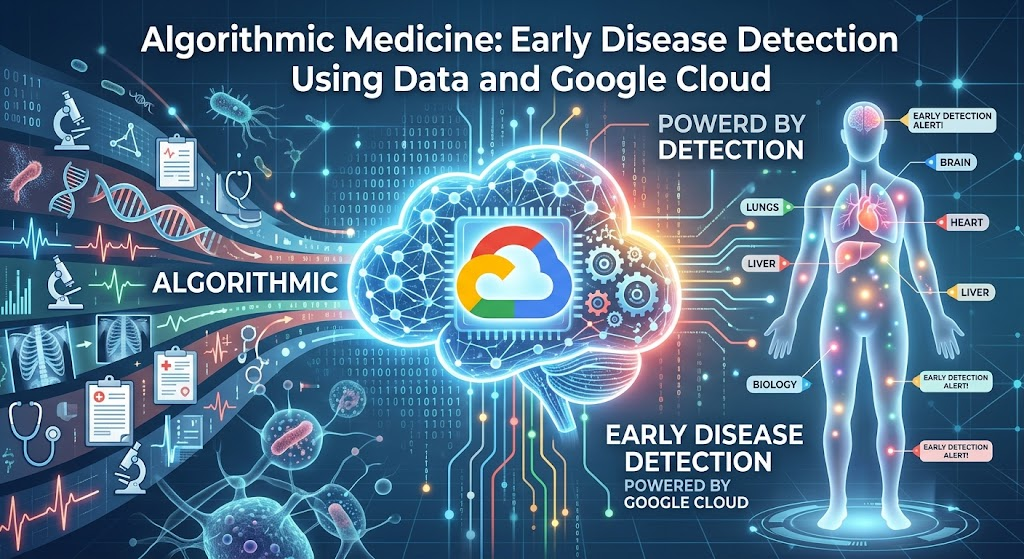
Many diseases are discovered too late. Patients arrive at the hospital when symptoms are already strong, treatment becomes harder, and risks increase. Early detection can save lives, reduce costs, and improve patient outcomes. This article explains how to build a simple and reliable early‑detection algorithm using medical data and Google Cloud.
Key Insights
- Early detection is a data problem, not only a medical problem.
- Symptoms, lab results, and patient history can be analyzed automatically.
- Algorithms help doctors notice risks earlier.
- Google Cloud provides tools for fast, secure, and scalable medical analytics.
- The goal is not to replace doctors, but to support them with better information.
1. Business Problem: Diseases Are Detected Too Late
Hospitals and clinics face the same challenge:
- patients arrive when symptoms are already severe
- early signs are missed
- doctors do not have enough time to analyze all data
- manual review is slow and inconsistent
- treatment becomes more expensive and less effective
This is not only a medical problem. It is a data‑analysis problem.
2. Turning the Problem Into Measurable Parameters
To detect diseases early, we must convert medical information into measurable signals.
Important parameters:
- patient symptoms
- lab test results
- vital signs (heart rate, blood pressure, oxygen level)
- medical history
- risk factors (age, smoking, chronic diseases)
- previous diagnoses
- medication history
- lifestyle information
These parameters allow us to build a clear and predictable model.
3. Algorithm: Early Disease Detection Engine
We create a deterministic algorithm that identifies early warning signs.
Step 1 — Collect Patient Data
The algorithm gathers:
- symptoms from medical records
- lab results from laboratory systems
- vital signs from monitoring devices
- historical data from EHR (Electronic Health Records)
Step 2 — Normalize and Clean the Data
We remove:
- incorrect values
- missing fields
- duplicated records
- inconsistent formats
Clean data is essential for medical accuracy.
Step 3 — Identify Risk Patterns
We analyze patient data to find patterns linked to early disease stages.
Examples:
- unusual changes in blood pressure
- abnormal lab values
- repeated symptoms over time
- combinations of risk factors
This step does not diagnose. It only detects risk signals.
Step 4 — Calculate Risk Score
We calculate a risk score for each patient.
Where:
- w₁–w₄ are weights based on medical importance
- each component is normalized
- the score shows how likely early disease signs are present
Step 5 — Generate Alerts
If the risk score is above a threshold:
- the system alerts the doctor
- the patient is flagged for early review
- additional tests may be recommended
This helps doctors act before the disease becomes serious.
Step 6 — Continuous Monitoring
The algorithm runs daily or hourly.
It updates:
- risk scores
- alerts
- patient status
This creates a real‑time early‑warning system.
4. Technology Stack (Google Cloud Implementation)
To make the algorithm practical, we implement it on Google Cloud.
Data Storage
- BigQuery stores patient records, lab results, vital signs, and risk factors.
- Cloud Storage keeps raw medical files (CSV, JSON, HL7, FHIR).
Computation
- Cloud Functions (Python) calculate risk scores and detect patterns.
- Cloud Run handles more complex medical logic.
- Vertex AI trains and deploys ML models for advanced detection.
Automation
- Cloud Scheduler runs the algorithm every hour or every day.
- Pub/Sub sends alerts to doctors or medical systems.
Visualization
- Looker Studio shows dashboards with risk scores and patient trends.
- Looker provides deeper analytics for medical staff.
Integration
- The system connects to hospital EHR systems through Cloud Functions or Workflows.
- Alerts can be sent to mobile apps, email, or internal medical portals.
Security
- All data is encrypted.
- Access is controlled through IAM.
- Google Cloud supports HIPAA compliance.
5. Case Studies
Case 1 — Early Detection of Heart Problems
The algorithm noticed unusual blood pressure changes in a patient.
Result:
- doctor reviewed the case early
- treatment started before symptoms became severe
- risk of hospitalization decreased
Case 2 — Hidden Infection
Lab results showed small but consistent changes.
Result:
- infection detected early
- antibiotics prescribed
- patient recovered faster
Case 3 — Diabetes Risk
The algorithm found a pattern in glucose levels and lifestyle data.
Result:
- patient received early advice
- lifestyle changes prevented disease progression
6. Anti‑Patterns
Anti‑Pattern 1 — Manual Review Only
Doctors cannot manually check thousands of records every day.
Anti‑Pattern 2 — Ignoring Small Changes
Small changes often signal early disease stages.
Anti‑Pattern 3 — No Historical Analysis
Single lab results are not enough. Trends matter.
Anti‑Pattern 4 — No Automation
If detection is not automated, early signs are missed.
7. Practical Recommendations
- Collect data from multiple medical sources.
- Normalize all values before analysis.
- Use simple models first; add ML later.
- Monitor patients continuously.
- Alert doctors only when risk is real.
- Visualize trends, not only single values.
- Protect patient data with strong security.
- Integrate the system with hospital workflows.
- Update risk models regularly.
- Use Google Cloud for scalability and reliability.
8. Closing Thought
Early disease detection is not magic. It is a combination of data, algorithms, and medical expertise.
The goal is simple:
Help doctors act earlier, treat faster, and save more lives.
With Google Cloud, this becomes practical, scalable, and safe.