
The Definitive Guide to Building Fault-Tolerant, Self-Healing Data Connectors
Introduction: Why Simple Scripts Fail
Building data connectors for ETL (Extract, Transform, Load) or ELT processes often starts with a simple script. A developer writes a few lines of code to call an API, parse a JSON response, and push the results into a database. In a controlled environment, this works perfectly.
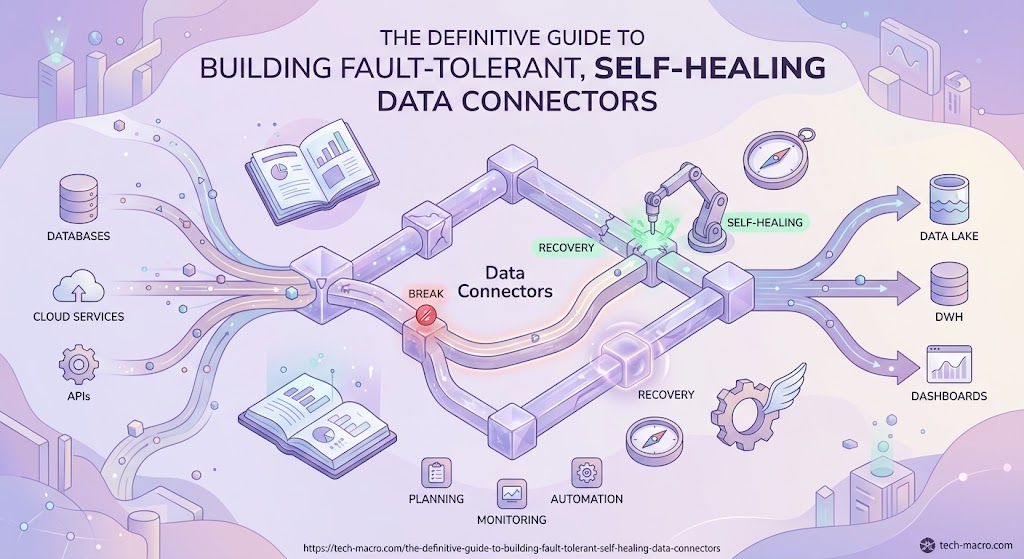
However, in a production environment, failure is not a possibility; it is a guarantee. APIs experience downtime, networks drop packets, schema structures change without warning, and data volumes grow unexpectedly. When a simple script encounters these real-world conditions, it crashes. If your business intelligence and analytics depend on this data, a failed script means making critical business decisions based on outdated or missing information.
To build enterprise-grade data pipelines, we must shift our mindset from writing “data extraction scripts” to engineering “fault-tolerant data connectors.” A reliable connector must expect errors, handle them gracefully, maintain a strict record of its progress, and provide deep visibility into its operations.
12 Real-World Cases: Anti-Patterns and Best Practices
Below, we analyze twelve common scenarios in data engineering, exploring how they are often built incorrectly, why they fail, and the architectural standards required to build them correctly.
Case 1: State Management and Incremental Loading
- How they do it: A scheduled job runs nightly with a hardcoded time window:
fetch_data(start = today - 1 day). - The Problem: This assumes the schedule never fails. If the server goes down on Friday and is fixed on Monday, the script will only fetch Sunday’s data. Friday and Saturday data are permanently lost. Additionally, if the script fails halfway and restarts, it will insert the same data twice, causing duplicates.
- How it should be done: Use Watermarking. The connector must store its state (e.g.,
last_synced_timestamp) in an external, persistent storage (like a dedicated database table or Cloud Storage). Before extraction, it reads this cursor. It only updates the cursor after successfully committing the data to the destination.
Case 2: Memory Consumption and Data Transit
- How they do it: The developer downloads the entire API response into the application’s RAM using
data = response.json(), processes it in a pandas DataFrame, and sends it to the database. - The Problem: As the business grows, the API payload increases from 5 megabytes to 5 gigabytes. The script runs out of memory (OOM error) and crashes. This is especially problematic in serverless environments with strict memory limits.
- How it should be done: Implement Streaming and Chunking. Read the API response as a stream of bytes and write it directly to a local temporary file or an object storage bucket (like Google Cloud Storage) in chunks. Keep the memory footprint small and constant, regardless of the total data volume.
Case 3: Blind Retries vs. Granular Error Handling
- How they do it: The entire execution block is wrapped in a generic
try... except Exception: sleep(5); retry(). - The Problem: If the API returns a
401 Unauthorized(expired token) or400 Bad Request(invalid URL), waiting 5 seconds will not fix the issue. The script will enter an infinite loop, wasting resources and generating massive, useless log files. - How it should be done: Evaluate HTTP status codes.
- For
500, 502, 503, 504(Server Errors): Use an Exponential Backoff and Jitter strategy. - For
429 Too Many Requests: Read theRetry-Afterheader and wait exactly that long. - For
400, 401, 403, 404(Client Errors): Implement a Fail-Fast mechanism. Stop execution immediately and send a critical alert.
- For
Case 4: Pagination Strategies
- How they do it: Using Offset-based pagination (
limit=100, offset=200). - The Problem: If new records are added to the source system while the script is paginating, the entire list shifts. The connector might skip some records or download the same records twice across different pages.
- How it should be done: Use Cursor-based Pagination. The API returns a unique token (cursor) for the next page (
?next_cursor=abc123). This guarantees that the connector receives a consistent snapshot of the data, immune to real-time insertions.
Case 5: Handling Corrupted Data
- How they do it: The script iterates through a list of JSON objects and inserts them into the database. If one object has a string where an integer is expected, the database rejects the transaction, and the script crashes.
- The Problem: One bad row out of a million causes the entire pipeline to fail. The business loses access to 999,999 valid records because of a single typo.
- How it should be done: Implement a Dead Letter Queue (DLQ). Catch validation or insertion errors at the row level. Send the valid records to the main database table, and route the broken records to a separate DLQ table or file. The connector continues running, and engineers can inspect the DLQ later to fix the anomalies.
Case 6: Database Insertion Logic
- How they do it: Using basic
INSERTstatements or dropping the table and recreating it every day (TRUNCATEand load). - The Problem:
INSERTcauses duplicate data if the script runs twice. Truncating the table deletes historical data and causes downtime for reporting dashboards while the load is in progress. - How it should be done: Ensure Idempotency by using
UPSERTorMERGEstatements. The connector must identify a Primary Key for each record. The database then checks: if the key exists, update the record; if it does not exist, insert it. You can run the connector a hundred times, and the final state of the database will remain correct and consistent.
Case 7: Secret and Credential Management
- How they do it: API keys, database passwords, and tokens are hardcoded as text strings in the Python script or committed to GitHub in a
.envfile. - The Problem: A massive security vulnerability. Anyone with access to the code repository can access the production data. Rotating keys requires editing and redeploying the code.
- How it should be done: Use a dedicated Secret Manager (like Google Secret Manager). The script authenticates securely with the cloud provider and fetches the required credentials dynamically at runtime.
Case 8: Architectural Coupling (ETL vs. ELT)
- How they do it: The script extracts data, performs complex cleaning and joining (Transform) in Python, and loads the final product into the database.
- The Problem: If the transformation logic has a bug, the data is corrupted. To fix it, you must re-download the data from the API, which might take hours or be impossible if the data has changed.
- How it should be done: Adopt the ELT (Extract, Load, Transform) pattern. The connector’s only job is to extract raw data and load it as-is into a Data Lake or staging area (e.g., BigQuery raw dataset). All transformations are done later using SQL. If the SQL has a bug, you simply rewrite the query and run it again over the raw data.
Case 9: Observability and Logging formats
- How they do it: Using
print("Data downloaded successfully")or basic text logging. - The Problem: When running hundreds of connectors in a cloud environment, finding out exactly why a specific run failed in a sea of plain-text logs is like finding a needle in a haystack. You cannot easily filter or create alerts based on text.
- How it should be done: Use Structured JSON Logging. Every log entry is a JSON object containing a timestamp, log level, connector ID, and most importantly, a Correlation ID (Trace ID). This ID is generated when the run starts and is attached to every log message, allowing you to trace the exact path of a specific batch of data.
Case 10: Performance and Bottlenecks
- How they do it: The script downloads data sequentially in a single thread.
- The Problem: Downloading 10,000 pages takes hours because the script waits for one HTTP request to finish before starting the next.
- How it should be done: Use Asynchronous I/O (e.g.,
asyncioandaiohttpin Python) or thread pools to fetch multiple pages concurrently. However, this must be paired with strict concurrency limits (Semaphores) to avoid launching a DDoS attack on the source API and triggering immediate bans.
Case 11: Silent Failures
- How they do it: The team only monitors for code exceptions. If the code throws an error, they get a Slack message.
- The Problem: What if the API changes quietly and starts returning empty arrays
[]? The code executes perfectly, no errors are thrown, but no data is collected. The pipeline fails silently. - How it should be done: Monitor Business Metrics, not just logs. The connector should push metrics to a monitoring system (like Prometheus or Datadog). Alerting rules should be set: “If rows_extracted == 0 for 2 consecutive runs, trigger an alert.”
Case 12: Network Timeouts
- How they do it: Relying on default library configurations without specifying timeout parameters (e.g.,
requests.get(url)). - The Problem: If the source API hangs and does not close the connection, the script will wait infinitely. The pipeline stalls forever without crashing or alerting anyone.
- How it should be done: Always enforce Strict Timeouts. Define a connection timeout (time to connect to the server) and a read timeout (time waiting for the server to send the first byte). If the threshold is crossed, the connector drops the connection and initiates the retry logic.
Core Logic Implementation Standards
To build the ideal connector, you must standardise three pillars: Logging, Error Handling, and Metrics.
1. Structured Logging Logic Logs must be machines-readable. Use libraries like python-json-logger. A standard log entry must include:
timestamp: ISO 8601 format.level: INFO, WARN, ERROR, FATAL.trace_id: A UUID generated at the start of the job.connector_name: e.g., “hubspot_to_bigquery”.event: A short string defining the action (e.g., “api_request_sent”, “db_commit_success”).
2. Self-Healing and Error Handling Logic Implement a Circuit Breaker pattern combined with Exponential Backoff.
- Attempt 1: Fails (502 Bad Gateway). Wait 2 seconds + random jitter.
- Attempt 2: Fails. Wait 4 seconds + random jitter.
- Attempt 3: Fails. Wait 8 seconds + random jitter.
- Circuit Open: After 5 consecutive failures, the connector stops making requests for 15 minutes to allow the source system to recover, rather than hammering a broken server.
3. Metrics Logic Logs tell you why something broke. Metrics tell you that something is broken. Send lightweight numerical data via UDP (StatsD) or HTTP to a monitoring dashboard. Track:
records_extracted_countrecords_loaded_countapi_latency_millisecondsapi_429_errors_count
The Ideal Connector: Architecture Example
An ideal Python-based connector operates in a strict, decoupled sequence:
- Initialization: The script starts, generates a
trace_id, and pulls credentials from the Secret Manager. It queries the Data Warehouse to find thelast_synced_timestamp. - Extraction (Stream): It opens an async HTTP session with a connection pool limit. It requests data starting from the cursor. It reads the response in streaming mode (chunks).
- Transit (Stage): As chunks arrive, they are immediately written to a local
data.jsonlfile or uploaded directly to Cloud Storage as a raw payload. Memory usage remains flat. - Loading (Idempotent): Once extraction is complete, the connector issues an asynchronous command to the Data Warehouse (e.g., BigQuery) to load the file from Cloud Storage into a staging table, and then executes a
MERGEstatement into the production table using Primary Keys. - State Update & Cleanup: If the
MERGEis successful, the connector updates thelast_synced_timestampin the state table. It deletes the temporary files, sends final metrics (success=1, total_rows=5000), logs a completion message, and safely shuts down.
Conclusions
Reliable data ingestion is not about writing clever data transformations in Python; it is about infrastructure engineering. The most successful data pipelines assume that the network is unreliable, APIs are fragile, and data is dirty. By decoupling extraction from transformation, managing state externally, and implementing robust retry and logging frameworks, you guarantee data integrity regardless of environmental failures.
Practical Recommendations
- Stop writing custom retry logic: Use established libraries like
TenacityorBackoffin Python. They handle jitter and exponential math flawlessly. - Adopt ELT today: Stop using Pandas for data transformation in your extraction scripts. Move raw data to your warehouse and use tools like dbt (data build tool) for transformations.
- Audit your State Management: Check your cron jobs. If a job uses
CURRENT_DATE - 1, rewrite it immediately to use a database-stored cursor. - Mandate Trace IDs: Update your logging configuration. Ensure that every single log message emitted by your pipeline can be grouped by a unique execution ID.
The Future of Connectors: From Fault-Tolerant to Fully Autonomous Systems
While the factual engineering patterns described above will solve 95% of pipeline failures, they are still fundamentally reactive. They wait for an error to occur before triggering a recovery mechanism. The next evolutionary step in data engineering is building Autonomous State-Machine Connectors that actively anticipate failures and adapt their behavior in real-time.
Advanced Concept 1: Predictive Throttling
Currently, connectors rely on receiving a 429 Too Many Requests error before they back off. A truly self-healing connector analyzes HTTP response headers (like X-RateLimit-Remaining and X-RateLimit-Reset) and monitors API latency in real-time.
If the connector notices that the API response time has increased from 200ms to 800ms, or that the remaining token bucket is depleting faster than it replenishes, it proactively and automatically reduces its own concurrency limit (e.g., dropping from 10 parallel threads to 2) before hitting the error wall. This ensures a smooth, uninterrupted flow of data and maintains a good reputation with the source platform’s firewall.
Advanced Concept 2: Dynamic Schema Drift Auto-Resolution
The most difficult failures to manage are those caused by undocumented API changes (Schema Drift). If an API suddenly changes a user ID field from an integer (12345) to a string ("UUID-12345"), standard connectors crash during the database insertion phase because of type mismatches.
A self-healing connector handles this via Schema Virtualization:
- Instead of defining strict schemas in the connector, the destination database table is designed with a hybrid structure: core indexed columns, plus a
raw_payloadcolumn (using theJSONBdata type). - When the connector detects a new or altered field in the API payload, it does not fail. It dynamically maps the known fields to the standard columns and dumps the unrecognized or altered fields into the
JSONBcolumn. - The connector then triggers a “Schema Drift Alert” to the engineering team via Slack, containing the exact diff of the schema change. The data is safely secured in the warehouse without pipeline downtime, and analytics queries can temporarily use JSON extraction functions until the underlying tables are officially updated.
Advanced Concept 3: Multi-Level Graceful Degradation
Enterprise platforms often provide multiple ways to extract data (e.g., REST API v2, GraphQL, and Webhooks). A highly mature connector possesses a map of fallback routes.
If the primary GraphQL endpoint experiences a hard outage (continuous 502 errors), the connector dynamically degrades. It switches its extraction logic to the older REST API to pull mission-critical fields, ignoring supplementary data. If REST is also down, it spins up an endpoint to catch Webhooks, buffering real-time events in a message queue (like Pub/Sub) until the primary APIs are restored, at which point it runs an automated reconciliation process to fill in the gaps.
Synthetic Conclusion
The ultimate goal of pipeline engineering is to make data extraction completely invisible to the business. By combining strict engineering discipline (State, ELT, Idempotency) with intelligent, adaptive algorithms (Predictive Throttling, Schema Auto-Resolution), we move away from maintaining fragile scripts. Instead, we deploy robust data agents that protect themselves, adapt to their environment, and guarantee the delivery of analytical truth.