Airflow vs Dagster vs Prefect: The Ultimate Engineering Guide
The modern data stack requires robust orchestration to manage complex dependencies, ensure fault tolerance, and optimize cloud infrastructure costs. Selecting the right orchestrator is not a matter of finding the “best” tool, but rather finding the architecture that aligns with your team’s topology, infrastructure deployment model, and FinOps strategy. This section provides a strictly technical breakdown of Apache Airflow, Dagster, and Prefect, analyzing their core mechanics, market positions, real-world applications, and architectural anti-patterns.
1. Apache Airflow: The Task-Centric Monolith
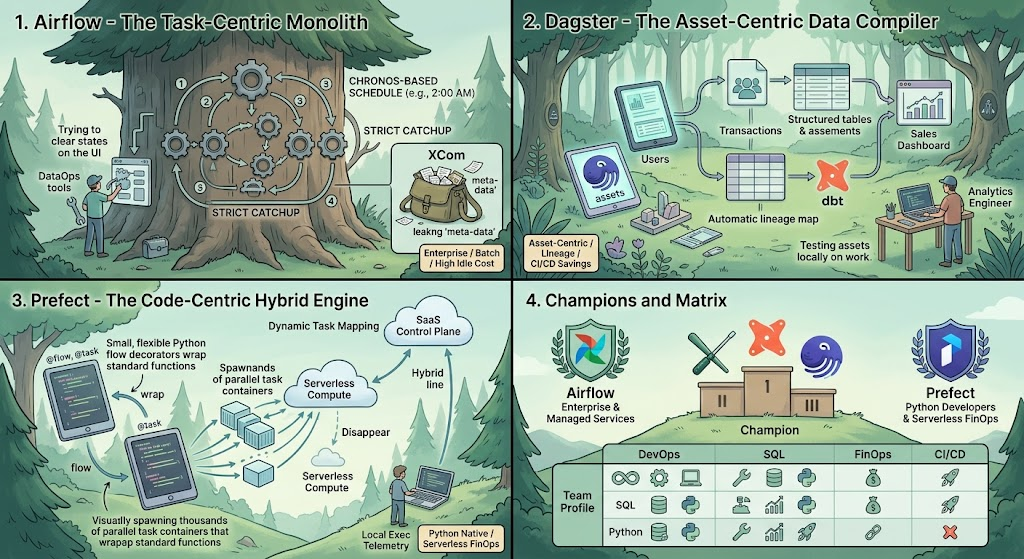
Apache Airflow is the industry standard for orchestration, currently holding approximately 47.3% of the market share. It operates on a task-centric paradigm where a Directed Acyclic Graph (DAG) defines the strict execution order of independent tasks. Airflow is fundamentally a state machine and a time-based scheduler. It does not natively understand the data it processes; it only understands whether a task returned a success (code 0) or an error.
Technical Capabilities & Strengths:
- Time-Based Scheduling & Catchup: Airflow is built around “data intervals.” If a pipeline is paused for five days and then restarted, Airflow’s Catchup mechanism will automatically generate five independent DAG runs with the correct historical
execution_datecontext. This is highly effective for strict batch processing. - Vast Integration Ecosystem: Through its Providers packages, Airflow has hundreds of ready-to-use operators for almost every cloud service (e.g., BigQuery, Dataflow, Dataproc). Engineers rarely need to write raw API requests.
- Deferrable Operators: Modern Airflow can pause tasks that are waiting for external events (like a Spark job finishing) and release the worker slot, preventing resource blocking and reducing infrastructure costs during idle waiting periods.
Real-World Case (Enterprise Data Lake): A large retail company uses managed Airflow (such as Google Cloud Composer) to process nightly sales data. The DAG triggers a massive Dataproc cluster to transform raw logs, waits for the cluster to finish using a Deferrable Sensor, and then executes a BigQuery SQL script to update the central data warehouse. The process runs strictly at 2:00 AM. If it fails, the DataOps team gets a Slack alert and can easily clear the failed task state in the Airflow UI to retry it.
Architectural Anti-Pattern:
- Heavy Data Transfer via XCom: Attempting to pass large objects (like a 1GB Pandas DataFrame) directly between tasks using Airflow’s Cross-Communication (XCom) feature. XCom stores data in Airflow’s metadata database (PostgreSQL/MySQL). Passing large datasets will overload the database and crash the entire cluster. Instead, engineers are forced to write boilerplate code to upload data to Cloud Storage in Task A and download it in Task B.
- Event-Driven Low-Latency Workloads: Using Airflow to process data triggered by real-time webhooks where sub-second latency is required. The Airflow scheduler operates in parsing loops; it introduces an inherent delay (often several seconds to minutes) before a task actually begins execution.
2. Dagster: The Asset-Centric Data Compiler
Dagster holds around 6.2% of the market but is experiencing rapid adoption (up to 11%) in modern data engineering teams and startups. It introduces a paradigm shift: Software-Defined Assets (SDA). Instead of orchestrating arbitrary tasks, Dagster orchestrates the actual data assets (tables, machine learning models, files) that the code produces.
Technical Capabilities & Strengths:
- Separation of I/O from Business Logic: Dagster uses I/O Managers. A Python function simply returns a DataFrame. The I/O Manager automatically determines how to serialize it and where to store it (e.g., as a Parquet file in Cloud Storage or a table in BigQuery). This makes the core business logic incredibly clean and testable.
- Native Data Lineage: Because Dagster knows what data goes into a function and what data comes out, it automatically builds a visual map of data lineage. If a BI dashboard is showing incorrect numbers, an engineer can trace the error back through the UI to the exact Python script or dbt model that generated the underlying asset.
- Declarative Scheduling (Auto-materialize): Instead of writing cron schedules, engineers can define policies. For example, “Update the Sales table only when the Users table and Transactions table have new data.” Dagster resolves these dependencies dynamically.
Real-World Case (Modern Data Mesh): An analytics engineering team uses Dagster to manage a complex pipeline heavily reliant on dbt and Python. They need to ensure strict Data Governance. Because of Dagster’s asset-centric view, they can test the entire pipeline locally on their laptops. The I/O Manager is configured to use a local DuckDB database for testing, but when deployed to production via CI/CD, the exact same code uses the BigQuery I/O Manager. This eliminates the need for expensive staging environments.
Architectural Anti-Pattern:
- Pure IT/Infrastructure Automation: Using Dagster to orchestrate tasks that do not produce data, such as rotating SSL certificates, restarting Kubernetes pods, or sending purely administrative emails. Because Dagster forces the engineer to think in terms of “assets” or “resources,” wrapping simple IT scripts into Dagster’s architecture requires unnecessary boilerplate code, resulting in severe overengineering.
3. Prefect: The Code-Centric Hybrid Engine
Prefect (holding about 1.3% of the enterprise market, but highly popular on GitHub with over 23,500 stars) is built for “negative engineering.” It assumes you already have working Python code and simply want to add retry logic, observability, and scheduling without rewriting your logic into a rigid DAG framework. It utilizes a hybrid architecture: the orchestration metadata lives in the cloud (Prefect Cloud), while the execution happens entirely on the user’s infrastructure.
Technical Capabilities & Strengths:
- Dynamic Task Mapping in Runtime: Prefect can generate tasks dynamically based on the output of previous steps. If a web scraper discovers 500 new URLs, Prefect instantly spawns 500 parallel tasks. The shape of the DAG changes during execution, which is something legacy orchestrators struggle with.
- Scale-to-Zero FinOps Optimization: Prefect workers can run as lightweight agents. They can route task execution directly to serverless compute platforms (like Google Cloud Run). You only pay for the exact CPU milliseconds used during task execution, resulting in near-zero idle infrastructure costs.
- Frictionless Developer Experience: Engineers simply add
@flowand@taskdecorators to their standard Python functions. The code can be executed locally like a normal script, but all logs and states are automatically synchronized with the central Prefect UI.
Real-World Case (Dynamic ML Pipelines on Serverless): A data science team processes unpredictable volumes of images uploaded by users. They deploy a lightweight Prefect worker pool. When a batch of images arrives, Prefect dynamically maps a task for each image. The execution is routed to serverless containers (Cloud Run). The infrastructure instantly scales from 0 to 1,000 parallel containers, processes the images, and scales back to 0. The cloud bill is strictly optimized, and the Python code remains clean.
Architectural Anti-Pattern:
- Rigid Historical Backfilling: Using Prefect in environments that require strict, partition-based historical recalculations for financial auditing. Unlike Airflow, which handles
execution_datepartitions natively in its core scheduling loop, Prefect requires engineers to manually write custom loops and parameterize their flows to achieve comprehensive backfilling.
4. Infrastructure Costs and FinOps Analysis
The architectural differences directly impact the monthly cloud bill and FinOps strategy:
- High Idle Costs (Airflow): A managed Airflow cluster requires a constantly running web server, metadata database, and scheduler. Even if no tasks are running, the baseline cost remains high. This is economically viable only if the cluster is highly utilized 24/7, effectively diluting the fixed costs across thousands of tasks.
- Engineering Time Optimization (Dagster): While Dagster requires persistent infrastructure (a daemon and UI server), its real FinOps advantage is the reduction of engineering hours. By enabling rapid local testing and seamless CI/CD branch deployments, companies save thousands of dollars in developer productivity and reduce the Mean Time to Recovery (MTTR) when data pipelines break.
- Compute-Optimized (Prefect): Prefect wins in direct cloud cost optimization for intermittent workloads. The hybrid model allows the control plane to be managed by Prefect SaaS, while the execution plane scales strictly based on demand using serverless resources. This completely eliminates the “idle tax” associated with heavy orchestrators.
Based on extensive engineering practice and architectural benchmarking, it is clear that there is no absolute “best” orchestrator. Instead, the optimal choice is heavily dictated by Conway’s Law (how your team is structured) and your specific infrastructure requirements.
The Champions by Category
- The Champion of Enterprise & Managed Services: Apache Airflow. If your infrastructure relies heavily on managed cloud services and you require an orchestrator strictly to act as a trigger (a conductor that tells other massive systems like BigQuery or Snowflake what to do), Airflow is the undisputed champion. Its massive market share guarantees that you will easily find engineers who know how to maintain it. It is the safe, corporate choice for predictable batch processing.
- The Champion of Data Engineering & Lineage: Dagster. If your core product is data itself, and your team consists of Analytics Engineers utilizing tools like dbt, Dagster is the champion. It forces engineering discipline onto data pipelines. By treating data as software assets, it solves the “silent failure” problem where a pipeline runs successfully but produces empty or corrupted tables. It provides the best local development and CI/CD experience in the industry.
- The Champion of Python Developers & Serverless FinOps: Prefect. If your team is primarily composed of software engineers or data scientists who want to deploy highly dynamic, event-driven Python code without learning complex DevOps concepts, Prefect is the champion. Its hybrid architecture and seamless integration with serverless compute make it the absolute best choice for minimizing infrastructure costs and accelerating Time-to-Market for custom algorithms.
Practical Block: Conclusions and Recommendations
To make a final architectural decision, follow this step-by-step recommendation matrix:
- Assess Your Team Profile:
- If you have a dedicated DataOps/DevOps team comfortable with Kubernetes and Helm charts, you can afford to maintain Airflow.
- If your team is heavy on Analytics Engineers (SQL, dbt) who care deeply about data quality and governance, invest the time to learn Dagster.
- If your team is mostly pure Python developers or Data Scientists who just want their scripts to run reliably on the cloud, implement Prefect.
- Audit Your FinOps Strategy:
- Are you paying a massive monthly bill for an Airflow cluster that sits idle 70% of the time? If your workloads are sporadic or event-driven, migrate those specific workloads to Prefect utilizing serverless workers (e.g., Cloud Run). The cost reduction will be immediate and substantial.
- Evaluate Your CI/CD Maturity:
- If you suffer from broken staging environments and engineers struggle to test data pipelines locally before merging code, you have a critical architectural flaw. Dagster’s I/O managers solve this by decoupling the environment from the logic. Moving to Dagster will significantly improve code quality and deployment confidence.
- Avoid the “Hype” Migration:
- Do not migrate from Airflow to Dagster or Prefect simply because of new features. The cost of rewriting hundreds of legacy DAGs is enormous. Instead, adopt a strangler fig pattern: leave legacy batch processing in Airflow, but build all new event-driven micro-pipelines or dbt-heavy analytics meshes using Prefect or Dagster.
By aligning the orchestrator’s core architecture with your team’s skills and your FinOps constraints, you ensure a scalable, cost-effective, and fault-tolerant data platform.