Why Integration Connectors are Bleeding Nordic SMEs and How to Build a Resilient Google Cloud Architecture
Let’s be honest. If you run a mid-sized business in Sweden, Norway, Denmark, or Finland, you are already playing on “Hard Mode.” You have some of the highest labor costs in the world, strict labor laws, and the watchful eye of GDPR regulators. To survive and scale, you need automation. You need data.
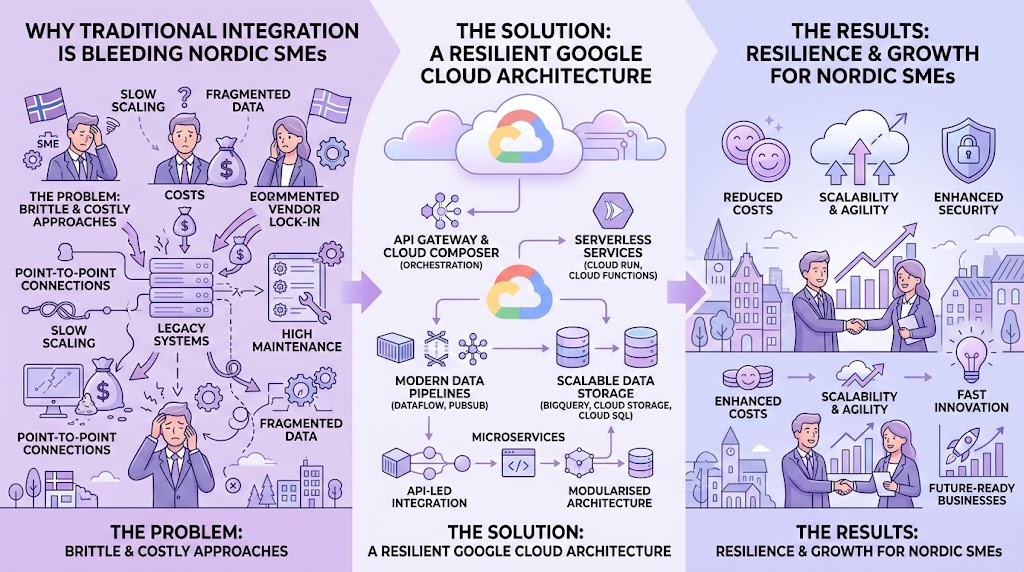
But when you try to become a “data-driven” company, you hit a massive wall: getting the data out of your 20 different SaaS tools and legacy systems into one place. Software vendors promised us a magical plug-and-play future. They lied. The reality is a chaotic mess of broken APIs, missing data, and astronomical bills from third-party connector platforms.
As an engineering practice focused on cloud architecture and FinOps, I see this daily. Businesses treat symptoms (“our dashboard is broken again”) instead of the root cause (“our data ingestion pipeline is fundamentally flawed”).
Let’s grab a coffee (or enjoy a Fika, if you prefer), roll up our sleeves, and look under the hood. We are going to diagnose the five biggest data collection problems draining Nordic SMEs today, and I will show you exactly how to solve them using a mathematically sound, cost-effective Google Cloud Platform (GCP) architecture.
1. The FinOps Trap: The “SaaS Tax” on High-Volume Data
Diagnostics: The Problem
The modern approach to data engineering often relies on managed ELT (Extract, Load, Transform) tools. You buy a service, click a few buttons, and your data flows. But there is a trap: volume-based pricing.
Tools like Fivetran or Airbyte Cloud charge based on Monthly Active Rows (MAR) or compute time. For low-volume data (like a CRM with 10,000 customers), this is fine. But Nordic e-commerce and tech startups generate massive volumes of high-frequency data: website clickstreams, server logs, or IoT telemetry. Pushing 100 million rows of behavioral data through a commercial connector will generate a monthly bill that makes your CFO weep. You end up paying a “SaaS tax” just to move your own data from point A to point B.
The Google Cloud Solution: Hybrid Ingestion Architecture
We do not abandon managed connectors entirely; we optimize where they are used. We split the pipeline:
- For low-volume, complex relational data (e.g., Salesforce, Hubspot): Keep the managed connector. The time saved is worth the small fee.
- For high-volume, flat data (e.g., Web Analytics, Webhooks, Logs): We build a Serverless custom ingestion pipeline on GCP.
The Tech Stack:
- Cloud Run (or API Gateway): Acts as a lightweight, scalable endpoint to receive webhooks or HTTP POST requests containing JSON data.
- Pub/Sub: A highly durable message broker. Cloud Run drops the payload here instantly, ensuring no requests are dropped even during massive traffic spikes.
- BigQuery (Pub/Sub Subscription): We use a direct Pub/Sub to BigQuery subscription to stream data straight into the data warehouse without writing a single line of intermediate processing code.
Financial Breakdown & Comparison
| Metric | Commercial Managed Connector (e.g., Fivetran) | GCP Serverless Architecture |
| Resource Cost (per 100M rows) | ~$1,500 – $2,500 / month | ~$15 – $25 / month (Pub/Sub + BQ Streaming) |
| Maintenance Cost | Zero (fully managed) | Low. Requires basic monitoring. |
| Setup Cost | 1 hour (€100 internal labor) | 15-20 hours of Data Engineer time (~€1,500) |
Conclusion: The custom GCP pipeline pays for itself in less than a month.
Bottlenecks and Compromises
- Engineering Overhead: You need infrastructure-as-code (Terraform) knowledge to set this up reliably.
- No Transformation on the Fly: This architecture dumps raw, nested JSON directly into BigQuery. You must handle the parsing and cleaning later using SQL.
2. SaaS Sprawl and API Chaos
Diagnostics: The Problem
A typical Nordic SME uses anywhere from 15 to 40 different software tools. HR uses one system, marketing uses five, sales uses another three. Each tool has its own API, its own pagination logic, and its own rate limits (how many times you can ask for data per minute).
Running custom Python scripts on a single virtual machine (VM) to pull all this data is a recipe for disaster. The VM runs out of memory, scripts overlap, and if one API hangs, the whole daily batch fails.
The Google Cloud Solution: Containerized Micro-Batching
Instead of a monolithic script, we isolate every single data source into its own independent container.
The Tech Stack:
- Cloud Scheduler: The cron-job orchestrator. It triggers extraction events at specific times.
- Cloud Run Jobs: We wrap Python extraction scripts into Docker containers. When triggered, the container spins up, connects to the specific API, downloads the data, and shuts down. You pay only for the exact seconds the code is running.
- Cloud Storage (GCS): The raw JSON/CSV files are saved here (Data Lake layer).
- BigQuery Data Transfer Service: Automatically loads files from GCS into BigQuery.
Financial Breakdown & Comparison
| Metric | Monolithic VM (EC2/Compute Engine) | GCP Cloud Run Jobs (Micro-batching) |
| Resource Cost | ~$70 – $150 / month (always on) | <$2 / month (billed by the millisecond) |
| Maintenance Cost | High (OS patching, rebooting) | Zero (Serverless) |
| Scalability Cost | Requires upgrading the whole server | Scales automatically to zero or 100 instances |
Bottlenecks and Compromises
- Execution Time Limits: Cloud Run Jobs have a maximum timeout (usually 60 minutes to 24 hours depending on the generation). If you are pulling 5 years of historical data from an API, the container might time out.
- Solution: You must write the Python code to support state management (saving a bookmark of where it stopped) or use Google Cloud Dataflow for truly massive historical backfills.
3. The Legacy Anchor: On-Premise Databases
Diagnostics: The Problem
Many established Nordic manufacturing, logistics, or retail companies are anchored by legacy systems. Deep in the basement sits a server running Microsoft Dynamics NAV or an old PostgreSQL database.
You cannot connect a modern BI tool directly to this database. If a data analyst runs a heavy GROUP BY query, the database will lock up, the warehouse scanners will stop working, and the business halts. Extracting data via daily batch jobs means your analytics are always 24 hours late, which is unacceptable for modern supply chain optimization.
The Google Cloud Solution: Change Data Capture (CDC)
We bypass the API and query layers entirely. We listen directly to the database’s heartbeat: its transaction logs.
The Tech Stack:
- Google Cloud Datastream: A serverless CDC service. It connects securely to your on-premise MySQL, PostgreSQL, Oracle, or SQL Server. Instead of running queries, it reads the replication logs (e.g., binlog or WAL). Whenever a row is inserted, updated, or deleted in your legacy system, Datastream instantly captures that change and streams it to the cloud.
- BigQuery: Datastream merges these changes into BigQuery automatically, maintaining a near real-time replica of your legacy database without adding query load to the source.
Financial Breakdown & Comparison
| Metric | Enterprise CDC (e.g., Qlik Replicate, GoldenGate) | Google Cloud Datastream |
| Resource Cost | $3,000 – $5,000+ / month (licensing) | ~$150 – $300 / month (pay per GB processed) |
| Infrastructure Setup | Requires dedicated heavy servers | Serverless |
| Latency | Milliseconds | Seconds (near real-time) |
Bottlenecks and Compromises
- Database Compatibility: Datastream does not support every ancient database version. If you are running an unsupported system, you will have to fall back on custom incremental batch extraction.
- Analytical Overhead: CDC produces a stream of events (Updates, Deletes). To get the “current state” of a table for reporting, you must regularly materialize views in BigQuery, which consumes computational slots.
4. Silent Failures and API “Breaking Changes”
Diagnostics: The Problem
APIs change. A SaaS vendor updates their platform, adds a new mandatory field, or changes a date format from DD-MM-YYYY to a Unix timestamp. They rarely warn you.
When this happens, standard data pipelines crash. The data is lost in the void. The worst part? You usually don’t notice until a manager complains that the weekly report looks weird. In data engineering, silent failures are infinitely more dangerous than loud crashes.
The Google Cloud Solution: The Dead Letter Architecture
We design pipelines expecting them to fail. We implement a mathematical certainty that no data payload will ever be dropped, regardless of API changes.
The Tech Stack:
- Pub/Sub Dead Letter Queues (DLQ): When our Cloud Run script or Dataflow pipeline fails to parse an incoming JSON payload due to a schema change, the system does not delete the message. Instead, it routes the “broken” payload to a separate, secure queue (the DLQ).
- Cloud Monitoring & Error Reporting: The moment a message hits the DLQ, an alert is triggered and sent directly to the engineering team’s Slack or Microsoft Teams channel.
- Cloud Storage: The broken messages sit safely in storage.
Once the data engineer updates the parsing logic to match the new API structure, they simply replay the messages from the DLQ. Zero data is lost.
Financial Breakdown & Comparison
| Metric | Custom Logging & Basic Alerts | GCP Pub/Sub DLQ + Error Reporting |
| Cost of Lost Data | Incalculable (bad business decisions) | Zero |
| Resource Cost | Varies | Basically Free (included in standard GCP tiers) |
| Time to Discovery | Days or weeks (manual dashboard checks) | Seconds (automated Slack push) |
Bottlenecks and Compromises
- Manual Intervention is Still Required: Technology cannot write business logic for you. When the API changes, a human engineer still must rewrite the extraction code. The DLQ simply buys you time and guarantees data preservation while you fix the issue.
5. The “Garbage In, Garbage Out” Dilemma
Diagnostics: The Problem
Congratulations, you successfully connected all 40 SaaS tools and your legacy database to the cloud warehouse. The data is flowing. But it is filthy.
A Danish sales rep entered a phone number with a country code, a Swedish rep didn’t. In the e-commerce system, a glitch caused 500 duplicate orders to be logged. If you connect Looker or Power BI directly to this raw data, the algorithms will produce hallucinations. The business loses trust in the numbers, and the entire data project fails.
The Google Cloud Solution: In-Warehouse Data Quality Assertions
Because we use the ELT approach (extract and load raw data first, transform later), we must build a strict quality checkpoint inside the data warehouse before the data reaches the business layer.
The Tech Stack:
- Dataform (Integrated in BigQuery): Dataform allows you to manage data transformations using SQL and version control (Git). Crucially, it allows you to write “Assertions” (automated data tests).
- The Logic: Before building the final reporting tables, Dataform runs mathematical checks:
- Uniqueness check:
COUNT(order_id)must equal exactly 1. - Null check:
customer_emailcannot be NULL. - Range check:
discount_percentagemust be between 0 and 100.
- Uniqueness check:
- If a test fails, the pipeline halts. The “dirty” data is quarantined, and the reporting tables freeze at their last known good state.
Financial Breakdown & Comparison
| Metric | Premium Transformation SaaS (e.g., dbt Cloud) | GCP Dataform (Native BigQuery) |
| Orchestration Cost | ~$100 / developer / month | Free (Fully managed in GCP Console) |
| Compute Cost | Billed by underlying warehouse | Billed as standard BigQuery query costs |
| Maintenance Cost | Low | Low |
Bottlenecks and Compromises
- The FinOps Blindspot: Running complex SQL assertions across terabytes of data every hour costs money (BigQuery bills by bytes scanned or compute capacity used).
- Solution: You must apply rigorous FinOps practices. Do not scan historical partitions every day. Use incremental processing in Dataform, testing only the data that arrived in the last 24 hours.
Conclusion: Stop Treating the Symptoms
The algorithmic business does not tolerate bad data. If your goal is to build predictive machine learning models, implement dynamic pricing, or just get an accurate view of your Customer Acquisition Cost, you cannot build it on a foundation of fragile, expensive connectors.
By shifting from a mindset of “buying expensive band-aids” to “building resilient infrastructure” on Google Cloud, Nordic SMEs can break free from the SaaS tax. Yes, it requires a structural engineering effort up front. But the reward is a fault-tolerant, scalable platform where the marginal cost of adding a new data source approaches zero.
And that is an equation that any CFO will approve.