
Algorithmic Business: An Engineering Framework for Solving Business Problems
Businesses tend to formulate problems based on symptoms: “customers are leaving,” “logistics are getting expensive,” “the budget is being spent inefficiently.” A systematic engineering approach translates these symptoms into a rigorous mathematical model. Any non-trivial problem can be digitized, paired with a deterministic algorithm, and solved through a structural implementation.
This method is universal. It works in finance, logistics, marketing, manufacturing, healthcare, e-commerce, SaaS, and operational processes.
Below is a structural, reproducible 4-step framework that moves a problem from the realm of abstract discussion into the field of data engineering.
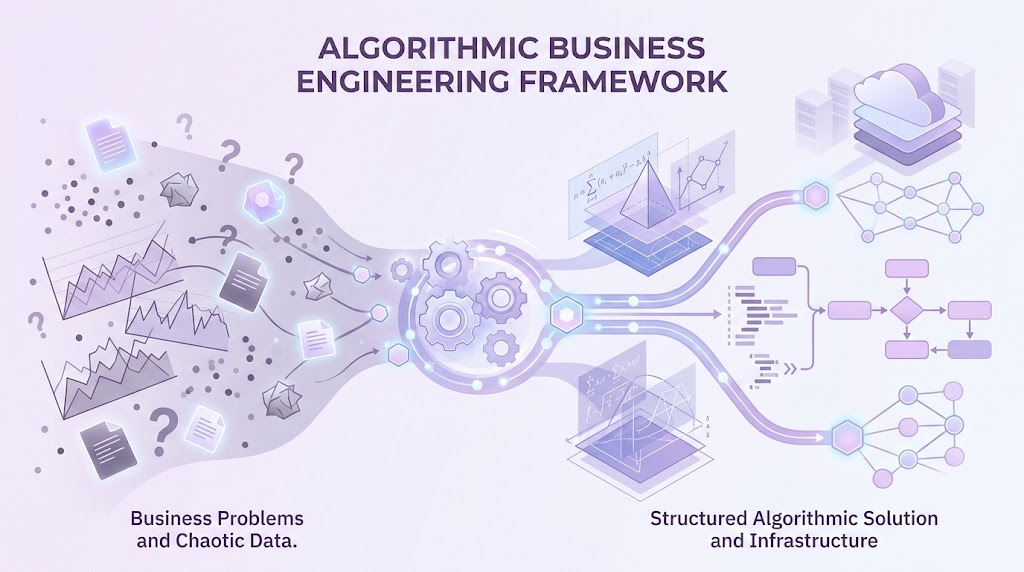
Step 1. Formulate the Business Problem (Non-Technical)
This is a critical stage. The problem must be stated exactly as the business sees it. Technical formulations are a consequence, not a cause.
Examples of real-world problems:
- “We lose customers after their first purchase.”
- “We don’t know what inventory to order for the next season.”
- “We can’t forecast demand.”
- “We don’t understand why our logistics costs are rising.”
- “We cannot predict user churn.”
- “We don’t know which marketing campaigns are actually working.”
Step 2. Translate the Problem into Measurable Parameters
The abstract business phrase is transformed into a mathematical model. The problem becomes measurable.
For example, for the problem “We lose customers after their first purchase,” the following parameters are established:
- Time between purchases.
- Probability of a repeat purchase.
- Customer segments.
- Customer Acquisition Cost (CAC).
- Retention Cost.
Step 3. Formulate the Algorithm (Deterministic Logic)
The algorithm is the deterministic logic that solves the digitized problem. It must be reproducible, explainable, and measurable, and it must have a strict mathematical expression (e.g., calculating probability, minimizing a function, or computing weights).
Basic Algorithm Classes:
- Anomaly Detector — finds statistical deviations from the norm.
- Forecasting Model — predicts the future based on historical data.
- Optimization Engine — minimizes costs or maximizes profits given specific constraints.
- Segmentation Algorithm — groups users based on hidden patterns.
- Recommendation / Prioritization Algorithm — mathematically ranks options and suggests the best action.
Step 4. Implement the Solution (Infrastructure)
Implementation depends on the domain, but it is always the final step, never the first. The infrastructure is selected strictly based on the algorithm: BigQuery for storage, Python for mathematical calculations, SQL for transformations, Cloud Functions or Dataflow for pipeline automation, Vertex AI for complex computations.
Applying the Framework to Real-World Examples
The same 4 steps can solve problems in completely different industries.
Example 1: Logistics
Problem:“Our order delivery is too expensive.”
Parameters: Delivery cost by region, order density, distance, product type, delivery time, SLA, return rate.
Algorithm (Cost Optimization Algorithm):
- Collect historical data for all deliveries.
- Calculate the average cost per segment.
- Identify anomalies (deliveries that are statistically more expensive than average).
- Solve the Vehicle Routing Problem—mathematically calculating the optimal route that minimizes total costs without violating the SLA.
- Forecast costs for the next month.
- Provide the dispatcher with the optimal delivery method.Implementation: BigQuery (storage) → SQL (analysis) → Python (optimization) → Cloud Functions (automation) → Dashboard (visualization).
Example 2: Marketing
Problem:“We are spending money on advertising, but we don’t know what is working.”
Parameters: Cost per click, sequence of touchpoints, final conversion rate, ROI.
Algorithm (Attribution Algorithm):
- Collect all user events.
- Build the chain of touchpoints from the first click to the purchase.
- Calculate the mathematical contribution of each channel (using Markov chains or Shapley value).
- Forecast the ROI for each campaign.
- Disable inefficient channels whose weight approaches zero.Implementation: BigQuery → SQL → Python → Looker.
Example 3: Sales
Problem:“Managers don’t know who to call first and waste their time.”
Parameters: Company characteristics, interaction history, budget, probability of a successful deal.
Algorithm (Lead Prioritization Algorithm):
- Estimate the mathematical probability of a purchase for each lead (binary classification model from 0 to 1).
- Sort leads by priority.
- Automatically send the ranked list to the managers.
- Measure the result (change in conversion rate).Implementation: CRM API → Dataflow → Vertex AI → return data to the CRM.
Example 4: E-commerce / Retail
Problem:“We don’t know what inventory to order for the next season.”
Parameters: Sales velocity, current stock levels, seasonality, profit margin, storage costs.
Algorithm (Forecasting & Inventory Optimization):
- Analyze historical demand and current stock.
- Calculate the mathematical optimum (Economic Order Quantity), where the cost of storing excess inventory is exactly equal to the loss from stockouts.
- Generate the precise purchase volume for each item.Implementation: BigQuery → Python (time series models) → ERP integration.