
Why Algorithms Fail at Grocery Discounts (And How We Fixed It)
If you run a quick-commerce (Q-commerce) or grocery delivery business in Europe, you know the silent killer of your P&L: the dumpster.
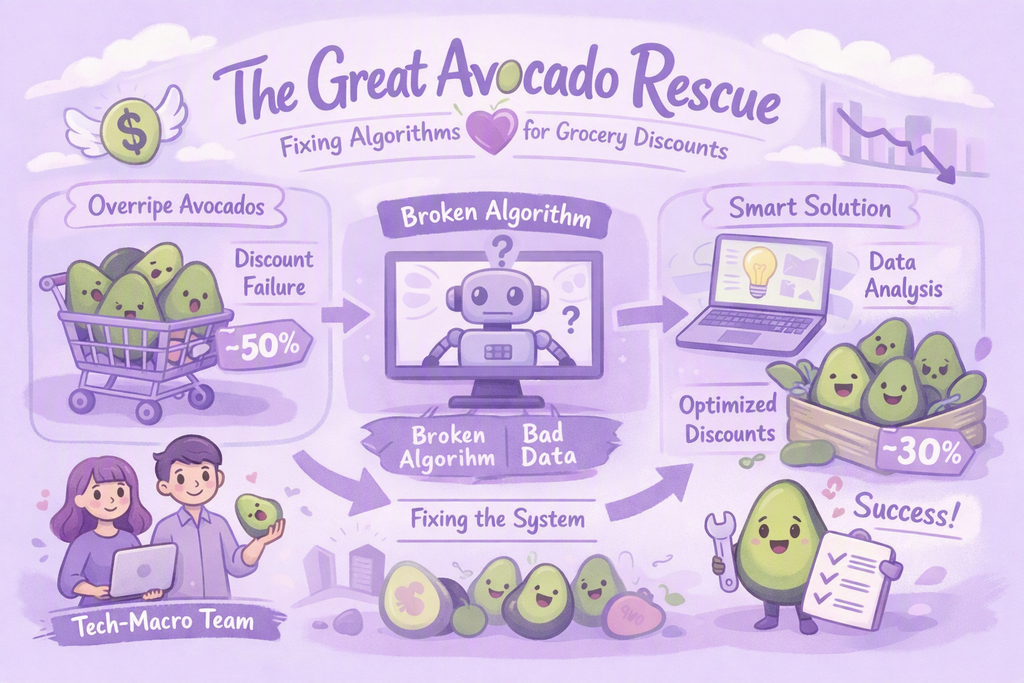
Every day, perfectly good food expires and gets written off. The industry average for perishable inventory shrinkage is roughly 5% of gross volume. When your overall net margin hovers around 2-3%, losing 5% to the trash bin is a financial tragedy.
The Dream: Code Can Fix Anything, Right?
The Task: Create an automated markdown system.
The Expectation: We build a slick machine learning model. It analyzes sales velocity in real-time. When the probability of selling that expensive organic milk before its expiration date drops below 30%, the system automatically cuts the price and pushes it to a “Last Chance” section in the app.
The expected result? 100% of that 5% waste is magically converted back into cash. The CFO cries tears of joy. The environment is saved.
The Reality: The algorithm went live, and it was a spectacular disaster. Why? Because data scientists rarely work inside a dark store.
The Collision with Reality
When pure mathematics leaves the cloud and hits the warehouse floor, it faces two brutal enemies. Let’s look at the real-life cases that broke our beautiful model.
Case Study 1: The “Picker’s Blindness” (The Logistics Trap)
Imagine you have 10 cartons of milk on the shelf. Three expire tomorrow; seven expire next week. Our algorithm correctly calculates that we need a 40% discount to sell those three expiring cartons today. A customer sees the discount and orders.
Here is the problem: the standard EAN-13 barcode on a milk carton does not contain the expiration date.
The warehouse picker gets an order for “Milk (Discounted).” Their KPI is to pack the bag in 90 seconds. They grab the closest carton, scan it, and pack it.
The Result: The customer gets a perfectly fresh milk carton for a 40% discount (destroying our margin), and the old milk stays on the shelf to rot and get thrown away anyway. We lost money twice.
Case Study 2: The Pavlovian Consumer (The Game Theory Trap)
Algorithms are logical. If they always discount baked goods at 19:00, consumers learn this pattern faster than a neural network.
Our analytics showed that full-price evening sales plummeted. Customers weren’t buying more bread; they were just waiting until 19:01 to buy the exact same bread cheaper. We didn’t save waste; we just cannibalized our own revenue.
The Math (Explained for Humans)
To fix this, we had to go back to a classic Operations Research concept: the Newsvendor Problem.
Imagine a person selling newspapers. If they buy too many, the left-over papers are worthless the next day. If they buy too few, they lose potential profit. The math looks for the perfect balance point using this formula:
CR = C_u / (C_u + C_o)
- C_u (Cost of Underage): The profit you lose by missing a sale.
- C_o (Cost of Overage): The money you lose by throwing the item away.
Plain-text translation: The formula calculates the “Critical Ratio” ($CR$). If throwing away the item costs you a lot more than the profit you make from selling it, the algorithm tells you to drop the price aggressively and early. But if the item is cheap to produce but highly profitable, you hold the price steady for longer.
The Real Parameters We Used
| Metric | Industry Average | Our Model’s Target |
| Base Gross Margin | 25-30% | Protect at all costs |
| Price Elasticity | -1.8 (10% discount = 18% sales boost) | Dynamic per category |
| Shrinkage (Waste) | 5% of Gross Volume | Reduce to 2.5% |
The Solution: Bridging the Digital and Physical Worlds
We realized that writing more code wouldn’t fix a physical warehouse problem. We needed to change the system architecture. Here is the three-step solution that actually worked.
1. The Virtual SKU (Fixing the Logistics)
We stopped discounting items on the main shelf. Instead, 24 hours before expiration, our system generates a task for the dark store staff. They physically remove the expiring items, slap a bright “Sale” sticker with a new internal barcode on them, and move them to a dedicated physical shelf.
In the ERP system, this becomes a Virtual SKU. When a customer orders the discounted milk, the picker’s app explicitly directs them to the discount shelf. Zero mistakes.
2. Stochastic Pricing via GCP (Fixing the Consumer Behavior)
To stop customers from gaming the system, we stopped using fixed schedules. Using Google Cloud Platform (BigQuery and Dataform), the discount triggers became dynamic. Sometimes the discount hits at 16:00, sometimes at 19:30, depending on real-time weather, current stock, and historical elasticity.
3. The Safety Net (Fixing the Data Risks)
Letting an algorithm control your pricing in real-time is terrifying. A single data duplication bug can make your system think demand is zero and discount your entire store by 90%.
Before the pricing pipeline executes, the data must pass through BQ Omni-Monitor at the Data Warehouse level. If the monitor detects a data anomaly, it freezes the price changes and alerts the engineering team.
The Final Reality Check
Did we save 100% of the 5% waste? No. That is a fairy tale. Factoring in the labor cost of moving items to the discount shelf and minor, unavoidable cannibalization, here are the real results:
| Objective | Naive Expectation | Actual Achieved Result |
| Waste Reduction | 100% saved | 45% saved |
| Net EBITDA Impact | +5.0% | +1.6% (Pure Profit) |
| Margin Protection | Perfect | Protected via Virtual SKUs |
Adding 1.6% to your bottom line in a business where 3% is considered a massive success is a huge win. The lesson? Algorithms only generate cash when you engineer them to survive the chaos of the physical world.