
Quantum Computing by 2031: Less Magic, More I/O Bottlenecks
Quantum Computing by 2031: Less Magic, More I/O Bottlenecks
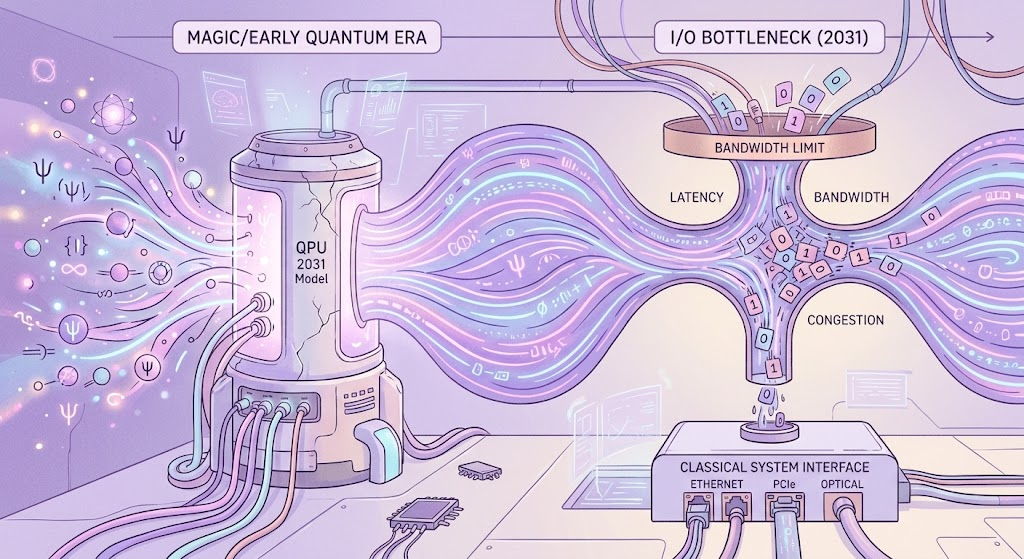
Every time I read another press release about how quantum computers will soon solve all of humanity’s problems and make classical data centers obsolete, I can only smile. As an engineer who spends days digging into cloud architecture, debugging data pipelines, and optimizing infrastructure costs, I trust physics and I/O metrics, not marketing departments.
Let’s cut the promotional fluff. The next five years are not about magic; they are a brutal fight against thermodynamics, decoherence, and input/output bottlenecks. Here is an objective system analysis of three realistic industry scenarios, complete with real-world validation.
Scenario 1: The Vacuum Unicorn (FTQC Utopia)
Concept: A fully scalable, fault-tolerant quantum computing (FTQC) system that operates autonomously without classical orchestration.
- Probability by 2031: P(FTQC) = 5%
- The Reality: This is a beautiful fairy tale for venture capital pitch decks. To get 1,000 stable (logical) qubits, you need between 1 and 10 million physical ones. Try scaling microwave control cables and cryogenic chambers to that volume without violating the laws of thermodynamics through massive heat dissipation.
- Real-World Evidence: Look at IBM’s recent hardware roadmap pivot. After hyping up their massive 1,121-qubit “Condor” chip, they realized that managing the noise, crosstalk, and physical I/O at that scale on a single monolithic processor was practically impossible. They quietly shifted their focus back to smaller, 133-qubit “Heron” chips that must be linked together using classical communication protocols. Physics forced them to abandon the monolithic FTQC dream.
- Verdict: A technological singularity that won’t happen this decade. I certainly wouldn’t base any product architecture on this scenario.
Scenario 2: The Quantum Coprocessor (Quantum-Centric Supercomputing)
Concept: The Quantum Processing Unit (QPU) acts strictly as a wildly expensive, highly specialized accelerator within a hybrid cloud environment.
- Probability by 2031: P(Hybrid) = 80%
- The Reality: This is the only pragmatic path forward. You wouldn’t try to run standard SQL queries on a GPU, right? Similarly, no one will run basic business logic on a quantum machine. Heavy data infrastructure remains classical. Dataform or Airflow will prepare clean data in BigQuery, and a classical orchestrator will slice out the most complex (NP-hard) part of the graph, sending it to the QPU via an API.
- Real-World Evidence: BMW Group and Airbus are currently testing quantum algorithms for supply chain routing and aerodynamic optimization. They do not upload their entire supply chain databases into a quantum computer. The heavy lifting, data storage, and constraint filtering happen in standard classical data warehouses. The quantum solver (often accessed via AWS Braket or direct API) only receives a highly compressed mathematical matrix containing the combinatorial explosion (e.g., QAOA algorithm), calculates the minimum energy state, and returns a string of probabilities back to the classical server.
- The Bottleneck (Trade-off): The I/O curse. Quantum calculation takes microseconds, but if translating a terabyte of classical data into quantum states takes two hours, the speedup is completely pointless.
- Verdict: This is the actual engineering reality. The market winner will not be the company with the most qubits, but the one that writes the perfect middleware for graph decomposition.
Scenario 3: Quantum Winter and the Consolation Prize
Concept: Physics fights back. Decoherence (noise) proves too difficult to overcome at scale. Hardware stagnates, but the math survives.
- Probability by 2031: P(Winter) = 15%
- The Reality: Hardware budgets freeze as scaling becomes economically unviable, but the mathematical frameworks developed for quantum mechanics (quantum-inspired algorithms and tensor networks) are adapted to run on classical GPU clusters.
- Real-World Evidence: The rise of Fujitsu’s Digital Annealer. It is not a quantum computer; it is a classical ASIC processor designed to run quantum-inspired algorithms. Companies like Toyota and NatWest bank got tired of waiting for stable qubits and now use this classical hardware to run quantum math for portfolio optimization and factory floor scheduling. They get the algorithmic boost without the need to rent a cryogenic freezer.
- Verdict: The fallback plan. There will be no true exponential speedup, but businesses will still receive a solid performance boost in Operations Research.
Practical Conclusions: What to Do While You Wait
If you are planning a tech strategy or engineering career, waiting for a perfect universal quantum computer is a losing game. Here is the pragmatic reality:
- For Business (The Infrastructure Check): A QPU will not fix a broken data warehouse. If your current data pipelines are a mess, your attribution is failing, and you cannot stream clean data efficiently, quantum acceleration is useless. Focus on building robust classical data architecture first. Tracking data quality, monitoring costs, and ensuring perfect data governance is the actual first step toward quantum readiness.
- For Cloud and Data Engineers: Stop worrying about quantum physics and focus on hybrid orchestration and Operations Research. The highest-paid skill will not be writing pure quantum circuits. It will be the ability to analyze a massive business problem, mathematically slice the NP-hard core, route it to a QFaaS (Quantum Function-as-a-Service) endpoint, and seamlessly merge the result back into a classical database without causing an I/O bottleneck.
- The Bottom Line: Treat quantum technology exactly like any other cloud service. Discard the marketing magic, calculate the I/O overhead, evaluate the specific mathematical limits, and prepare your classical pipelines to integrate a very fast, but very narrow, accelerator.