
F# in the Data World: Functional Magic on Harsh GCP Servers
In the data processing industry, there is a common belief that you only have Python for scripts, SQL for databases, and perhaps Scala or Java if your infrastructure suffers from a severe enterprise headache. Using F# for data engineering is like bringing a Mars rover to an illegal street race: it is highly unconventional, raises eyebrows among the crowd, but its technical superiority in harsh conditions is undeniable.
Python is undeniably fantastic for quick prototyping. However, in production, high-load pipelines written in dynamically typed languages often resemble a game of Jenga. One unexpected None arriving from an external API, and the nightly pipeline crashes, leaving behind nothing but tracebacks and missed SLAs. F# is a strongly typed functional language. Its philosophy is ruthless but fair: if the code compiles, it most likely works correctly. For an engineer who refuses to be woken up by PagerDuty alerts, this translates to a radical reduction in debugging hours.
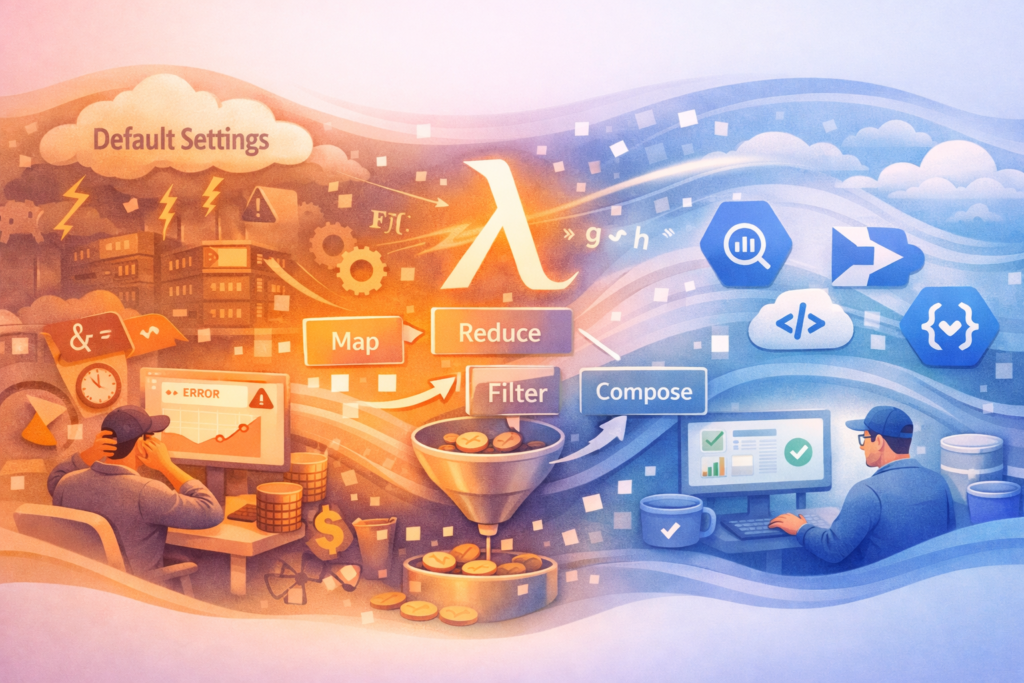
Why F# is a Hidden Gem for Data Engineering
- Immutability by Default: In F#, variables cannot be changed after creation unless you explicitly allow it. This completely destroys an entire class of bugs related to state during parallel data processing. No data races—only pure functions.
- Algebraic Data Types and Pattern Matching: F# allows you to model complex business logic as closely as possible to mathematical formulas. Pattern Matching makes parsing monstrous JSON files or messy logs elegant and type-safe.
- Type Providers: This is the killer feature of F#. The compiler can read external data schemas (CSV, JSON, SQL databases) while you are writing the code. You get autocomplete and type checking for external data before the program is even launched.
- Speed and Memory Management: Comparing the performance of F# and Python in stream processing is like racing a Formula-1 car against a lawnmower. Due to the GIL (Global Interpreter Lock), Python is physically incapable of true multithreading without C++ crutches (hello, Pandas) or distributed frameworks. F# runs on top of CoreCLR, compiles to machine code, and uses abstractions like
Span<T>to parse gigabyte-sized streams in memory with zero allocation.
Cloud-Native Architecture on GCP
If you are building a modern system, virtual machines belong in the scrapyard of history. The focus is exclusively on managed Google Cloud services.
- Entry Point (Messaging):
Google Cloud Pub/Sub. F# easily digests asynchronous data streams. Subscribing to topics and processing batches of events viaasync { ... }happens without any thread blocking. - Compute Core:
Google Cloud Run. F# packs perfectly into minimalist Docker containers (especially with AOT compilation). Cloud Run scales instances down to zero during idle times and up to thousands under heavy load. - Storage and Analytics:
Google BigQuery. Using the official SDK, F# initiates complex analytics, executes parameterized queries, or streams real-time data via the Storage Write API.
Serious Business: Where F# Unleashes its Potential
Simple ETL scripts that just move JSON from one bucket to another can be written in anything. The true power of F# shines at the intersection of Data Engineering and Operations Research, where complex mathematics collides with streaming data.
Case 1: Dynamic Routing in Logistics
Scenario: Telemetry from thousands of trucks pours into Pub/Sub at a rate of 50,000 messages per second. The system must recalculate routing graphs on the fly, accounting for traffic jams and delivery windows. The Traveling Salesperson Problem grows factorially — mathcal{O}(N!) — so calculations require extreme optimization.
Implementation: A container in Cloud Run pulls batches from the queue. F# has a built-in MailboxProcessor abstraction (the Actor model). Every truck is represented in memory as a separate, lightweight actor that processes its state in isolation. Mathematical heuristics are written as pure functions. The recalculated route matrices are then dumped into BigQuery.
Case 2: High-Load FinOps Engine
Scenario: Hourly analysis of cloud infrastructure billing exports (terabytes of logs) to find anomalies and forecast costs based on historical data.
Implementation: Raw logs are pulled from BigQuery via the Storage Read API. Using Type Providers, the log structure is statically typed. If the billing schema in BQ changes (which Google loves to do), the code simply will not compile. The error is caught during the CI/CD build stage, not in production. Unit economics calculations are parallelized via Async.Parallel, and data immutability guarantees that threads do not overwrite each other’s coefficients.
The Business Perspective: F# vs. Enterprise Dinosaurs (Java and Scala)
When it comes to Big Data, businesses instinctively look toward the JVM stack. But let us put aside the technical manuals and look at the unit economics (Total Cost of Ownership) and Time-to-Market.
1. Infrastructure Costs (The Cloud Bill)
- Java/Scala: The JVM is a heavyweight. To run stream processing in Scala (usually Apache Spark), you need to deploy and pay for a Google Cloud Dataproc cluster. Virtual machines will burn money even during idle moments, just waiting for new data.
- F#: Thanks to the lightweight CoreCLR, F# fits perfectly into the serverless architecture of Cloud Run. You only pay Google for the exact milliseconds when your code is processing data. During idle times, costs drop to zero. For a business, this means cutting infrastructure bills by 3 to 5 times.
2. The Personnel Issue and Team Size
- Java/Scala: Hiring a Scala engineer is like collecting rare Swiss watches: it is expensive, time-consuming, and there is no guarantee they will show the right time without tweaking the cluster. Java development requires massive teams: someone writes the logic, someone covers it with tons of tests, and someone else configures CI/CD for heavy artifacts.
- F#: Finding a ready-made Senior F# Data Engineer on the market is difficult, that is a fact. But the catch is that the strict typing and concise syntax of F# allow a single R&D engineer or a tiny two-person team to deliver the volume of work that would require an entire department in the Java world. The compiler takes on the role of a strict QA Lead.
3. Time-to-Market and Reliability
In the Java and Scala ecosystems, a huge chunk of the budget goes into hunting down runtime bugs (the infamous NullPointerException). F# shifts error detection to the compilation stage (shift-left testing). The business faces a paradoxical situation: the initial algorithm development in F# might take slightly longer due to strict typing rules, but the testing and stabilization phase is reduced to a minimum. The code is simply deployed to production and works, allowing the business to validate hypotheses faster without burning budgets on endless refactoring.
Conclusion: F# in Data and ML Engineering
So, where does F# truly belong in the modern data landscape?
In Data Engineering, F# is an absolute beast for complex transformations, real-time event streaming, and mathematically intensive tasks (Operations Research). It is the perfect tool for building a zero-trust, highly reliable pipeline where data integrity is not just a nice-to-have, but a strict requirement. It allows lean R&D setups to punch far above their weight class on GCP.
In ML Engineering, let us be brutally honest: F# is not going to replace Python for training Deep Learning models. The ecosystem around PyTorch and TensorFlow is too massive. However, when it comes to MLOps—serving those models in production, calculating real-time features, and building the infrastructure that feeds data into the ML algorithms—F# is exceptional. It acts as an unbreakable bridge. While Python scientists experiment in Jupyter notebooks, F# ensures that the data flowing into their models in production is clean, correctly typed, and delivered with microsecond precision.