
The True Cost of Bot Traffic and How to Cure GA4 with BigQuery
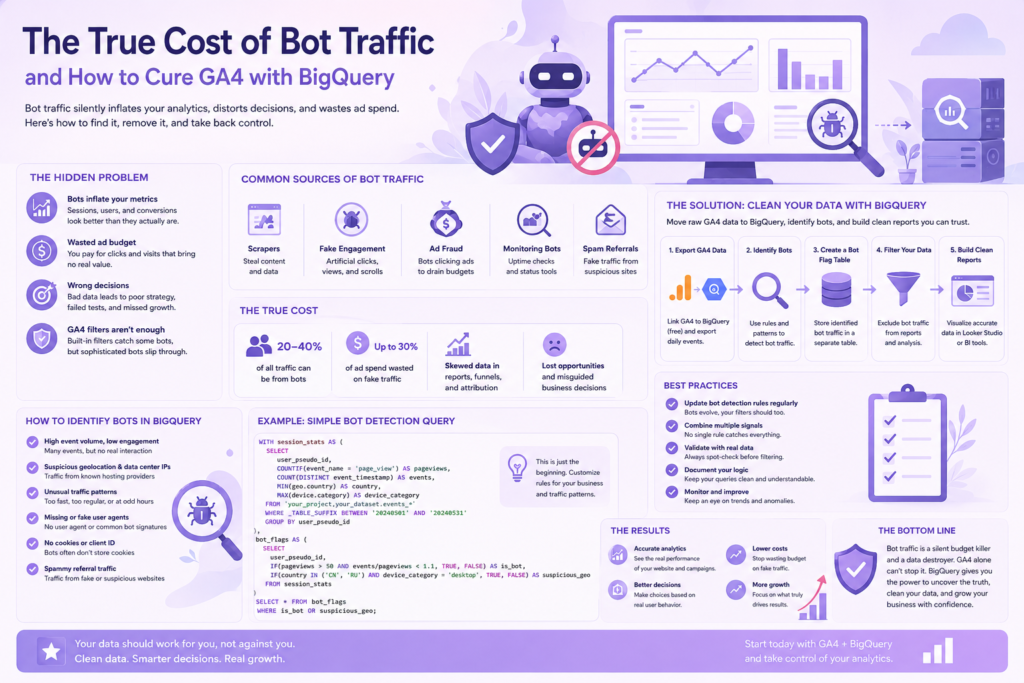
Part 1. The Death of the “Traffic = Humans” Axiom
For over a decade, digital analytics has been comfortably resting on a highly optimistic, yet entirely delusional axiom: one web session equals one living, breathing human being. Marketing departments built their entire quarter-end presentations around this myth. Traffic goes up, the charts look green, and everyone gets a bonus.
But let’s face reality. That axiom is dead. Today, your website is essentially a digital waiting room for LLM crawlers, competitor price scrapers, SEO monitoring tools, and automated QA scripts. According to recent infrastructure reports, automated requests now account for roughly 40% to 50% of total internet traffic. And the worst part? To Google Analytics 4, a headless Chromium browser spun up in an AWS data center looks exactly like your most loyal customer.
Modern bots do not politely identify themselves as python-requests anymore. Frameworks like Playwright and Puppeteer execute JavaScript flawlessly, accept cookies, simulate screen resolutions, and trigger your carefully configured session_start and page_view events. They look legitimate. And this is exactly where the financial bleed begins.
The Mathematics of Data Poisoning
The problem is no longer just “dirty data” annoying your analysts. It is a direct financial liability known as Data Poisoning.
Let’s look at the math. Conversion Rate (CR) is simple: (Valuable Actions / Sessions) * 100. Automated scripts do not buy your software, nor do they apply for your loans. They artificially inflate the denominator (sessions) while the numerator (conversions) remains static. If your e-commerce site suddenly gets an extra 50,000 sessions from a competitor’s pricing scraper, your overall CR plummets.
In a vacuum, a dropping CR is just a sad metric on a dashboard. But in the modern marketing stack, you are feeding this polluted data back into Google Ads or Meta via Server-Side GTM.
Here is what actually happens to your money:
- The Illusion of Growth: Your marketing team celebrates a 30% spike in traffic. Meanwhile, the sales team is staring at a completely flat pipeline. The business concludes the product is losing its market fit, completely missing the fact that the “new audience” consists of servers in Virginia.
- Smart Bidding Sabotage: Algorithms like Target CPA or Maximize Conversions rely on precise behavioral signals. When you feed them a dataset where 30% of the highly engaged users are actually scrapers (who view 100 pages in 3 seconds), the neural networks panic. They attempt to find patterns in the noise.
- Burning Cash: Eventually, your advertising algorithms start optimizing bids to acquire more bots because they mistake synthetic navigation for high engagement. Congratulations, you are now paying $2 per click to retarget a Python script.
We have spent years obsessing over Data Collection—ensuring every button click is tracked. But collecting data is a solved problem. The real engineering challenge of this decade is Data Validation: proving algorithmically that the data sitting in your warehouse actually deserves to influence a business decision.
In the next part, we will dissect why the out-of-the-box tools—from GA4’s default filters to expensive enterprise Anti-Bot SaaS—are failing to solve this problem, and why the only reliable answer requires getting your hands dirty in BigQuery.
Part 2. The Illusion of Protection: Why Out-of-the-Box Solutions Fail
When executives realize their dashboards are heavily polluted with synthetic traffic, the natural corporate reflex is to try and buy a magical filter. The market is more than happy to oblige, offering a variety of solutions ranging from free checkboxes to enterprise-grade software. Unfortunately, when you subject these solutions to the harsh light of unit economics and actual data architecture, their superficial nature becomes glaringly obvious.
Let us brutally break down the three standard approaches to bot mitigation and why the industry defaults are essentially security theater.
1. GA4 Default Bot Filtering: The Security Theater
Google Analytics 4 automatically filters known bots and spiders. It sounds comforting, but it is dangerously misleading.
- The Pros: It is built-in, completely free, and requires zero configuration. It successfully drops the absolute bottom-tier of automated traffic—the scripts that are too lazy to mask their user-agent strings.
- The Cons: GA4 relies heavily on the IAB (Interactive Advertising Bureau) bot/spider list. This approach was relevant in 2015. Today, it is effectively useless against modern automation. If a competitor uses headless Chromium via Playwright, it executes your tracking tags perfectly. It generates a valid client ID, accepts cookies, and sends standard HTTP requests. GA4’s default filters are entirely blind to this because they look for technical signatures, not behavioral anomalies. Relying on this is like leaving your front door wide open but feeling safe because you put up a “No Robbers Allowed” sign.
2. Enterprise Anti-Bot SaaS: The Expensive Black Box
The next logical step for many companies is purchasing dedicated SaaS solutions like Cloudflare Bot Management, DataDome, or similar WAF (Web Application Firewall) extensions.
- The Pros: These tools are excellent for DevOps and infrastructure teams. They stop DDoS attacks, mitigate credential stuffing, and prevent brute-force scraping that could crash your servers.
- The Cons: They are extraordinarily expensive (often starting at $5,000+ per month) and operate as complete black boxes. More importantly, they have zero understanding of your specific business logic. A SaaS tool evaluates HTTP request headers and IP reputation. It does not know that a user visiting your B2B “Pricing” page 40 times a week without ever clicking “Request Demo” is actually a competitor monitoring your rates. Furthermore, if these tools aggressively block traffic at the edge, you lose the raw data completely. You cannot analyze what you do not collect, stripping your data engineers of the ability to audit the traffic retroactively.
3. The Custom Validation Layer (BigQuery + SQL + dbt): The Engineering Reality
If standard filters are blind and SaaS tools are expensive black boxes, the only mathematically sound approach is shifting the battlefield from the application layer to the data warehouse. You collect everything in GA4, export the raw events_* tables to Google BigQuery, and build a Validation Layer using SQL and transformation tools like dbt or Dataform.
- The Pros: Total transparency and complete alignment with your business logic. Instead of a binary “Bot vs. Human” label, you calculate a behavioral Trust Score for every session. You control the heuristics. You do not delete the raw data; you enrich it. Furthermore, storing a terabyte of logs in GCP costs roughly $20 a month—a microscopic fraction of what enterprise Anti-Bot software charges.
- The Cons: It requires actual data engineering competence. You cannot just click a button. You have to write precise, incremental SQL models using window functions to calculate time-to-first-interaction, navigation entropy, and event variance. If your team writes inefficient
SELECT *queries over unpartitioned GA4 datasets, your BigQuery processing costs will skyrocket. It demands a mature data platform architecture.
We have established that you cannot buy your way out of this problem with a vendor subscription. You have to engineer your way out. In the next part, we will drop the high-level theory and look at the actual SQL mechanics. We will explore how to identify synthetic navigation patterns using window functions and why transparent SQL heuristics consistently outperform trendy, uncalibrated Machine Learning models.
Part 3. Practical Engineering: Catching Bots with SQL (Not Magic)
Once you move your raw events_* tables into BigQuery, you face a new temptation: throwing complex Machine Learning at the problem because it looks great on a resume. Data scientists often want to feed these raw logs into a K-Means clustering algorithm or an anomaly detection neural network.
Do not do this. Feeding unlabelled, polluted data into a black-box AI model does not solve your bot problem; it merely automates your bad decisions at a massive scale. Before you even think about Python and scikit-learn, you need transparent, deterministic heuristics. You need a SQL-based Trust Score where every penalized point can be explained to your CFO.
Let’s look at the actual behavioral patterns that expose automated traffic and how to catch them using standard BigQuery SQL.
The Behavioral Signatures of a Script
You cannot catch modern bots by looking at their coats (User-Agents or IP addresses). You catch them by watching how they walk. Humans browse the internet with chaos and hesitation. Software executes tasks with terrifying efficiency.
1. The Speedrunner (Timing Anomalies)
A human takes 40 seconds to read a product description and 15 seconds to fill out a form. A scraper script executes these actions as fast as your server responds.
By using SQL window functions, specifically LAG(event_timestamp) OVER (PARTITION BY user_pseudo_id, ga_session_id ORDER BY event_timestamp), you can calculate the exact microsecond difference between events. If a user views 80 pages in a row, and the standard deviation of the time between those page views is close to zero (e.g., exactly 1.2 seconds every time), you are not looking at an enthusiastic buyer. You are looking at a while loop.
2. The Alphabetical Reader (Navigation Entropy)
Real users do not navigate your website in alphabetical order. They go from the homepage to a category, click a product, get distracted, go back, and maybe add an item to the cart. Bots, on the other hand, frequently scrape your sitemap.xml or iterate through sequential product IDs (e.g., id=1001, id=1002, id=1003). If a session contains 50 page views with zero logical UX connection between them, it is synthetic navigation. You can flag this by calculating the depth of the session against the variety of event types.
3. Deep Diving with Zero Business Value
Conventional marketing wisdom dictates that high “Pages per Session” equals high loyalty. In the era of automated web scraping, this is a dangerous assumption. A session that views 150 pages in 4 minutes but triggers absolutely zero scroll events (past 50%), zero add_to_cart events, and zero form interactions is highly toxic. It inflates your denominator and destroys your Conversion Rate.
Building the Trust Score
Instead of hard-deleting these sessions (which destroys evidence), you use a tool like dbt (data build tool) to build a Staging Layer. You create a new column called trust_score, starting at 100. Then, your SQL logic starts deducting or adding points:
- Time between events < 2 seconds for 10+ events? -50 points.
- Session depth > 30 pages but zero interaction events? -40 points.
- Traffic source has a valid Google Ads GCLID or organic referrer? +20 points.
- User triggers a
purchaseorgenerate_leadevent? Auto-set to 100 points. (Even if a bot buys your product, their money is just as good as human money).
The Infrastructure Trap: How Not to Go Bankrupt
A word of warning about executing these complex SQL queries. BigQuery charges by the amount of data processed. Running heavy window functions across your entire historical GA4 dataset every morning is a fantastic way to get fired by your Finance department.
The architecture must be incremental. Your dbt models or scheduled queries must only target yesterday’s data partition using the _TABLE_SUFFIX (or the partitioned event_date). You calculate the Trust Score for the new sessions, append them to your production Data Mart, and move on. When engineered correctly, processing even hundreds of gigabytes of traffic data daily costs less than the price of a cup of coffee.
By building this transparent Validation Layer, you finally create two separate realities. The Security team gets a list of low-trust IP subnets to block at the firewall. The Marketing team gets a Looker Studio dashboard built only on sessions with a Trust Score above 60. Suddenly, your CPA (Cost Per Acquisition) looks accurate, and your ad algorithms start learning from real humans again.
In the final part, we will zoom out and look at the macro trend. We will discuss why the “Internet of Machines” is making this Validation Layer not just a competitive advantage, but a basic requirement for corporate survival.
Part 4. The Internet of Machines: Why Data Trust is the Only Metric That Matters
If you think the current volume of automated traffic is annoying, brace yourself. We are standing at the absolute beginning of a massive paradigm shift. The internet is fundamentally changing its demographic.
For the last twenty years, the web was a place where humans consumed content created by humans. Today, it is increasingly a place where machines consume content to train other machines. LLM crawlers (like GPTBot, ClaudeBot, and Perplexity) are constantly indexing your pages. Very soon, autonomous AI agents will be booking tickets, comparing software prices, and interacting with your B2B funnels on behalf of their human owners.
We are moving rapidly from B2B (Business to Business) and B2C (Business to Consumer) to B2M (Business to Machine). Industry analysts project that non-human traffic will soon consistently exceed 70% of all web activity.
If you continue to believe that every page_view in your Google Analytics dashboard represents a person sitting behind a screen, your business strategy is going to hit a wall.
The Death of the “Collect Everything” Era
For the past decade, Data Engineering was obsessed with storage and pipelines. The industry mantra was “Collect everything now, figure it out later.” Companies spent millions building massive Data Lakes, arguing over ETL vs. ELT, and optimizing their cloud infrastructure to process petabytes of logs.
Congratulations, we succeeded. Collecting data is now a cheap, solved problem. Any junior developer can deploy a tracking script and dump millions of rows into BigQuery.
But this success created a new, much more dangerous bottleneck. Because we made data collection so frictionless, we also made it incredibly easy to collect garbage. The challenge is no longer moving data from Point A to Point B. The challenge is proving that the data is not a hallucination.
This marks a profound shift in the role of the Data Engineer and the Web Analyst. You are no longer just a pipeline builder or a dashboard creator. You are an internal auditor. Your primary job is to mathematically prove to the CEO and the CMO that the numbers they are using to allocate a $500,000 marketing budget are actually connected to commercial reality.
Optimizing for the Wrong Species
Let’s look at the final, fatal consequence of ignoring this trend.
Modern businesses use data to optimize everything. We run A/B tests to improve the UX. We rewrite landing pages to reduce the bounce rate. We let Meta and Google algorithms automatically adjust our ad bids based on conversion signals.
If your raw dataset is 50% bots, and you do not have a Validation Layer in place, who are you actually optimizing your product for?
- You might simplify a form because the “average time on page” dropped—but it only dropped because automated scrapers execute the page in one second.
- You might kill a highly profitable ad campaign because its overall Conversion Rate looks terrible—failing to see that it attracted thousands of competitor monitoring scripts alongside high-paying human clients.
You end up designing a website and a marketing strategy perfectly optimized for headless browsers and Python scripts. And unfortunately, Python scripts do not possess credit cards.
The New Competitive Advantage
In the Internet of Machines, the company with the most data does not win. The company with the most verified data wins.
Building a Staging Layer in BigQuery, calculating a Trust Score, and separating synthetic navigation from genuine human intent is not just a neat technical trick. It is corporate survival. It allows your marketing team to stop feeding their ad algorithms with poisoned data. It stops your product team from chasing UX ghosts.
A business making decisions based on 10,000 mathematically verified human sessions will always ruthlessly outcompete a business hallucinating over 100,000 polluted ones. Stop treating your raw GA4 logs as the absolute truth. Build your Validation Layer, embrace the Trust Score, and finally start reporting on reality.
We build, migrate, and optimize cloud data pipelines on Google Cloud Platform. From BigQuery query optimization to custom ingestion architectures, explore our Data Engineering on GCP services.