
GDPR vs. US CLOUD Act on Google Cloud Platform
Part 1: The Core Conflict and Real-World Legal Cases
1. Introduction to the Problem
When modern European companies build their analytical databases and data pipelines on Google Cloud Platform (GCP), they face a massive structural problem. This problem is not a software bug or a bad architecture design. It is a direct legal conflict between two powerful global laws.
On one side, the European Union protects user privacy with the General Data Protection Regulation (GDPR). On the other side, the United States enforces the CLOUD Act (Clarifying Lawful Overseas Use of Data Act). For a Data Engineer or an Enterprise Architect, this creates a paradox: following one law can automatically force you to break the other. This research explores the real conflicts, actual legal cases in Europe, the specific problems they create for businesses, and synthesized technical solutions to fix them.
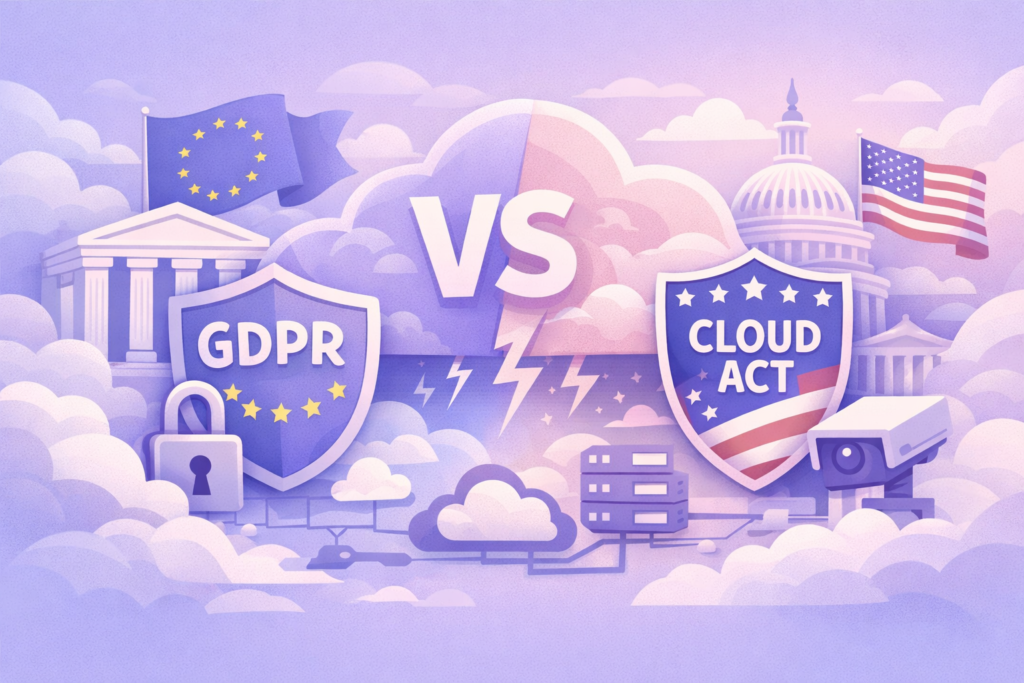
2. The Legal Conflict: Two Different Worlds
To understand why businesses are struggling, we must look at the facts of these two laws. GDPR is based on physical territory. It says that personal data belonging to European citizens must stay in Europe and cannot be given to foreign governments without a special international treaty.
However, the US CLOUD Act is based on corporate ownership, not physical geography. Because Google LLC is an American corporation, its European branch (Google Cloud EMEA) is still influenced by US laws. If a US judge demands data for a criminal investigation, Google is legally required by US law to provide it, even if the servers are located in Frankfurt (europe-west3) or Eemshaven (europe-west4).
If Google gives this data to the US government, the European business using GCP automatically violates GDPR.
Table 1: Comparison of GDPR and US CLOUD Act Constraints
| Feature / Law | EU GDPR (Article 48) | US CLOUD Act (2018) |
| Main Goal | Protect the personal privacy of EU citizens from unauthorized access. | Allow US law enforcement to access data quickly for investigations. |
| Rule of Territory | Data must stay in the EU. Physical borders are extremely important. | Physical location does not matter. Only corporate ownership matters. |
| Who Controls the Data? | The European business (The Data Controller). | The US government can bypass the business and order the Cloud Provider. |
| Financial Fines | Up to 4% of global annual revenue or €20 million. | Legal action and massive penalties for the US cloud provider if they refuse. |
| The Real Conflict | Strictly prohibits giving data to foreign governments without a treaty. | Demands data even if it breaks foreign privacy laws like the GDPR. |
3. Real Cases and Local Conflicts in Europe
The biggest challenge for businesses is that “Europe” does not act as one single country. Different European countries have different Data Protection Authorities (DPAs). What is considered perfectly legal in the Netherlands might be completely illegal and banned in Germany. Here are three real cases that show how this legal conflict affects businesses using US cloud services.
Case 1: The Schrems II Decision and Meta’s €1.2 Billion Fine
The Problem: For many years, European and American companies used a simple legal agreement called the “Privacy Shield” to transfer data safely across the ocean.
The Real Conflict: In 2020, an Austrian privacy activist named Max Schrems took this issue to the European Court of Justice. The court analyzed US surveillance laws (such as FISA Section 702) and decided that the US government has too much power to spy on European data without giving EU citizens any rights to defend themselves.
The Result: The court completely destroyed the Privacy Shield framework. Overnight, thousands of companies using GCP or AWS found out their data storage architectures were illegal. The reality of this risk was proven in May 2023, when the Irish DPA fined Meta (Facebook) a record €1.2 billion for transferring EU user data to US servers without proper protection against US surveillance laws. This proved to all businesses that “paper contracts” are no longer enough.
Case 2: Germany (DSK) – Zero Tolerance and Cloud Bans
The Problem: Germany has the strictest privacy rules in Europe. The German Data Protection Conference (DSK) has a policy of “zero risk” regarding American cloud providers.
The Real Conflict: The DSK officially stated that even the theoretical risk of the US CLOUD Act makes US companies “unreliable” partners. In 2021 and 2022, several German states banned the use of Microsoft 365 and Google Workspace in schools and government offices.
The Facts and Metrics: Security authorities found that these cloud platforms were secretly sending telemetry data back to servers in the USA. This data included IP addresses, User-Agent strings, and system diagnostic logs. Because Google is a US company, Germany decided that standard business contracts are useless. If a German business wants to use GCP for sensitive databases, local regulators demand that they use strong encryption where Google has absolutely no access to the decryption keys.
Case 3: The Netherlands (Dutch DPA) – Pragmatic Audits and Technical Fixes
The Problem: The Dutch government was also very worried about the US CLOUD Act and Google’s hidden telemetry data. However, they took a completely different, more practical approach compared to Germany.
The Real Conflict: The Dutch Data Protection Authority ordered a massive, highly detailed Data Protection Impact Assessment (DPIA) on Google enterprise services. They discovered the exact same problem as the Germans: Google was acting as a Data Controller for diagnostic data and sending European IPs to the US.
The Synthesized Solution: Instead of banning GCP, the Dutch government negotiated directly with Google’s engineers and lawyers. They forced Google to change its software architecture globally. Google had to create new admin tools that allow European IT administrators to completely turn off the sending of telemetry data to the US. Also, Google had to legally change its status to a “Data Processor” for this data. This case shows that in the Netherlands, businesses can solve the GDPR problem by correctly configuring their cloud architecture and auditing the platform, rather than abandoning the cloud entirely.
Отлично. Продолжаем исследование. В этой части мы погружаемся в инженерные реалии: как именно юридический конфликт ломает архитектуру данных, почему компании теряют статистику и как инженеры вынуждены перестраивать работу GCP. Текст по-прежнему на уровне B2, объем увеличивается.
Part 2: Engineering Problems, Data Loss, and Financial Impact on GCP
When a company tries to solve the legal conflict between GDPR and the US CLOUD Act, the problem shifts from the lawyers’ office to the IT department. To protect data from foreign laws, Data Engineers must build strong walls around their Google Cloud architecture. However, building these walls creates major technical problems. Let us explore the real engineering conflicts and the financial costs of compliance.
4. Real Engineering Conflicts: The Attribution Void
When you build a system on GCP (like BigQuery and Cloud Dataflow) to track how users behave on your website or app, you normally send raw data directly from the user’s browser to Google’s global servers (using Google Analytics 4). This is cheap and fast.
The Real Conflict: Under strict European rules, sending a user’s IP address or browser details directly to an American server is illegal, because those details are considered Personally Identifiable Information (PII). Furthermore, because of the GDPR “Consent Mode” rules, users can click “Reject All” on the cookie banner.
The Engineering Problem:
When users reject tracking, or when companies block direct connections to US servers, Data Engineers lose the unique identifiers for those users (like client_id or session_id). This creates a massive problem called the “Attribution Void.”
Imagine an e-commerce store running on GCP. If 40% of users reject cookies, the database in BigQuery suddenly breaks. The marketing team sees 10,000 purchases in their bank account, but BigQuery only shows 6,000 purchases connected to specific users. The remaining 4,000 purchases are “orphaned” – they have no user history.
Table 2: The Impact of Strict GDPR Compliance on Data Pipelines
| Architecture Metric | Standard Setup (Global GCP) | Strict GDPR Setup (Localized GCP) |
| Data Flow | Browser -> Direct to Google Analytics (USA) | Browser -> European Proxy Server -> Google Analytics |
| User Tracking (IDs) | Very High (90%+ accuracy) | Low (Significant data loss due to rejected consent) |
| Orphaned Transactions | Very Low (Standard (not set) values) | High (Requires custom markers like not_add) |
| System Latency | Very Fast (Global CDN routing) | Slower (All data must pass through local EU bottlenecks) |
| Engineering Effort | Low (Out-of-the-box GCP tools work fine) | Very High (Requires custom scripts, hashing, and proxies) |
5. Synthesized Technical Solutions on GCP
Because standard Google tools often fail under strict European laws, architects must synthesize new, complex solutions to keep the business running legally. Here are the three main technical options implemented by modern companies on GCP.
Option A: Server-Side Proxies (The “Middleman” Architecture)
The Solution: Instead of sending data directly to Google Analytics, the company rents private servers inside Europe (for example, using Google Cloud Run in the europe-west3 region). They install Server-Side Google Tag Manager (sGTM) on these servers.
How it Works: All user data first goes to this private European server. The server acts as a filter. It deletes the user’s IP address, hides their real location, and changes their email address into an unreadable mathematical code (SHA-256 hashing). Only this “clean” data is then sent to Google’s main servers.
The Fix for Data Loss: To solve the “Attribution Void” (orphaned transactions), engineers must create custom database markers. Instead of letting BigQuery write a generic (not set) error for missing users, engineers program the proxy server to write a specific tag like not_add. This tells the Data Scientists: “This data is missing because the user legally rejected tracking, not because our website is broken.”
Option B: External Key Management (EKM) – The Cryptographic Shield
The Solution: To stop the US government from reading data under the CLOUD Act, companies encrypt their BigQuery tables. But the trick is: Google does not hold the key.
How it Works: The company buys an encryption key from a European security company (like Thales) that stores the key in a secure hardware box (HSM) in Europe. When BigQuery needs to read the database, it must ask the European company to unlock it. If the US government orders Google to give them the data, Google only has locked, unreadable files.
The Real Conflict (System Failure): Every time BigQuery reads data, it must send a signal over the internet to the external European key server. This takes time (latency). If a company has a fast backend system written in Go that needs to process 150,000 requests per second, waiting for an external key can cause the entire system to crash. Security destroys speed.
Option C: Sovereign Cloud (The Expensive Fortress)
The Solution: In countries like Germany (T-Systems Sovereign Cloud) or France (S3NS by Thales), Google partnered with local European companies.
How it Works: The European company builds and controls the physical servers. Google only provides the software. No Google employee in the USA can access these servers without a European engineer pressing an approval button. This completely defeats the US CLOUD Act.
The Real Conflict (Vendor Lock-in and Delays): Businesses using Sovereign Clouds do not get new GCP features immediately. When Google releases a new Machine Learning tool, the Sovereign Cloud customers might wait 6 to 12 months because the European partner must manually check the code for hidden spy tools.
6. The Financial Impact (FinOps): The Hidden Costs of Privacy
Compliance is incredibly expensive. Moving from a standard global cloud to a legally safe European enclave breaks the budget of many IT departments.
When engineers build Server-Side Proxies, they must pay for new Cloud Run servers that must be online 24/7 to process millions of clicks. When they use External Keys (EKM), they must pay the European security vendor a large monthly fee.
Because of these massive new costs, companies must implement strict Cloud Financial Operations (FinOps). They can no longer just look at the total Google bill. Data Engineers must write automated monitoring scripts that connect directly to BigQuery logs. These dashboards must calculate the cost of data processing down to the gigabyte, tracking exactly how much money each user, each department, and each database table is spending. Without this strict financial tracking, the cost of running a legal GDPR architecture will bankrupt the analytical department.
Here is the final part of the research document. This section synthesizes the technical evaluations, provides a comprehensive pros and cons analysis of GCP, and outlines strategic recommendations for engineering teams.
Part 3: Strategic Synthesis, GCP Platform Analysis, and Final Recommendations
7. Strengths and Weaknesses of GCP in a Heavily Regulated Environment
When we evaluate Google Cloud Platform strictly through the lens of GDPR and the US CLOUD Act, it presents a complex mix of highly advanced security tools and fundamental jurisdictional flaws. Data Engineers and Enterprise Architects must carefully weigh these factors before building or migrating their data infrastructure.
The following table synthesizes the real-world advantages and disadvantages of using GCP for European businesses that handle sensitive data.
Table 3: Analysis of GCP for European GDPR Compliance
| Architectural Component | Strengths (Pros) | Weaknesses (Cons) |
| Data Masking (Cloud DLP) | Excellent native tools. Cloud Data Loss Prevention (DLP) can scan streams of data in real-time, finding and hiding sensitive information (like credit cards or European phone numbers) before it is saved into the BigQuery database. | Setting up perfect Identity and Access Management (IAM) rules so that only authorized users can see the “unmasked” data is very difficult and requires constant maintenance. |
| Cryptographic Control (EKM) | High flexibility. GCP easily connects with External Key Management (EKM) providers. This allows European businesses to mathematically block US government access to their storage disks. | Massive performance penalty. External keys create network delays (latency). As analyzed in Part 2, high-speed backend systems (e.g., custom Go scripts routing thousands of events) can fail if they must wait for external decryption. |
| Network Security Perimeters | VPC Service Controls allow engineers to build a strong virtual wall around their EU databases. It prevents anyone, even an administrator, from downloading or moving data outside of the permitted European region. | While it stops internal employees from making mistakes, it does not stop Google as a company from accessing the data if compelled by a US federal judge. |
| Data Residency (Regions) | GCP offers multiple data centers across Europe (Frankfurt, Eemshaven, Paris, etc.), making it easy to store physical data drives legally within EU borders. | Hidden telemetry. As audits in the Netherlands proved, even if you select a German server, the GCP system still sends some diagnostic logs and metadata back to the US by default. |
8. Strategic Recommendations for Data Architecture
Because the legal conflict between Europe and the United States will not be resolved quickly, companies cannot simply wait for politicians to agree. The business must operate today. To survive in this environment without facing millions of euros in fines or destroying system performance, organizations must implement the following synthesized strategies:
Recommendation 1: Implement “Zero-Trust” Data Ingestion
Do not allow raw, unencrypted personal data to ever reach your main analytical database. Companies must build an intermediate layer (a “buffer zone”). When user data arrives from a website or mobile app, it should first hit a secure, server-side processing pipeline (such as Cloud Dataflow). In this pipeline, all personal identifiers (names, emails, precise GPS coordinates) must be replaced with random tokens or hashed mathematically. The main BigQuery database should only store these anonymous tokens. If the US government demands the BigQuery records, they will only receive a list of meaningless numbers.
Recommendation 2: Segment Your Cryptography (Tiered Security)
As proven earlier, encrypting absolutely everything with External Key Management (EKM) will slow down your systems and dramatically increase your monthly cloud bill. Instead, architects must divide their data into different “Tiers” of importance.
- Tier 1 (Highly Sensitive): Medical records, financial details, and unhashed personal contacts. This data must use EKM and be stored in isolated European buckets.
- Tier 2 (Analytical/Aggregated): Website clickstreams, anonymous product views, and general marketing statistics. This data does not need EKM. It can be encrypted using standard Google-managed keys to keep the databases running at maximum speed.
Recommendation 3: Redesign Dashboards for “Missing Data” (The Attribution Fix)
Marketing and analytical departments must accept that perfect user tracking is dead in Europe. Because of strict Consent Mode rules, a large percentage of data will always arrive without user identifiers. Engineers must stop treating this as a system error. Instead, they must actively design their databases and financial dashboards to handle this reality. By using explicit custom parameters (for example, intentionally labeling unattributed website traffic as not_add), data scientists can isolate the missing data. They can then use advanced probabilistic machine learning models to estimate the missing user behavior, rather than simply losing the statistics entirely.
Recommendation 4: Deploy Strict Cloud Financial Operations (FinOps)
Building compliant infrastructure—renting proxy servers, paying European encryption vendors, and storing data locally—is expensive. To prevent compliance from destroying the IT budget, companies must treat cloud costs as an engineering metric. Teams should build automated scripts that read BigQuery processing logs every 24 hours. These scripts must calculate the exact cost of compliance by tracking the volume of gigabytes processed, and distribute these costs precisely to individual users, departments, and specific data tables.
9. Future Trends and Final Conclusion
The conflict between the GDPR’s territorial protection and the US CLOUD Act’s global reach is the defining challenge of modern cloud engineering. Today, European businesses using Google Cloud Platform are caught in the middle.
Looking to the future, the industry is slowly moving toward a concept called “Federated Learning” and “Edge Computing.” In the future, instead of sending all user data to a central Google server in Europe to be analyzed, the analytical calculations will happen directly on the user’s mobile phone or laptop. Only the final, anonymous mathematical results will be sent to the cloud. Because the raw personal data never leaves the user’s device, the legal conflict disappears completely.
Until that technology becomes standard, organizations must rely on smart engineering. Signing standard business contracts is no longer enough to protect a company. True compliance requires a combination of server-side proxy architectures, intelligent cryptographic key management, and strict financial monitoring. By carefully synthesizing these technical tools, European businesses can safely use the power of American cloud platforms while successfully keeping foreign authorities away from their users’ private data.
We build, migrate, and optimize cloud data pipelines on Google Cloud Platform. From BigQuery query optimization to custom ingestion architectures, explore our Data Engineering on GCP services.