Cloud Run vs Kubernetes: A FinOps and Architectural TCO Analysis
Cloud platforms rarely fail because architects select inherently flawed technologies. More often, catastrophic platform bloat occurs when engineering teams select excellent technology to solve the wrong problem. This distinction challenges a fundamental engineering instinct: building infinitely scalable, fault-tolerant infrastructure for hypothetical workloads that may never materialize. Modern Google Cloud Platform (GCP) services make infinite scaling technically trivial, but evaluating whether that scalability is economically justified requires strict FinOps discipline.
This case study analyzes an architecture review for a rapidly growing platform where customer acquisition was accelerating, and the engineering department projected a 100% increase in microservices over an 18-month horizon.
1. Baseline Architecture: The Serverless Ecosystem
The existing platform was built entirely around managed serverless infrastructure, heavily leveraging Google Cloud Run.
Current Infrastructure Profile:
- Workloads: 40+ independent stateless services handling REST API requests, heavy ETL/ELT data transformations, scheduled cron jobs via Cloud Scheduler, and real-time machine learning inference.
- Peak Traffic: ~600 Requests Per Second (RPS) distributed across all active services.
- Infrastructure Utilization: ~32% of current allocated Cloud Run quotas.
- Deployment Metrics: Mean time to deploy (MTTD) was consistently under 4 minutes, utilizing a fully automated CI/CD pipeline.
- Failure Rates: Deployment failure rate stood below 1%. Production incidents caused directly by the underlying compute infrastructure were statistically zero.
Despite these optimal metrics, the architecture team proposed a complete migration to Google Kubernetes Engine (GKE). The justification was purely preemptive: migrating before the system became “too large” and adopting the perceived industry standard for enterprise technology companies.
2. The Proposed GKE Architecture vs. Operational Reality
The formal migration proposal outlined a highly sophisticated target architecture. It included Istio for service mesh capabilities, Horizontal and Vertical Pod Autoscalers (HPA/VPA), multi-zone node pools, NGINX ingress controllers, private VPC networking, Workload Identity for IAM integration, and comprehensive disaster recovery manifests.
However, when cross-referenced against actual business requirements, the technological sophistication lacked justification.
| Architectural Capability | Cloud Run (Current State) | GKE (Proposed State) | Measurable Business Impact |
| Traffic Handling | Natively handles current 600 RPS with sub-second scaling. | Requires precise HPA tuning and node pool provisioning. | None. Both systems handle the load effectively. |
| Autoscaling Mechanics | Out-of-the-box concurrency up to 1000 requests per container. Scales to zero. | Pod scaling takes seconds; Node scaling takes minutes. | Advantage Cloud Run. Better burst handling and cost efficiency during idle periods. |
| Infrastructure Control Plane | Fully managed by Google (OS patching, networking, orchestration). | Internal responsibility (Control plane upgrades, worker node patching, CNI/CSI management). | Advantage Cloud Run. Eliminates operational overhead. |
| Deployment Flexibility | High (Revisions, traffic splitting, gradual rollouts). | Very High (Custom deployment strategies, GitOps via ArgoCD). | None. Existing deployment patterns were sufficient. |
| Operational Complexity | Low. Developers deploy source code directly. | High. Requires dedicated platform engineers to manage YAML manifests and cluster state. | Advantage Cloud Run. Lower barrier to entry for feature teams. |
3. FinOps and Total Cost of Ownership (TCO)
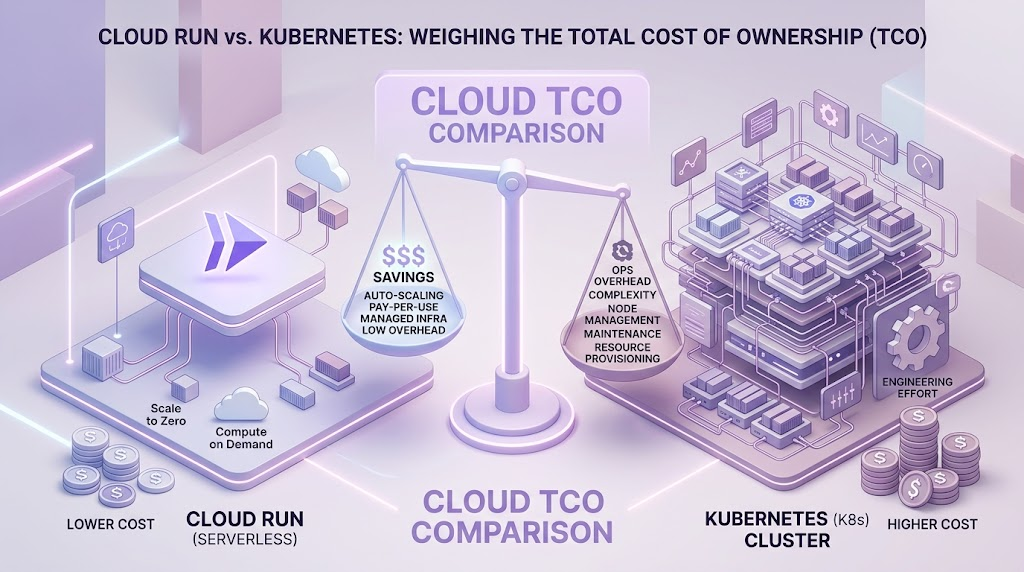
When the evaluation shifted from a technical capabilities comparison to a financial investment analysis, the total cost of ownership (TCO) dismantled the migration proposal.
Capital Expenditure (CapEx) – The Migration Cost:
The engineering department estimated the transition would require approximately 4,500 development hours. Based on the blended internal hourly rate for senior backend and cloud engineers, this represented a capital investment of approximately $650,000 before a single new business feature reached the end user.
Operational Expenditure (OpEx) – The Post-Migration Cost:
- Compute Over-provisioning: Cloud Run charges per 100 milliseconds of active execution time. GKE requires paying for underlying Compute Engine instances regardless of pod utilization. Standard Kubernetes clusters typically run at 30-40% resource waste due to necessary buffer capacity for burst traffic.
- Management Fees: GKE management fees ($73/month per cluster) plus cross-zone network egress costs inherent to service mesh architectures.
- Human Capital: Maintaining GKE requires at least 2 Full-Time Equivalent (FTE) Platform Engineers dedicated to cluster administration, version upgrades, security patching, and monitoring. This represents an ongoing OpEx increase of $250,000+ annually.
4. Opportunity Cost and Business Impact
The most severe cost of the GKE migration was not financial, but strategic. Reallocating the engineering team to rebuild functioning infrastructure meant stalling the product roadmap for 9 months.
Delayed Deliverables Included:
- Two major customer-facing platform products.
- A critical fraud detection algorithm upgrade.
- Three core ELT analytics pipelines requested by commercial teams.
- High-priority performance optimizations committed to Enterprise-tier clients.
The decisive question from the CTO ultimately terminated the project: “If we completed this migration tomorrow, what would our customers be able to do that they cannot do today?” The answer was that customers would notice zero difference. The migration competed directly against business growth and lost.
5. Post-Decision Outcomes (6-Month Validation)
By canceling the GKE migration and retaining Cloud Run as the primary compute layer, the engineering team avoided the infrastructure black hole. Over the subsequent six months, the resulting metrics validated the decision:
- Product Velocity: Delivered 17 new customer-facing features.
- Performance: Reduced overall API response times by 30% through application-level optimization rather than infrastructure changes.
- Expansion: Successfully launched operations in two additional markets.
- Innovation: Deployed a new machine learning inference service on Cloud Run, leveraging native scaling without adding custom operational burden.
Cloud Run remained the preferred platform. Infrastructure costs remained highly predictable, production incidents stayed near zero, and deployment frequency increased.
Synthesis
The compulsion to adopt Kubernetes often stems from “Resume-Driven Development” and cognitive biases within engineering cultures. Architects frequently evaluate success through the lens of technical sophistication, whereas the business evaluates success through velocity, reliability, and capability. Managed services like Cloud Run exist precisely because the overwhelming majority of technology companies derive their enterprise value from building products, not from maintaining container orchestration control planes.
GKE is an extraordinarily powerful tool, but it is an infrastructure framework, not a mandatory evolutionary stage for growing companies. Moving away from a managed serverless architecture should never be a preemptive measure based on industry trends; it must be a reactive measure triggered by hard, quantifiable constraints.
A framework for justifying GKE over Cloud Run requires at least one of the following hard thresholds to be crossed:
- Protocol & Networking Constraints: The workload requires complex stateful networking, custom TCP/UDP protocols not supported by Cloud Run’s HTTP/gRPC ingress, or deep integration with legacy on-premises networks that demand custom routing layers.
- Resource Limitations: The individual microservices consistently exceed Cloud Run’s maximum hardware allocations (e.g., needing more than 32GB RAM or 8 vCPUs per instance for highly specialized in-memory data processing), or require specialized hardware accelerators (specific GPU configurations) unavailable in the serverless tier.
- Stateful Workloads: The platform requires self-hosting complex clustered databases or stateful middleware that cannot be delegated to managed services like Cloud SQL, Cloud Bigtable, or Pub/Sub.
- Regulatory & Compliance Mandates: Strict data sovereignty or security compliance regulations demand absolute, low-level control over the hypervisor, underlying virtual machines, and network egress points, superseding the shared responsibility model of serverless environments.
Until a company hits these specific, measurable walls, migrating to Kubernetes is simply paying a premium to increase operational friction. The ultimate objective of cloud architecture is not to maximize technical complexity, but to maximize business outcomes per engineering hour invested. Building for the future means maintaining flexibility, not pre-building infrastructure for problems that do not currently exist.