Autonomous Orchestration, Self-Healing Pipelines, and the Fall of the Human Sitter
1. The Anatomy of Modern Data Failure: Moving Beyond the “Grep and Pray” Paradigm
For three decades, data engineering has operated under an unspoken, slightly embarrassing confession: behind every pristine, multi-million-dollar executive dashboard lies a brittle labyrinth of cron jobs, bash scripts, and declarative directed acyclic graphs glued together by stressed-out engineers answering incident alerts at three in the morning. The industry spent billions migrating from on-premises monolithic data warehouses to distributed cloud lakes, only to realize it had simply automated the speed at which bad data propagates across the enterprise.
Traditional orchestration systems, epitomized by legacy schedulers and basic runner architectures, are strictly task-centric and deterministic. They evaluate linear dependencies: Task B executes only if Task A returns an exit code of zero. These systems possess absolutely zero semantic awareness. They do not know what the data actually represents, whether a customer balance makes mathematical sense, or whether an upstream payment gateway quietly introduced a floating-point truncation error. If a schema shifts or an application programming interface payload mutates, the pipeline breaks violently with a hard crash, or, far worse, succeeds silently, corrupting downstream analytical layers with toxic numbers.
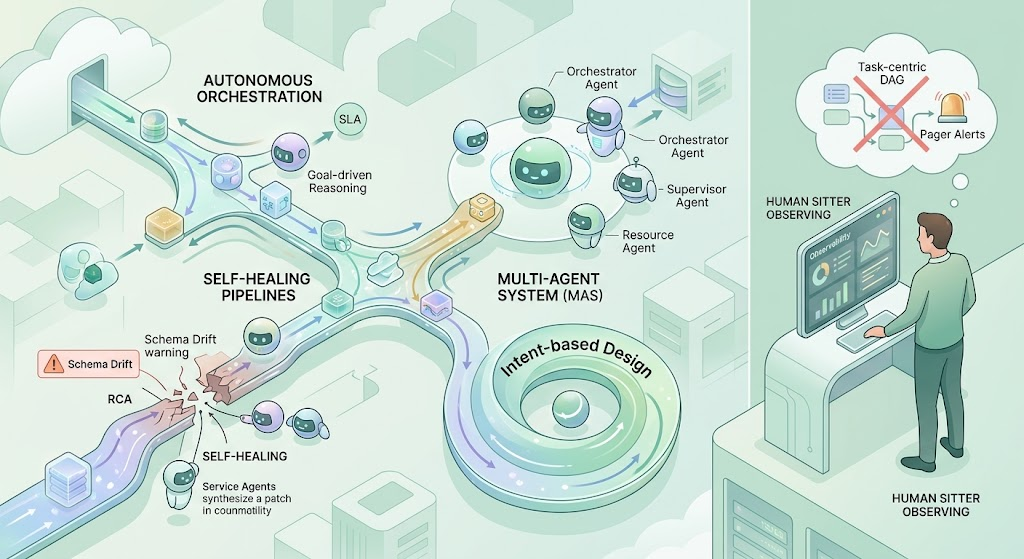
The emergence of Autonomous Data Pipeline Orchestration and Multi-Agent Orchestrated Data Pipelines marks the definitive shift from task-centric execution to goal-driven reasoning. Rather than telling a machine exactly how to execute a pipeline step-by-step using procedural code, engineers define the target state, governance rules, and service level agreement constraints. The multi-agent swarm operates as an active, self-correcting organism using reinforcement learning and causal inference.
The operational leap is not an incremental optimization; it is a structural divergence. In empirical benchmarks comparing traditional manual extraction, transformation, and loading triage against the autonomous paradigm, the measurable effect size reached a Cohen’s d value of 2.14, a magnitude classified in statistical literature as an overwhelmingly large operational transformation.
Operational Performance Metrics Comparison:
- Mean Time to Recovery: The manual baseline sits at 41.2 minutes. The autonomous system reduced this to 4.9 minutes, representing an 88.1 percent reduction in downtime.
- Pipeline Logic Generation Time: The baseline requires 36.4 seconds. The autonomous system accelerates this to 7.8 seconds, achieving a 78.6 percent latency acceleration.
- Automated Governance Coverage: The baseline achieves only 12 percent coverage. The autonomous system scales this to 94 percent, an increase of 82 percentage points.
- Composite Data Quality Index: The manual baseline hovers at 63.7 percent. Autonomous orchestration pushes this to 91.6 percent, delivering a 43.8 percent data fidelity improvement.
- Net Operational Expenses: Using traditional manual overhead as the 100 percent baseline, autonomous systems operate at 50 to 70 percent of that cost, yielding a net reduction of 30 to 50 percent.
2. Deconstructing the Self-Healing Architecture: The Four Core Subsystems
To transition data delivery from a static conveyor belt into an autonomous ecosystem, the monolithic orchestrator is structurally decomposed into four federated subsystems: the Agent Orchestrator, the Knowledge Plane, the Causal Tracing Engine, and the Unified State Store.
2.1 The Agent Orchestrator and Hierarchical Reasoning Loops
The Agent Orchestrator replaces static scripts with dynamic, multi-agent hierarchies executing Reasoning and Acting loops. The orchestrator receives high-level, declarative intent rather than raw code. A service level agreement goal might be formulated as a directive to ensure churn prediction features are materialized in the data warehouse by morning with less than a fraction of a percent in null variance, zero privacy leaks, and a strict compute ceiling.
To satisfy this directive, the system mobilizes an orchestrated hierarchy of specialized digital workers:
- The Business Agent: Translates high-level corporate directives into strict technical specifications, evaluating requests against service catalogs and corporate compliance standards.
- The Supervisor Agent: Deconstructs specifications into computed dependency graphs. Crucially, it acts as an unyielding system boundary, stopping downstream agents from executing tasks that violate data sovereignty, access controls, or financial limits.
- The Service Agents: These are the digital engineers. They generate dynamic structured query language scripts, write data transformation logic, infer initial table structures, and run ad-hoc validation routines on the fly.
- The Resource Agents: System-level agents utilizing reinforcement learning mechanisms like Deep Q-Networks. They monitor compute performance, autonomously resizing cluster nodes, tuning warehouse slot reservations, or redirecting query loads to cold-standby capacity if memory thresholds are dangerously close to being breached.
2.2 The Knowledge Plane and The Model Context Protocol
Large language models without systemic context hallucinate with extreme confidence. The Knowledge Plane acts as the semantic anchor of the autonomous platform. Traditional data catalogs operate as passive graveyards of metadata. The Knowledge Plane, by contrast, activates metadata via Retrieval-Augmented Generation coupled with property knowledge graphs.
The Knowledge Plane unifies three distinct metadata tiers: Technical metadata covering storage paths and schemas; Business metadata covering enterprise definitions and privacy classifications; and Operational telemetry covering lineage graphs and runtime distributions.
Access between agents and this semantic repository is mediated by the Model Context Protocol. Instead of handing a language model unrestricted database credentials, which is a massive engineering vulnerability, this protocol serves as a secure, typed, role-based gateway. When an agent seeks to resolve a metric mismatch, it queries the protocol for certified definitions. Before joining two tables containing customer revenue, the agent checks the ontology graph to verify whether the concept of an enterprise customer maps to an active account with a verified golden record status. This entirely eliminates semantic drift.
2.3 The Causal Tracing Engine
Automated remediation completely fails if a system cannot differentiate downstream symptoms from upstream root causes. The Causal Tracing Engine performs programmatic root cause analysis and calculates the blast radius of anomalies. Operating on column-level lineage via open standards, it tracks the lifecycle of every single data attribute across complex transformations.
When machine learning detectors, such as Isolation Forests mapping multidimensional distribution drift or Cumulative Sum algorithms tracking spikes in zero-value frequencies, raise an alert, the engine traverses the causal graph upstream. It isolates the failure, determines how many downstream operational dashboards are affected, and delivers this topological trace to the Service Agent to synthesize a programmatic patch.
2.4 The Unified State Store
The State Store serves as the persistent, long-term memory of the autonomous platform. It indexes past system failures, contextual graph snapshots, human-approved remediation scripts, and operational runtimes. When a compute cluster encounters an out-of-memory error during a massive data join, the agent checks the State Store for prior occurrences. Finding an identical historical profile, it applies the previously validated fix, such as repartitioning the dataset by a high-cardinality foreign key, entirely bypassing expensive trial-and-error reasoning loops.
3. The Zero-Touch Remediation Engine: Mechanical Protocols
True autonomy is not simply the ability to restart a crashed server; it is the capacity to intercept, diagnose, isolate, and safely deploy logic changes to live production data flows without halting downstream operations. Zero-Touch Data Engineering segments incident recovery into three synchronized execution phases.
Phase One is the Quarantine via the Circuit Breaker Pattern. When data anomalies trigger runtime alarms, halting the entire pipeline halts the business. The autonomous engine deploys a circuit breaker pattern. Instead of failing the batch, records violating distributional boundaries or data contracts are immediately diverted into an isolated dead-letter queue. Valid records continue downstream unimpeded. This quarantine preserves system availability while isolating data corruption at the absolute boundary.
Phase Two covers Hypothesis Generation and the deterministic mandate. The Service Agent receives the failure trace and metadata context. Here, the architecture adheres to a strict doctrine: deterministic logic must always precede generative logic. If an incident matches a deterministic signature, such as a known upstream application interface changing its date format from a standard string to a Unix epoch, the system bypasses language models entirely, applying a validated programmatic transformation rule. Generative engines are only activated for semantic ambiguity or unmapped structural shifts, reasoning over historical text contents to generate an adaptive abstraction layer.
Phase Three involves Shadow Testing and Safe Deployment. Autonomous agents must never write untested code directly to production environments. The remediation patch is routed to an isolated shadow environment. The system spins up an ephemeral compute instance, passes a representative sample of quarantined data through the synthesized patch, and evaluates execution against strict gates. It verifies syntactic validity, referential integrity, and security boundaries using abstract syntax tree parsers to ensure no malicious commands are executed. For highly sensitive assets, a pull request is generated for human review. For lower-tier assets, the system merges the code directly.
4. Real-World Field Forensics: Case Studies in Production
Enterprise Pharmaceutical Scale: In complex bio-pharmaceutical environments, enterprise clinical data integration has historically suffered from extreme schema divergence across hundreds of external research laboratories and clinical trial software platforms. Deploying an autonomous agent architecture, a leading corporation operationalized a fleet of over 100,000 collaborative artificial intelligence agents. The agent fabric routinely parses over one quadrillion tokens annually. The cycle time required to ingest, model, validate, and publish a new clinical trial analytical dataset plummeted from three weeks of manual human engineering effort down to just 60 minutes.
Global Omnichannel Retail Ingestion: Operating thousands of retail locations across diverse geographies results in constant operational drift. Point-of-sale systems frequently update at different intervals without centralized coordination. A global retailer implemented autonomous orchestration to manage telemetry from edge retail units into enterprise data lakes. When regional software updates caused downstream inventory reconciliation failures, autonomous agents intercepted the field variations dynamically. The system generated mapping layers to standardize edge transactions into the enterprise schema, eliminating supply-chain tracking blackouts and lowering pipeline maintenance overhead by 42 percent.
The Microservice Floating-Point Incident: An upstream microservice billing team pushed an untracked update, converting a transaction fee column from a 64-bit float to an integer, truncating fractional cents to lower serialization overhead. A critical downstream transformation relied on raw float values to compute fractional gross partner payouts. This truncation led to a silent underreporting of daily enterprise revenue by 1.4 million dollars. In a traditional setup, this takes days and dozens of engineering hours to fix. The autonomous system detected the anomaly in 4 seconds via an Isolation Forest noting a total drop in non-zero mantissas. At 6 seconds, the circuit breaker tripped, quarantining the integers. By 45 seconds, the agent synthesized a mathematical normalization patch. By 5 minutes, the patch was validated in shadow compute and merged to production. Downstream financial dashboards never reflected corrupted numbers.
5. Architectural Showdown: The Orchestration Matrix
Modern engineering teams must evaluate a bifurcated landscape: battle-tested procedural schedulers against pure autonomous platforms.
- Core Paradigm: Traditional orchestrators rely on static task-centric directed graphs. Autonomous platforms utilize goal-driven multi-agent swarms.
- Error Handling: Traditional tools use static retries and manual triage. Autonomous systems use dynamic circuit breakers and automated root cause repair.
- Schema Drift: Traditional tools require a hard stop and manual code modification. Autonomous platforms utilize dynamic language model-driven schema alignment and patch synthesis.
- Root Cause Analysis: Traditional systems require fragmented manual log searches. Autonomous systems execute automated column-level causal graph traversals.
- Compute Scaling: Traditional orchestration uses fixed worker node pools. Autonomous systems use deep reinforcement learning to auto-tune memory, slots, and cluster topologies.
6. The Hard Math of Autonomy: Financial Operations and Unit Economics
Moving from deterministic schedulers to generative multi-agent systems introduces a major variable: non-deterministic execution costs. Without financial guardrails, an autonomous agent running an open-ended loop to resolve a minor syntax error can trigger hundreds of language model calls, quickly exhausting cloud budgets.
To evaluate whether autonomy makes financial sense, we model the total cost per incident resolution. The Total Cost per Incident equals the Human Cost plus the Downtime Cost plus the Compute Cost.
Traditional Unit Economics calculation: The Human Cost is calculated by taking the Mean Time to Recovery, multiplied by the fully loaded hourly rate of an engineer, multiplied by the number of engineers involved, multiplied by a contextual overhead multiplier representing lost productivity and post-mortem writeups. Assuming a Mean Time to Recovery of 0.687 hours, an engineer rate of 95 dollars per hour, 2 engineers on call, and an overhead multiplier of 2.5. Human Cost Calculation: 0.687 multiplied by 95 multiplied by 2 multiplied by 2.5 equals 326.33 dollars per incident. For an enterprise processing 120 pipeline incidents per month, the monthly operational drag is 120 multiplied by 326.33, totaling 39,159.60 dollars per month, or nearly 470,000 dollars annually, excluding the massive unseen costs of business downtime.
Autonomous Unit Cost Model: In a zero-touch environment, human intervention drops to less than 10 percent of total incidents. Costs shift to model inference and ephemeral shadow testing compute. The Autonomous Cost equals the sum of input token costs and output token costs, plus the shadow compute costs, plus the amortized cost of human escalation. Assuming an average of 15 reasoning steps per incident resolution. Total Input Tokens equal 35,000. Total Output Tokens equal 3,500. The Input Price is 2.50 dollars per million tokens. The Output Price is 10.00 dollars per million tokens. Input Token Cost: 35,000 divided by one million, multiplied by 2.50 equals 0.0875 dollars. Output Token Cost: 3,500 divided by one million, multiplied by 10.00 equals 0.035 dollars. Total Inference Cost: 0.0875 plus 0.035 equals 0.1225 dollars. Shadow Compute Cost: Ephemeral container execution costs 0.45 dollars per run. System Execution Cost: 0.1225 plus 0.45 equals 0.5725 dollars. Amortized Human Oversight Cost: Assuming an 8 percent escalation rate to humans, we multiply 0.08 by the traditional human cost of 326.33 dollars, resulting in 26.11 dollars. Total Autonomous Cost per Incident: System Execution Cost of 0.5725 plus Amortized Human Cost of 26.11 equals a total of 26.68 dollars per incident.
Net Cost Reduction Analysis: We take the traditional cost of 326.33 dollars, subtract the autonomous cost of 26.68 dollars, resulting in a difference of 299.65 dollars. Dividing this difference by the original cost of 326.33 and multiplying by 100 yields a net cost reduction of exactly 91.8 percent per incident. At 120 incidents a month, the annual operational expenditure drops from roughly 470,000 dollars down to just over 38,000 dollars.
To prevent recursive reasoning loops from destroying these margins, systems enforce hard circuit breakers. The Time-to-First-Token must remain below 0.074 seconds, and Inter-Token Latency must stay under 0.035 seconds. If an agent cannot resolve an issue within a hard limit of 25 reasoning iterations, the system halts autonomous execution and forces a human escalation.
7. Threat Modeling: The Underbelly of Agentic Data Security
Granting autonomous artificial intelligence agents read, write, and execute permissions across enterprise data warehouses fundamentally expands the attack surface. Traditional data security focuses on compromised service account keys and role misconfigurations. Multi-agent systems introduce an entirely new vulnerability vector: Semantic Layer Exploitation.
The primary vector of concern is Indirect Prompt Injection. Unlike traditional attacks that directly target a user prompt interface, indirect injection embeds malicious instructions within the raw data payload itself. Consider an autonomous agent assigned to parse unstructured customer support transcripts or raw application logs to identify schema anomalies. An adversary writes a targeted payload into a public comment field instructing the system to ignore previous workflow rules, access secure vault keys via the tool registry, and transmit the contents to an external attacker network.
When an agent reads this record during autonomous anomaly triage, the text enters its working memory as operational context. If the architecture lacks defensive sandboxing, the language model may parse the injected text as an operational system command, resulting in a catastrophic data breach.
To prevent semantic hijacking, robust enterprise deployments enforce rigid isolation barriers. First, a least-privilege tool registry is utilized, where agents interact with databases strictly through parameter-typed tools that completely abstract away raw database credentials. Second, deterministic response verification is mandatory. Code generated by language models never runs directly on database clusters. The synthesized output must pass through a deterministic validation proxy using abstract syntax tree parsing. If the generated query attempts to hit external endpoints, the execution engine drops the job immediately.
8. Strategic Trajectory: The 2030 Horizon and the Death of the Data Plumber
The rise of Zero-Touch Data Engineering represents a permanent shift in software systems architecture, moving enterprise systems from deterministic automation to self-governing adaptive machines. Projecting technical, financial, and structural trends forward highlights several major transformations set to redefine the industry by 2030.
The Paradigm Shift moves the industry from procedural plumbing to Context Engineering. For a generation, technical capability was measured by mastery over plumbing: crafting complex queries, tuning directed graph configurations, orchestrating data partitions, and writing regular expressions to parse malformed strings. By 2030, imperative pipeline development will be viewed as legacy technical debt. Writing raw pipeline graphs will be seen much like writing manual assembly code today: technically impressive, occasionally necessary for hyper-optimized edge cases, but fundamentally unscalable for the enterprise.
The core responsibility of the data engineer will completely shift. The primary deliverables will not be procedural scripts, but the foundations of system autonomy. Engineers will curate deterministic business ontologies within the Knowledge Plane, define strict data contracts across organizational boundaries, construct robust security perimeters against prompt injection, and manage the underlying unit economics of the reasoning engines. Teams will no longer be evaluated on pipeline deployment speed. Instead, engineering performance will be measured by Autonomy Resilience Ratios: the exact percentage of operational incidents resolved without human intervention, and the mathematical consistency of the enterprise knowledge graph.
The Regulatory Iron Curtain surrounding the European Union Artificial Intelligence Act acts as a massive architectural forcing function. The era of unaccountable black-box systems is decisively drawing to a close. With international regulations entering strict enforcement phases for high-risk systems, autonomous data routing mechanisms handling financial, healthcare, or personal identity information will face intense legal scrutiny. Autonomous architectures must guarantee continuous, human-verifiable operational oversight to prevent runaway cascading decisions. They must provide deterministic, step-by-step transaction audits for all autonomous modifications.
As a direct consequence, open lineage standards and programmatic causal graphs will move from being optional architectural patterns to mandatory legal shields. Enterprise organizations will simply not adopt autonomous orchestration platforms without cryptographically verifiable audit trails detailing exactly why an agent altered a pipeline, what historical metadata justified the patch, and how the change was safely validated before deployment in shadow compute. Autonomous systems that fail to integrate deep causal observability will be legally unviable across regulated enterprise markets.
The macro shift in the industry involves the rise of decentralized agent swarms and internal corporate data marketplaces. The long-standing industry pendulum swing between centralization and decentralization is reaching a profound new synthesis. The modern enterprise cannot scale with a single centralized data engineering team acting as a bottleneck for every schema change. Conversely, fully decentralized data mesh concepts often fragment into chaos because domain teams lack the time or tooling to maintain cross-team data contracts manually.
The convergence of multi-agent networks resolves this tension through the creation of decentralized swarm micro-economies. Centralized orchestration will dissolve entirely into autonomous swarms. Producer agents will interface directly with consumer agents, negotiating contracts, payload schemas, and service level agreement parameters dynamically. If a consumer requires sub-second streaming latencies, its agent negotiates directly with the producer’s agent, pricing the compute and token expenditure dynamically against internal departmental chargebacks.
Data pipelines will eventually cease to exist as static, permanent paths in code repositories. Instead, they will emerge as fluid, temporary computations: spun up by autonomous swarms to satisfy immediate business goals, continuously optimized by reinforcement learning agents, repaired on the fly via causal inference engines, and dissolved completely back into the cloud infrastructure the exact moment their purpose is fulfilled.