The Databricks: Building a “Zero-Tax” Lakehouse Natively on Google Cloud
The world of data engineering loves a good buzzword, and for the last few years, “Lakehouse” has been the undisputed king of the hill. Databricks deserves massive credit for this. They took Apache Spark—a tool that historically required a PhD in patience to configure—and wrapped it in a beautiful, managed interface. They bridged the gap between the chaotic data lake and the rigid data warehouse.
However, architecture is not about blindly following trends; it is about context. If your company is already deeply rooted in the Google Cloud Platform (GCP) ecosystem, bringing Databricks into your stack is a lot like renting a luxury hotel room when you already own a fully furnished mansion across the street. You get a nice mint on your pillow, but the financial and architectural overhead is staggering.
For European mid-market companies and startups, cloud budgets are heavily scrutinized. In 2026, the industry has reached a tipping point. The native tools within GCP have evolved to the point where running a third-party Lakehouse is no longer a technical necessity—it is an expensive luxury. Let’s dive deep into why the Databricks model creates friction on GCP, how the underlying technology has shifted, and exactly how you can engineer a perfectly native, highly scalable alternative without paying the dreaded “double tax.”
1. The Friction of Databricks on Google Cloud: A Technical Dissection
To understand the shift away from Databricks for GCP-native companies, we must look under the hood at the structural friction points that emerge when you force two massive platforms to co-exist.
The Double Billing Trap (The DBU Tax)
Databricks does not own the physical servers your data runs on. When you spin up a Databricks workspace on GCP, you are using Google Compute Engine (GCE) virtual machines and Google Cloud Storage (GCS). Google bills you for the CPU, RAM, disk I/O, and network egress. But then, Databricks adds its own invoice. They charge you in Databricks Units (DBUs) for the software layer orchestrating those machines.
In a high-load event analytics scenario, this double billing compounds aggressively. If your clusters are running 24/7 to process streaming webhooks, you are paying a massive premium. Even with auto-termination enabled, clusters take several minutes to spin up and spin down, meaning you often pay for idle time while the system prepares to work.
The Security and Governance Disconnect
European businesses operate under the strict shadow of GDPR, NIS2, and DORA regulations. Compliance requires a single, verifiable source of truth for access control. GCP uses its native Identity and Access Management (IAM). Databricks pushes its own governance layer called Unity Catalog.
When you use both, you create a “split-brain” security perimeter. Your data engineers must synchronize access rights between Google IAM and Unity Catalog. If an analyst leaves the company, revoking their GCP account might not automatically sever their active sessions or API tokens inside Databricks. Maintaining this dual-governance state requires complex automation and introduces severe compliance risks.
The Illusion of Multi-Cloud Freedom
One of the main sales pitches for Databricks is that it prevents vendor lock-in. “Build on Databricks, and you can move to AWS or Azure tomorrow,” the marketing says. This is mathematically true but practically false. Once your data teams start writing pipelines using proprietary Databricks features (like DBUtils, Delta Live Tables, or optimized Photon engine specific syntax), your code is locked into the Databricks ecosystem. You haven’t escaped vendor lock-in; you have simply chosen a different vendor.
2. Dispatches from the 2026 Trenches: Real-World Case Studies
The theoretical arguments against third-party overlay networks are validated by what engineering boutiques are actually building in the field. Here are three archetypal cases from the European market in the last 12-18 months.
Case 1: The Nordic E-commerce Giant (Cost Optimization & AI Speed)
A massive Scandinavian marketplace platform historically relied on a massive Databricks footprint to process clickstream data and train recommendation engines. As their data volume crossed the 5-petabyte mark, their DBU costs became unsustainable.
The Solution: They executed a complete migration to a native GCP stack. They moved their storage to Apache Iceberg format on GCS. For querying, they switched to BigQuery (which natively reads Iceberg via BigLake). For machine learning, they migrated their Spark jobs to Dataproc Serverless and their model training to Vertex AI.
The Result: Infrastructure costs dropped by 65%. More importantly, the time-to-market for new AI features accelerated because data no longer had to be moved between the GCP storage layer and the external Databricks computation layer.
Case 2: The Global Retail Supply Chain (Eradicating Idle Compute)
A European retail logistics network needed to run complex assortment calculations across 300 million SKUs every night. Their legacy managed Spark clusters took 12 minutes just to provision nodes before the actual calculation started.
The Solution: They eliminated managed clusters entirely and implemented GCP Dataproc Serverless.
The Result: Dataproc Serverless spins up containers almost instantly. A job that previously took 90 minutes (including provisioning) now executes in 22 minutes. The business pays strictly for the exact compute milliseconds used during those 22 minutes. Zero idle time. Zero cluster management.
Case 3: The FinTech Real-Time Ledger (Streaming Architecture)
A mid-sized UK-based payment gateway needed to reconcile millions of micro-transactions in near real-time. Databricks Structured Streaming was proving too expensive for their continuous, unpredictable workload spikes.
The Solution: A purely serverless native pipeline. Webhooks hit Google Cloud Run (which scales from zero to 1000 instances in seconds), dump payloads into Cloud Pub/Sub (acting as an asynchronous buffer), and stream directly into BigQuery using the Storage Write API.
The Result: The architecture requires zero manual scaling, handles Black Friday traffic spikes without a single dropped packet, and completely bypasses the need for a heavy Spark-based streaming engine.
3. The Catalyst: How Apache Iceberg Broke the Monopoly
If you suggested building a native GCP Lakehouse in 2022, data architects would have laughed. Back then, BigQuery was a closed box. To get BigQuery’s legendary speed, you had to ingest your data into Google’s proprietary Capacitor storage format. This meant duplicating data: keeping one copy in your data lake for your Python developers and another copy in BigQuery for your SQL analysts.
What changed the game in 2026? The absolute triumph of open table formats, specifically Apache Iceberg.
Iceberg is not a processing engine; it is a table format that acts as an intelligent abstraction layer over massive collections of raw Parquet files in object storage. It tracks metadata, manifest files, and snapshots. This allows data lakes to behave exactly like relational databases—supporting ACID transactions, time travel (querying older versions of data), and schema evolution (changing column types without rewriting the whole table).
Google recognized this industry shift and launched BigLake. BigLake is the bridge that changed everything. It allows BigQuery to execute its highly optimized Dremel compute engine directly against Apache Iceberg tables sitting in cheap Google Cloud Storage.
Suddenly, the border between the data warehouse and the data lake vanished. You no longer need Databricks to provide the ACID layer over your raw files. Google does it natively, and BigQuery queries those open-format files just as fast as its internal tables.
4. The Blueprint: Step-by-Step Implementation of a Native GCP Lakehouse
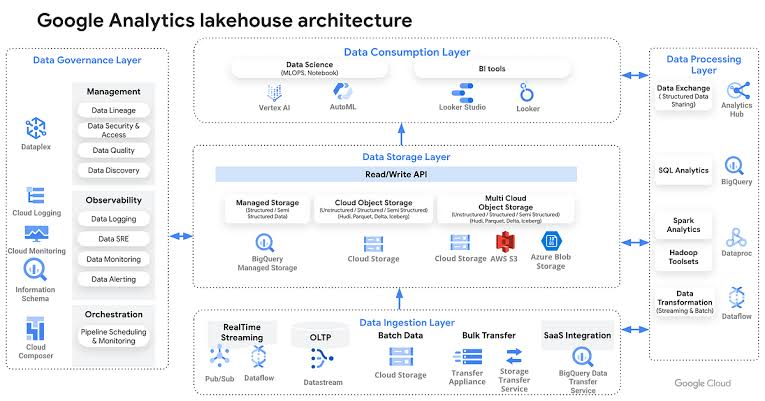
How do you actually build this? If you want to drop Databricks and build a high-performance, AI-ready Lakehouse using native GCP tools, here is the exact architectural blueprint, designed via Infrastructure as Code (Terraform).
Step 1: The Open Storage Foundation (Data Lake Layer)
Everything starts in Google Cloud Storage. You do not pump raw data into BigQuery. Instead, you create a tiered bucket architecture (Bronze/Raw, Silver/Cleansed, Gold/Curated).
All data ingested from your CRMs, ERPs, and external APIs is written to GCS in the Apache Iceberg format.
Engineering Reality: Because you are using Iceberg, your data is open. If you decide to leave GCP in five years, you do not have to export your data; you simply point your new cloud’s compute engine at your existing buckets. You own your data entirely.
Step 2: Universal Governance and Metadata (The Dataplex Layer)
To replace Unity Catalog, you deploy Google Cloud Dataplex. Dataplex acts as the central brain of your data mesh. It automatically scans your GCS buckets, identifies the Iceberg tables, and registers them in a central metadata catalog.
More importantly, Dataplex handles security. You define your Row-Level Security (RLS) and Column-Level Security (masking PII like emails and phone numbers) directly in Dataplex using native GCP IAM roles. This security policy is universally enforced. Whether a user tries to access the data via SQL in BigQuery or via Python in a Jupyter notebook, the rules apply perfectly.
Step 3: The SQL Muscle (The BigQuery Compute Layer)
For your BI dashboards (Looker, Tableau, PowerBI) and Data Analysts, BigQuery is the compute engine. But instead of loading data into BigQuery, you create External Tables via BigLake.
BigQuery reads the Iceberg metadata and executes distributed SQL queries directly against the files in GCS. Because BigQuery relies on a serverless pricing model (paying per terabyte scanned or via flexible slot capacity), you pay absolutely nothing when analysts are asleep and dashboards are inactive.
Step 4: The Heavy Lifting and Data Science (Dataproc Serverless & Vertex AI)
Not everything can be solved with SQL. For complex ML feature engineering, algorithmic transformations, or massive graph processing, you need Apache Spark.
Instead of managing a Databricks cluster, you use Dataproc Serverless. Your data engineers write standard PySpark code. When it is time to run the job, Dataproc provisions the exact amount of Docker containers needed, executes the Python code against the Iceberg tables in GCS, and instantly terminates the containers when finished.
For the Data Science team, you provide Vertex AI Workbench. These are managed JupyterLab environments that connect natively to Dataplex and BigQuery. Data scientists can train machine learning models, deploy endpoints, and utilize Large Language Models (like Gemini) directly on the curated data without ever moving it out of the GCP perimeter.
Step 5: Automated Orchestration (Cloud Composer / Dataform)
To replace Databricks Workflows, you deploy Google Cloud Composer (a managed version of Apache Airflow) for complex, cross-system orchestration, or Dataform (now built into BigQuery) to manage your SQL-based ELT transformations using Git-based CI/CD pipelines. Dataform natively handles data quality assertions, ensuring that if a partner API changes a schema, the pipeline breaks gracefully and alerts the team, rather than silently corrupting the business dashboards.
5. Economics, TCO, and the Mid-Market European Reality
Let’s translate this architecture into business reality for a European mid-market company (e.g., €20M-€100M revenue, 50-500 employees, processing 1-10 Terabytes of data daily).
| Architectural Component | Databricks on GCP Approach | Native GCP Lakehouse (Iceberg/BigLake) Approach |
| Compute & Licensing Cost | High: Cloud Provider VM costs + Databricks DBU software licensing premium. | Low: Zero markup. Pay only for pure GCP compute (BigQuery scans or Dataproc execution time). |
| Idle Infrastructure Cost | Moderate: Clusters require spin-up time and have auto-termination delays, leading to paid idle time. | Zero: BigQuery and Dataproc Serverless scale to zero instantly. You only pay for active execution milliseconds. |
| Data Format Lock-in | Moderate: Strong push towards proprietary Delta Lake optimizations (Photon engine). | None: 100% open-source Apache Iceberg format. Fully interoperable with any external compute engine. |
| Security & GDPR Compliance | Complex: Requires manual or scripted synchronization between GCP IAM and Unity Catalog. | Streamlined: Native GCP IAM integrated with Dataplex. A single control plane for all PII hashing and access logs. |
| Talent Acquisition (FTE Costs) | Very High: Requires specialized Databricks/Spark Platform Engineers (€90k – €140k/year in EU). | Standard: Requires standard Data Engineers proficient in SQL, Python, dbt, and Terraform (€70k – €110k/year in EU). |
The Hidden Cost of Talent
The most overlooked expense in the Databricks model is not the software bill; it is the payroll. Running a Databricks ecosystem requires specialized platform engineers who know how to tune Spark memory, optimize cluster instances, and untangle Unity Catalog permissions. In the DACH and Nordic regions, this is a rare and highly expensive skillset.
The native GCP architecture relies on industry-standard, generalized skills. A solid Data Engineer who knows Python, standard SQL, and Terraform can easily manage Dataproc Serverless and BigQuery without needing vendor-specific certifications.
6. Final Verdict: Strategic Recommendations for 2026
Building data infrastructure is about maximizing optionality while minimizing operational expenditure (OPEX).
If you are a massive, multi-cloud global enterprise that absolutely must run identical data platforms across AWS, Azure, and GCP simultaneously, Databricks remains an excellent choice. It abstracts away the underlying cloud provider and gives your engineers a unified interface.
However, if your business has chosen Google Cloud as its primary infrastructure provider, deploying Databricks in 2026 is an architectural redundancy.
By utilizing Apache Iceberg, BigLake, Dataproc Serverless, and Vertex AI, you can build a unified, AI-ready data pipeline that costs significantly less, ensures strict European data compliance out-of-the-box, and eliminates the “double billing” tax entirely.
The era of paying a premium for a managed Lakehouse is over. The open formats have won, the serverless compute engines have caught up, and the power has returned to the engineers who write the infrastructure code. Stop renting a platform; start owning your data.