
DPIA for Google Cloud Platform: GDPR Compliance, National Specifics of the Netherlands and Denmark, Key Settings, and Audit Preparation
Introduction
With stricter data protection requirements in Europe, conducting a Data Protection Impact Assessment (DPIA) is becoming a mandatory step when implementing cloud services like Google Cloud Platform (GCP). This is especially true for government and large corporate clients in the Netherlands and Denmark. This report is based on current GDPR requirements, national regulations, GCP technical capabilities, and best practices for audit preparation. It details: DPIA criteria and structure, national requirements (NL and DK), key GCP settings (encryption, IAM, logging, residency), data minimization, risk management, monitoring, as well as recommendations for documentation and audit preparation.
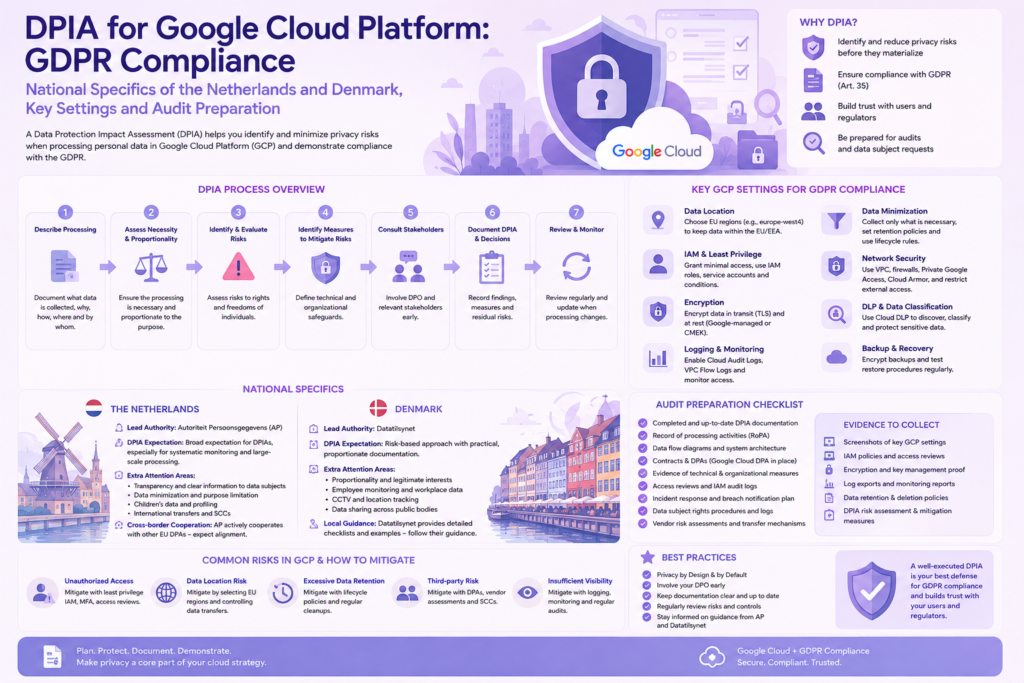
1. DPIA: Role, Criteria, and Structure by GDPR and National Standards
1.1. DPIA under Article 35 of GDPR: When and Why
A DPIA is a documented process that describes, assesses, and manages risks to personal data within a new or changing data processing project. Under Article 35 of the GDPR, a DPIA is mandatory if the proposed data processing is likely to result in a high risk to the rights and freedoms of individuals. A DPIA must be completed before processing begins and reviewed whenever there are significant changes to the processing procedures.
Criteria for a mandatory DPIA:
- Systematic and extensive evaluation of personal aspects based on automated processing, including profiling, which produces legal effects or similarly significant outcomes for the data subject.
- Large-scale processing of special categories of data (Art. 9 GDPR) or data relating to criminal convictions (Art. 10 GDPR).
- Systematic monitoring of publicly accessible areas on a large scale.
The European Data Protection Board (EDPB) identifies 9 factors. If two or more of these are present, a DPIA becomes mandatory:
- Profiling, evaluation, or scoring.
- Automated decision-making with legal or significant effects.
- Systematic monitoring.
- Processing of special categories of data.
- Data processing on a large scale.
- Matching or combining datasets.
- Processing data of vulnerable subjects.
- Use of new technologies.
- Processing that prevents data subjects from exercising their rights.
1.2. National Specifics: The Netherlands
In the Netherlands, DPIA is regulated not only by the GDPR but also by national acts, as well as a mandatory DPIA model for government agencies (Rapportagemodel DPIA Rijksdienst). The Dutch Data Protection Authority (Autoriteit Persoonsgegevens) publishes a list of processing activities where a DPIA is always required (e.g., large-scale processing of sensitive data, employee monitoring, and the use of new technologies).
A DPIA must include:
- A systematic description of the processing and its purposes.
- An assessment of necessity and proportionality.
- An assessment of risks to data subjects.
- Measures to mitigate risks and demonstrate GDPR compliance.
It is recommended to start the DPIA at the design stage (privacy by design). The process is considered continuous—the DPIA should be reviewed if there are changes in processing, technology, or context.
1.3. National Specifics: Denmark
In Denmark, the GDPR applies directly but is supplemented by the Danish Data Protection Act (Databeskyttelsesloven), which introduces extra rules for CPR numbers, CCTV, processing criminal data, the age of digital consent, and the supervisory structure. The Danish Data Protection Agency (Datatilsynet) publishes its own list of situations where a DPIA (konsekvensanalyse) is mandatory, along with relevant guidelines.
Specifics include:
- CPR numbers (civil registration numbers) require a separate legal basis (Art. 11 Databeskyttelsesloven).
- CCTV: recordings can be stored for no more than 30 days; private filming of public spaces without police permission is prohibited.
- For AI systems, a DPIA is required if there is a high risk.
- Consultation with a Data Protection Officer (DPO) and, if necessary, with Datatilsynet is mandatory before processing begins if there is a high residual risk.
2. Comparison of Requirements (GDPR, NL, DK) and GCP Settings
| Requirement / Control | GDPR (EU) | Netherlands (NL) | Denmark (DK) | GCP Settings and Capabilities |
| DPIA: criteria and structure | Art. 35, 9 EDPB factors | DPIA Rijksdienst model, AP list | Datatilsynet, Databeskyttelsesloven | DPIA template, documentation support |
| DPO | Art. 37–39 | Mandatory for government agencies | Mandatory for government agencies, sec. 24 | DPO assignment, consultations |
| CPR numbers, special data | Art. 9, 10 | Extra restrictions for BSN | Sec. 7, 8, 11 Databeskyttelsesloven | Tagging, access control, encryption |
| CCTV | Art. 35 | DPIA for video surveillance | 30 days storage, public space ban | Storage in EU, access control |
| Age of digital consent | ≥16 years | 16 years | 13 years (Art. 6(3) DK) | Age control, access settings |
| Breach notification | 72 hours, Art. 33 | 72 hours | 72 hours | Incident Response, logging, alerts |
| Cross-border transfers | SCC, Schrems II | DPIA for transfers, TIA | SCC, DPF, DPIA | SCC, DPF, Cloud EKM, CMEK, data localization |
| Sub-processor control | Art. 28 | DPA requirements, audit | DPA requirements, audit | Sub-processor list, DPA, audit |
| Documentation (ROPA, DPIA) | Art. 30, 35 | ROPA, DPIA, checklists | ROPA, DPIA, checklists | ROPA, DPIA templates, data export |
| Certification and evidence | ISO, SOC, CoC | Required for government agencies | Required for government agencies | ISO 27001/17/18/27701, SOC 2/3, CSA STAR, C5 |
| AI Act | Entering into force | SLM Rijk, preparation | Law No. 467/2025, Datatilsynet | AI service control, DPIA for AI |
Analysis: GCP provides tools and settings that fulfill all key requirements: DPIA support, encryption (CMEK, EKM), access control (IAM, Access Transparency), auditing, data localization, sub-processor management, export of compliance evidence, as well as templates and documentation for DPIA and ROPA.
3. Key GCP Settings for DPIA Compliance and Audit
3.1. Encryption: CMEK, CSEK, Cloud KMS, Confidential Computing
Basic encryption: All data in GCP is encrypted by default at rest (AES-256) and in transit (TLS 1.2+).
Key management options:
- GMEK (Google-managed): Keys are managed by Google. This offers minimal operational load but no access to key metadata.
- CMEK (Customer-managed): Keys are created and managed by the customer via Cloud KMS. This provides full audit trails, rotation control, the ability to revoke access, and compliance with residency and key independence requirements.
- CSEK (Customer-supplied): Keys are provided by the customer for each operation. It offers maximum control but has limited service support.
- Cloud KMS: Centralized key management, HSM support (FIPS 140-2 Level 3), auditing of key operations, IAM access control, organizational policy support for key location, and integration with BigQuery, Cloud Storage, Cloud SQL, etc.
- Cloud EKM: External key storage (on-premise or with a third-party provider). Keys never enter Google’s infrastructure. It supports Key Access Justifications (logging and approving every decryption request), which is critical for Schrems II and TIA.
- Confidential Computing: Protects data during processing (encryption in use) via Confidential VM, Confidential GKE, Confidential Dataflow, and Confidential Dataproc. Data and keys are encrypted in memory, Google has no access to keys, and hardware TEEs (AMD SEV, Intel TDX) are supported.
Practical steps:
- Enable CMEK for all services processing sensitive data.
- For highly critical data, use Cloud EKM and Key Access Justifications.
- For AI/ML and sensitive data processing, use Confidential VM/Confidential GKE.
- Document key locations, rotation policies, and access audits.
3.2. Access Control and Identity Management: IAM, Access Transparency, Access Approval
IAM (Identity and Access Management): Granular access control based on the principle of least privilege. It supports predefined and custom roles, auditing of all policy changes, temporary and conditional assignments, and Workload Identity Federation for external workloads. The use of primitive roles (Owner, Editor) in production is prohibited.
Service Accounts: A separate service account with minimum necessary rights is created for each service. This includes control over key creation and rotation, a ban on long-lived keys, and the use of impersonation and federation instead of static keys.
Access Transparency: Logs all actions by Google staff involving client data. It is available for most services, integrates with SIEM, and supports investigations and audits.
Access Approval: Requires explicit client approval for Google to access data or configurations, supporting notifications and logging.
Practical steps:
- Conduct an audit of all IAM policies and eliminate primitive roles.
- Implement regular access reviews (IAM Recommender).
- Enable Access Transparency and Access Approval for all supported services.
- Document access management and auditing processes.
3.3. Logging, Auditing, and Log Integrity: Cloud Audit Logs, Cloud Logging
Cloud Audit Logs: Maintains logs of administrative, user, and system actions. Allows export to Cloud Storage, BigQuery, or SIEM. It supports long-term storage, IAM access control for logs, and auditing of policy changes and key access.
Cloud Logging: Centralized log collection, storage, and analysis. It supports alerts, integrates with Cloud Monitoring, and allows export to third-party systems.
BigQuery Logging: Exports logs to BigQuery for analysis. It supports column-level security and column-level encryption (Cloud KMS), auditing of access to sensitive data, and both deterministic and non-deterministic column encryption.
Practical steps:
- Enable Cloud Audit Logs for all services.
- Set up log export to BigQuery and/or SIEM.
- Implement access control for logs (IAM Logging roles).
- Document log storage and retention policies.
3.4. Data Management and Residency: Regional Zones, Data Localization
Data localization: GCP allows you to select a specific storage region (e.g., europe-west4 for the Netherlands). Organization Policy can restrict resource creation to specific regions. It supports multi-region and single-region deployments, and location control for CMEK/Cloud KMS keys.
Assured Workloads: Restricts support and data processing to EU-based personnel only, supporting data sovereignty requirements.
Practical steps:
- Configure Organization Policy for permitted regions.
- For critical data, use a single region (NL or DK).
- Document data and key locations, as well as migration policies.
3.5. Data Minimization, Pseudonymization, and Anonymization
Data minimization: Collect and store only the data necessary for specific processing purposes. Regularly review the volume and relevance of data, delete or anonymize unnecessary data, and implement strict retention and deletion policies.
Pseudonymization: Use hashing, encryption, and tokenization techniques to replace identifiers. Keep correspondence tables separately, restrict access to additional information, and implement organizational measures (segregation of access, auditing, key encryption).
Anonymization: Apply this only if the data truly cannot be linked to a subject (otherwise, it is considered pseudonymization and GDPR still applies).
DLP API and Sensitive Data Protection: Use these for automatic discovery, classification, and de-identification of personal data in Cloud Storage, BigQuery, and Cloud SQL. It supports over 200 data types, custom rules, and integrates with Cloud Logging and Security Command Center.
Practical steps:
- Implement a regular audit of data and collection processes.
- Use the DLP API to discover and classify PII.
- Apply pseudonymization for logs, telemetry, and test data.
- Document the minimization and de-identification policy.
3.6. Risk Management, Assessment, and Monitoring: Security Command Center
Security Command Center (SCC): A centralized tool for detecting, analyzing, and responding to risks, vulnerabilities, and incidents in the cloud. It supports integration with DLP, Cloud Logging, and Cloud Monitoring, automated alerts and reporting, and compliance monitoring (GDPR, ISO, SOC).
Practical steps:
- Enable SCC at the organization/project level.
- Set up regular scans for vulnerabilities and non-compliance.
- Implement automatic alerts and response playbooks.
- Document risk management and monitoring processes.
3.7. Incident Management and Breach Notifications
The GDPR requires notifying the supervisory authority within 72 hours of discovering an incident (Art. 33) and notifying data subjects without undue delay if there is a high risk (Art. 34).
GCP capabilities: Provides tools for incident detection, investigation, and documentation. It supports Incident Response, logging, notification templates, SCC integration, and maintaining a breach register.
Practical steps:
- Set up incident detection and escalation processes.
- Prepare notification templates for regulators and data subjects.
- Maintain a register of all incidents, even those that do not require notification.
- Conduct staff training on incident response.
4. Documentation, ROPA, and Audit Preparation
4.1. DPIA Documentation: Structure, Templates, Checklists
DPIA Structure (based on the Google template and national models):
- Determining the need for a DPIA (criteria, triggers).
- Description of processing (data categories, purposes, subjects, sources, storage, access, transfers).
- Stakeholder involvement (DPO, IT, Legal, subject consultations).
- Assessment of necessity and proportionality (legal grounds, minimization, pseudonymization, informing, retention periods, sub-processors, cross-border transfers).
- Risk identification (unexpected use, loss of control, discrimination, data leak, re-identification, errors).
- Risk mitigation measures (opting out of collection, anonymization, technical and organizational measures, staff training).
- Final assessment and decision to launch the project (residual risks, need for DPA consultation).
- Version control and periodic DPIA review.
ROPA (Record of Processing Activities): Maintaining an up-to-date registry of all processing operations, including purposes, categories of data and subjects, recipients, retention periods, security measures, cross-border transfers, and sub-processors.
Audit Checklists:
- Relevance and completeness of ROPA.
- Signed DPAs with all processors and sub-processors.
- Procedures for handling Data Subject Access Requests (DSAR).
- Data retention and deletion policy.
- Documented security measures (encryption, IAM, audit).
- Incident response and notification procedures.
- Documentation of cross-border transfers and TIA/Schrems II.
- Up-to-date privacy notices and internal policies.
- Staff training and regular internal audits.
4.2. Evidence of Compliance: Certificates, Reports, Auditors
GCP provides:
- ISO/IEC 27001, 27017, 27018, 27701 certificates.
- SOC 1/2/3 reports.
- CSA STAR, C5 (DE), EU GDPR Cloud Code of Conduct.
- Compliance Reports Manager for downloading reports and certificates.
- Access to sub-processor audits and third-party reports.
Practical steps:
- Collect and store all certificates and reports for auditing.
- Include links to certificates in the DPIA and ROPA.
- Keep documentation and checklists up to date.
5. Contracts, DPAs, SCCs, Sub-processors, and Cross-border Transfers
5.1. Contracts and DPAs
All relationships with Google and sub-processors are formalized through a Data Processing Agreement (DPA). This reflects GDPR requirements, the rights and obligations of the parties, security measures, data deletion and return procedures, audits, and responsibility for sub-processors.
5.2. SCCs and Schrems II
For cross-border transfers, Standard Contractual Clauses (SCCs), updated in 2021, are used in consideration of Schrems II and EDPB recommendations. SCCs are supplemented with technical and organizational measures (encryption, EKM, Access Approval, auditing, key localization), as well as a Transfer Impact Assessment (TIA) to evaluate risks in the recipient country.
5.3. Sub-processors
Google publishes a list of sub-processors, audits their security practices, and remains fully responsible for their actions. Clients receive notifications about new sub-processors and can object to their engagement.
5.4. Special Categories of Data and National Restrictions
Processing CPR numbers (DK), BSN (NL), medical, and criminal data requires separate legal grounds and a DPIA. CCTV footage must be stored for no more than 30 days (DK), and filming public spaces without permission is prohibited. For AI systems, a separate DPIA and FRIA (Fundamental Rights Impact Assessment) under the AI Act are required, taking into account risks of discrimination, transparency, monitoring, and model lifecycle management.
6. Practical Steps for Configuring and Documenting GCP for a Successful Audit
6.1. GCP Configuration Steps
- Region Selection and Data Localization: Set up an Organization Policy for permitted regions (europe-west4 for NL, europe-north1 for DK), and use single-region for critical data.
- Enable CMEK/Cloud KMS: Create keys in the required region, set up an IAM policy, enable key operations auditing, and use Cloud EKM for maximum control.
- Implement IAM based on least privilege: Audit roles, eliminate primitive roles, implement temporary and conditional assignments, and use Workload Identity Federation.
- Enable Access Transparency and Access Approval: Configure notifications and logs, and integrate with SIEM.
- Enable Cloud Audit Logs and export to BigQuery/SIEM: Set up long-term storage and access control for logs.
- Implement DLP API/Sensitive Data Protection: Configure regular scanning of Cloud Storage, BigQuery, and Cloud SQL for PII, and enable automatic de-identification.
- Enable Security Command Center: Set up regular scans, alerts, and response automation.
- Set up incident response processes: Prepare notification templates, maintain an incident register, and train staff.
- Document all processes and settings: Use DPIA and ROPA templates, checklists, and store certificates and reports.
6.2. Documentation and Audit Preparation
- Maintain an up-to-date ROPA and DPIA: Update them when there are changes in processing, technology, or context.
- Store all DPAs, SCCs, TIAs, certificates, and reports: Include references and copies in the DPIA and ROPA.
- Conduct regular internal audits and staff training: Keep training logs, checklists, and inspection reports.
- Prepare evidence for each control: Settings screenshots, log exports, scan reports, and data deletion certificates.
- Maintain a register of incidents and data subject requests: Document all actions and decisions.
7. Organizational Measures: DPO, Training, Processes
Appointing a DPO: The DPO advises on the DPIA, monitors compliance, interacts with regulators, trains staff, participates in incident investigations, maintains documentation and audits, and ensures privacy by design and data minimization.
Staff Training: Regular training on the GDPR, security policies, and incident response.
Implementing Data Subject Request Processes: Handling DSARs, deletion, correction, restriction of processing, and data export.
Vendor Management: Evaluating and auditing sub-processors, monitoring DPAs, and ensuring compliance.
Privacy by Design: Integrating privacy across all stages of the data and service lifecycle.
8. Impact of the AI Act and National Implementation on DPIA and GCP
AI Act (enters into force in 2026): For high-risk AI systems, a DPIA (GDPR Art. 35) and a FRIA (AI Act Art. 27) are required. This includes risk management (Art. 9), documentation, monitoring, transparency, human oversight, regular reviews and updates of the DPIA/FRIA, supply chain and sub-processor control, auditing, and evidence of compliance.
In Denmark: Datatilsynet and Digitaliseringsstyrelsen are the supervisory authorities for the AI Act. A DPIA is mandatory for AI, with a preference for anonymization/pseudonymization, contractual and technical measures, model monitoring and auditing, and lifecycle documentation.
Conclusion and Recommendations
GCP provides all the necessary technical and organizational tools to comply with the GDPR and the national requirements of the Netherlands and Denmark, ensuring a successful outcome in strict audits. Key measures include: implementing CMEK/Cloud KMS/Cloud EKM, enforcing IAM based on the principle of least privilege, enabling Access Transparency/Approval, Cloud Audit Logs, DLP API, Security Command Center, data localization, regular auditing and training, maintaining a DPIA/ROPA, controlling sub-processors and cross-border transfers, and preparing compliance evidence and documentation.
Practical Recommendations:
- Start by analyzing DPIA criteria and involving the DPO.
- Implement all key GCP technical settings, document them, and review them regularly.
- Maintain up-to-date documentation (DPIA, ROPA, DPA, SCCs, certificates).
- Conduct regular internal audits, staff training, and test incident response processes.
- Stay informed about changes in national and European regulations (AI Act, Schrems II, Datatilsynet/AP).
- Prepare evidence for each control to present to auditors and regulators.
Following these steps and recommendations will not only allow you to successfully pass an audit in the Netherlands and Denmark but also build a robust, transparent, and manageable personal data protection system in the cloud.