
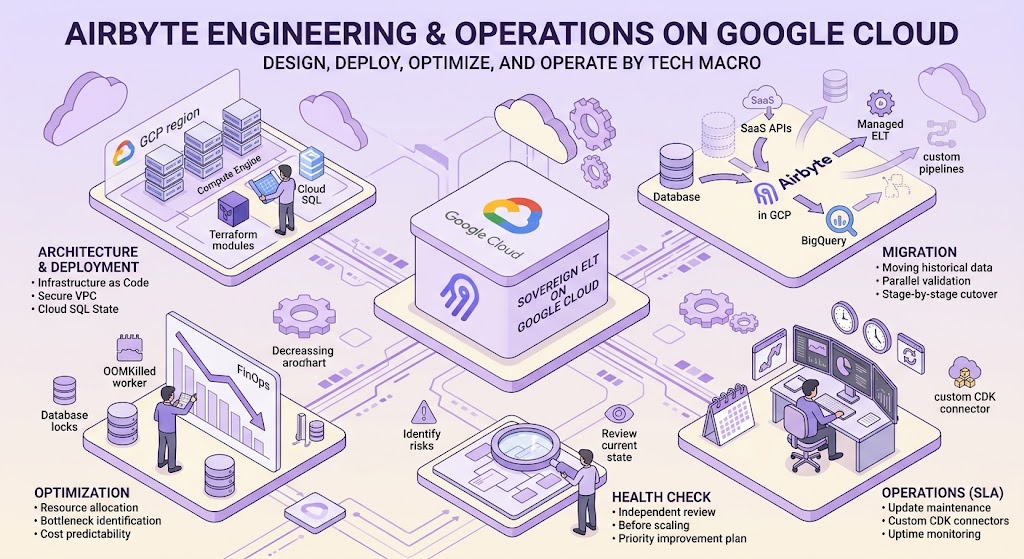
As a Cloud Solutions Architect, I treat Airbyte not as a standalone application, but as a specific integration layer within a broader Google Cloud Platform (GCP) architecture. At Tech Macro, my focus is on deploying, migrating, and optimizing Airbyte infrastructure strictly through code, ensuring predictable FinOps and data residency control.
Below is the exact technical scope of how I integrate Airbyte into your environment:
1. Architecture & Deployment (Infrastructure as Code) I do not install Airbyte manually. I deploy it as a production-grade environment inside your GCP Virtual Private Cloud (VPC) using Terraform.
- Infrastructure: Compute Engine or GKE for worker nodes, Cloud SQL (PostgreSQL) for internal state isolation, and Google Cloud Storage (GCS) for logs and staging.
- Security: The UI is locked behind Google Cloud Identity-Aware Proxy (IAP). No public IPs are assigned.
- Destination Setup: BigQuery is configured with GCS Staging to force batch loading, bypassing standard SQL insert limits and reducing query costs.
- Deliverable: A fully functioning environment handed over with Terraform state files, CI/CD deployment scripts, and runbooks.
2. Migration from SaaS ELT (Fivetran / Stitch) Moving away from managed platforms requires handling historical data and existing business logic.
- I map your existing incremental loads and Change Data Capture (CDC) pipelines.
- I deploy Airbyte in parallel with your current solution.
- We validate data consistency in BigQuery before executing a production cutover. The objective is to change the ingestion engine without breaking downstream analytical models.
3. Infrastructure Optimization & Health Checks When your existing Airbyte setup starts failing under load (e.g., OOMKilled workers, API rate limits, database lockups), adding more RAM is a temporary fix.
- I audit the specific bottlenecks: Java worker memory allocation, logical replication slot limits on source databases, and connector chunking behaviors.
- I reconfigure scheduling rules and resource limits to stabilize the pipelines, providing a prioritized list of architectural fixes rather than generic scaling recommendations.
4. Managed Operations (SLA) Operating an ELT platform requires constant maintenance. Source APIs deprecate endpoints, database schemas experience DDL changes, and Airbyte releases breaking version updates.
- I take operational responsibility for your integration layer.
- This includes monitoring pipeline failures via Cloud Monitoring/Airflow, resolving schema drift, and updating custom Python CDK connectors.
- You retain full ownership of your GCP environment and data; I manage the uptime of the data transit.
The Engineering Philosophy Behind the Tech Macro Approach
From my perspective, deciding to use Airbyte is a question of infrastructure control and total cost of ownership (TCO), not just connector availability. Managed services sell simplicity, but they bill on Monthly Active Rows (MAR). When your data volume scales—especially with CDC workloads from transactional databases—MAR billing becomes a financial liability.
Control vs. Convenience Self-hosting Airbyte inside your GCP environment shifts your costs from volumetric SaaS pricing to fixed Google Cloud infrastructure components. However, self-hosting is not automatically “cheaper” if it requires two full-time engineers to keep it running. My goal is to bridge that gap. By applying strict DevOps practices and isolated architecture, I make self-hosted Airbyte as reliable as a managed service, but with transparent, predictable costs.
Architectural Boundaries I enforce a strict ELT (Extract, Load, Transform) paradigm. Airbyte’s only job is to move data from point A to point B and load it in a raw, historically accurate format. It should never execute business logic.
- Airbyte handles the transit.
- BigQuery provides the storage and compute.
- dbt handles the transformations and schema unnesting.
If we attempt to force Airbyte to clean or heavily normalize data before it hits BigQuery, the pipeline will become brittle.
Whether you need a full deployment from scratch, a migration path off an expensive SaaS tool, or an engineer to fix an unstable existing setup, the first step is analyzing your actual data volume, current GCP footprint, and pipeline failure rates.