Part 1: The Illusion of Migration and the Harsh Engineering Reality
Let us start with an uncomfortable truth that the global IT outsourcing industry desperately wants to hide from you: Migrating a corporate Data Warehouse is not a file transfer.
Every year, hundreds of companies sign contracts for a “seamless cloud migration.” A generic agency looks at your massive Microsoft SQL Server or AWS Redshift cluster, counts the tables, and promises a complete transition in four weeks using a “Lift-and-Shift” strategy.
Six months later, the business finds itself in a technological nightmare. The old database is still running because the reporting dashboards refused to connect to the new one. The new cloud environment is generating catastrophic billing alerts. Your data engineers are having nervous breakdowns trying to rewrite 10,000 lines of legacy stored procedures that simply do not exist in modern SQL dialects. The company is now paying for two infrastructures simultaneously, achieving zero return on investment (ROI).
At Tech-Macro, we do not sell illusions. Migrating a Data Warehouse is a cardiovascular system transplant for your business. It requires surgical precision, brutal honesty, and a deep understanding of how columnar databases actually work.
Why the “Lift-and-Shift” Strategy is Dead
“Lift-and-Shift” means taking your exact current architecture and simply hosting it on someone else’s computer (the cloud). If you take a highly inefficient, tightly coupled, 10-year-old on-premise database and blindly copy it into Google BigQuery, you do not solve your problems. You simply make your problems run faster and cost more money. BigQuery is a serverless, columnar beast. If you feed it row-based legacy logic, it will punish your financial department.
Symptoms: When is it Time to Flee Your Legacy System?
How do you know that your current infrastructure (whether it is an aging on-premise SQL Server, an expensive Snowflake setup, or a bulky AWS Redshift cluster) is actively killing your business? Look for these three critical symptoms:
- The Billing Black Hole (Compute vs. Storage): You are paying massive monthly invoices just to keep servers turned on, even on weekends when no one is running reports. In legacy systems like Redshift, compute and storage are often chained together. To get more storage, you have to buy expensive compute nodes you do not need.
- The Analytics Bottleneck: Your marketing and finance teams wait 14 hours for the nightly ETL (Extract, Transform, Load) pipelines to finish. If a script fails at 4:00 AM, the entire company flies blind for the next 24 hours. The data is never truly “real-time.”
- The Artificial Intelligence Glass Ceiling: Your CEO wants to implement predictive analytics, dynamic pricing, or machine learning. But your Data Scientists cannot connect modern AI tools (like Gemini Enterprise or Vertex AI) to your closed, legacy database without building fragile, custom data pipelines that break every week.
If any of these sound familiar, modernization is no longer an option; it is a matter of market survival. But survival requires a strict, engineered plan.
Part 2: The “No BS” Policy and the Mandatory Paid Audit
When a client comes to Tech-Macro and asks, “How much will it cost and how long will it take to migrate our database to BigQuery?”, our answer is always the same: “We do not know. And anyone who gives you a number right now is lying to you.”
We refuse to play the traditional agency game of giving a low “free estimate” just to win the contract, only to multiply the budget by three through endless “change requests” down the line.
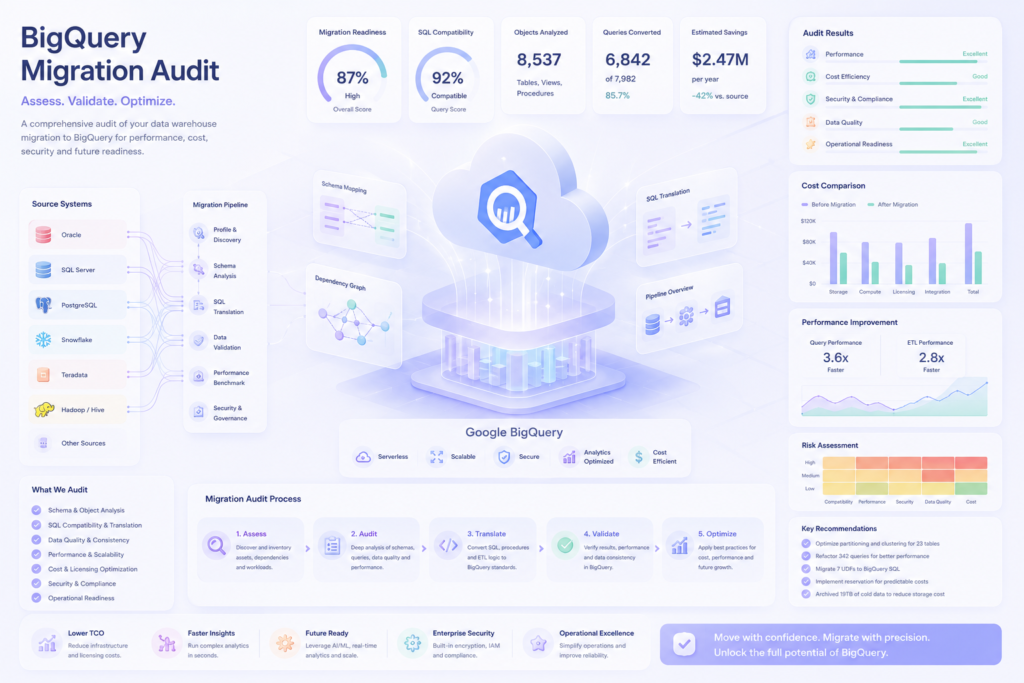
Before we touch a single table in your production environment, we require a Mandatory Paid Architecture Audit. This is a standalone, highly technical diagnostic project. You are paying for truth, transparency, and a mathematical calculation of your technical debt.
What We Actually Scan During the Audit
We do not just look at the size of your database. Our engineering team conducts a deep-dive autopsy of your entire data ecosystem:
- Schema and Dialect Translation Analysis: A
DATETIMEin SQL Server behaves differently than aTIMESTAMPin BigQuery. Legacy databases are full of complex Stored Procedures, Triggers, and User-Defined Functions (UDFs) that BigQuery intentionally does not support (because they destroy analytical performance). We map exactly how many of these exist and design the architectural workarounds. - The ETL Pipeline Autopsy: We analyze how data enters your current system. If you are using outdated, fragile Python scripts or slow middleware, we design a modernization plan. For high-load, complex logistical data routing, we map out a transition to robust, statically-typed F# pipelines, guaranteeing stability and mathematical precision that generic scripts simply cannot provide.
- The “Zombie Data” Purge: In any system older than three years, up to 40% of the tables are “zombies”—data that is updated daily but has not been queried by a human or a dashboard in over a year. We analyze the query logs to identify this dead weight. We will not migrate your garbage to a new premium cloud.
- BI & Dashboard Dependencies: We trace every table back to your Looker, Tableau, or PowerBI dashboards. We map the dependencies to ensure that when the new database goes live, your executives’ reports do not suddenly show empty charts.
The Audit Deliverables: The Blueprint
At the end of the audit phase, you receive a comprehensive Engineering Blueprint. This is not a marketing brochure; it is a strict technical document that includes:
- The Migration Topography Map: A clear visual architecture of how the data flows today, and exactly how it will flow in the modern Google Cloud environment.
- Trade-offs and Compromises: We highlight the uncomfortable truths. (For example: BigQuery is bad at row-level
UPDATEoperations. If your current logic relies on thousands of micro-updates per minute, we will explain how we must rebuild your logic into an “append-only” architecture). - The Exact Timeline and Fixed Budget: Once we know the exact depth of the technical debt, we provide a rigid timeline and a transparent cost structure. No hidden fees. No surprise invoices.
The architecture audit is a standalone, independent consulting service that requires 100% upfront payment.
We do not discount or credit this fee against future migration contracts. The Engineering Blueprint you receive is a fully realized, high-value technical product on its own. Once the audit is delivered, the choice is entirely yours: you can hire Tech-Macro to execute the migration, or you can hand our blueprint to your in-house engineering team. Either way, you are purchasing a risk-free roadmap that protects your business from catastrophic cloud failures.
Part 3: The Anatomy of Zero-Downtime (The Parallel Run)
The biggest fear any CTO has regarding a data warehouse migration is “Data Downtime.”
In a traditional, poorly planned migration, the outsourcing agency shuts down the legacy database on a Friday night, copies the data over the weekend, points the BI dashboards to the new cloud on Monday morning, and prays that nothing breaks. This is engineering roulette. When the inevitable bugs appear, the company’s reporting goes dark. Marketing cannot see ad performance, and logistics cannot track inventory.
Tech-Macro eliminates this risk entirely by utilizing a Zero-Downtime Parallel Run architecture. We do not “flip a switch.” We build a bridge.
Phase 1: Dual Data Ingestion
Before we ever attempt to turn off your MS SQL Server or AWS Redshift cluster, we configure your ETL (Extract, Transform, Load) pipelines to duplicate the data stream. If a transaction occurs on your backend, the ingestion pipeline sends one copy to the old legacy database, and simultaneously sends a second copy to the new Google BigQuery environment.
Phase 2: The Shadow Operation and Validation
For a period of two to four weeks, both databases operate simultaneously. The old database remains connected to your production dashboards, ensuring business continuity. Meanwhile, the new BigQuery environment works entirely in “shadow mode.”
During this time, we run automated validation scripts. The system continuously compares the analytical outputs of BigQuery against the outputs of the legacy system. If Redshift calculates daily revenue as €145,000, but BigQuery calculates €144,950, our engineers investigate and resolve the structural discrepancy immediately.
Phase 3: The Seamless Cutover
We only authorize the final cutover when the validation scripts return a 100% mathematical match for a full business week. At that point, we simply redirect your Tableau, Looker, or PowerBI dashboards to connect to BigQuery. The legacy database is safely decommissioned. The business never experiences a single second of analytical blindness.
Part 4: A Hardcore Case Study: Escaping AWS Redshift
To demonstrate exactly how this works in reality, let us dissect a typical enterprise scenario: migrating a mid-sized e-commerce data warehouse from AWS Redshift to Google BigQuery.
The Client Profile: A European e-commerce platform processing 500,000 events daily. They were spending excessive money on Redshift compute nodes just to store their historical data, and their nightly analytical queries were taking over 4 hours to execute.
The Engineering Challenges (and Solutions)
A true migration is never just “copying tables.” It is about adapting to a new physical reality. Here are the exact engineering problems we solved during this transition:
1. The Schema and Dialect Mismatch
AWS Redshift uses a PostgreSQL-based SQL dialect. BigQuery uses Google Standard SQL. They are fundamentally different beasts.
- The Problem: Redshift relies heavily on
VARCHAR(256)data types to limit storage, and uses specific window functions that do not behave identically in BigQuery. Furthermore, their Redshift database stored raw JSON payloads as flat text strings, making querying incredibly slow. - The Solution: We did not just copy the bad architecture. During the schema translation, we converted the flat JSON strings into BigQuery’s native
STRUCTandARRAYdata types. This simple structural modernization immediately reduced the query scan times by 60%.
2. Rebuilding Fragile ETL Pipelines
- The Problem: The client was loading data into Redshift using a messy collection of legacy Python scripts that frequently crashed due to memory leaks and untyped data errors.
- The Solution: We replaced the fragile Python layer with statically-typed F# pipelines. By leveraging F# for the core data routing and algorithmic logic, we guaranteed mathematical precision and eliminated runtime errors. The data was smoothly ingested into Google Cloud Storage (GCS) and then seamlessly loaded into BigQuery using reliable, compiled code.
3. The Uncomfortable Trade-Off: Managing Mutations
- The Problem: Redshift handles row-level updates (
UPDATE/DELETE) relatively well. The client had a script that updated user order statuses (“Pending” to “Shipped”) thousands of times per day. BigQuery is a columnar analytical engine; it heavily restricts frequentUPDATEoperations and charges high compute costs for them. - The Solution (Architectural Shift): You cannot force BigQuery to act like a transactional database. We completely redesigned the client’s logic into an “Append-Only” architecture. Instead of updating an existing row, the F# pipeline simply inserts a new row with the new status and a fresh timestamp. We then used BigQuery’s
QUALIFY ROW_NUMBER() OVER()function in the reporting layer to instantly fetch only the most recent status. This bypassed the mutation limits entirely and kept cloud costs near zero.
The Project Economics (Time and Cost)
After the initial Paid Architecture Audit (which took 2 weeks), we delivered a precise execution plan.
| Project Phase | Duration | Core Engineering Deliverable |
| Data & Schema Translation | 3 Weeks | Translating 150+ tables, converting data types, and setting up BQ partitioning. |
| F# Pipeline Modernization | 3 Weeks | Replacing fragile ingestion scripts with robust serverless architecture. |
| Parallel Run & Validation | 2 Weeks | Running both databases simultaneously to mathematically prove data accuracy. |
| Total Migration Time | 8 Weeks | Zero business downtime achieved. |
The ROI: By moving from Redshift’s node-based pricing to BigQuery’s highly optimized, partitioned storage, the client’s monthly infrastructure bill dropped by 45%. The nightly reporting queries went from 4 hours to 12 minutes.
We did not just move their data; we modernized their entire analytical capability.
Part 5: FinOps Guardrails and European Legal Compliance
Migrating a scaling business to the cloud introduces a new type of risk. When you own a physical MS SQL Server, the worst thing a bad SQL query can do is slow down the server. In a serverless cloud like Google BigQuery, a bad SQL query can process a petabyte of data and instantly generate a $5,000 bill.
For a mid-market company, unexpected cloud billing is not just an annoyance; it is a direct threat to profit margins.
FinOps: Hardwiring Financial Safety
At Tech-Macro, we do not just hand over the keys to a new BigQuery environment and walk away. We build an infrastructure that actively defends your budget. We call this “FinOps by Design.”
Before your analytics team writes their first query in the new system, we implement strict structural guardrails:
- Mandatory Partitioning: We physically configure your tables so that users cannot accidentally scan five years of data when they only need one day. If they write a query without a date filter, the database will instantly reject it before it costs you a single cent.
- API-Level Budget Limits: We configure Google Cloud IAM (Identity and Access Management) quotas. We can cap a junior analyst’s daily querying budget at $10. If they hit the limit, BigQuery stops serving their requests. Your monthly invoice becomes 100% predictable.
- Capacity Pricing Transitions: For heavy, automated ETL workloads that run every night, we transition those specific jobs from On-Demand pricing to Capacity pricing (buying dedicated slots). This provides a fixed operational expense (OpEx) for your heavy lifting, eliminating cost spikes.
The Legal Shield: GDPR and EU Data Sovereignty
If you operate in the European market, moving data between clouds is a legal minefield. Using random third-party connectors or cheap offshore teams exposes your customer data to severe GDPR violations.
Tech-Macro’s migration pipelines are built for strict European compliance:
- Data Sovereignty: We configure your entire Google Cloud perimeter to exist exclusively within European data centers (e.g.,
europe-west3in Frankfurt oreurope-west4in Eemshaven). Your physical data, temporary query tables, and automated backups never leave the legal jurisdiction of the European Union. - Secure Transit: Our F# ingestion pipelines do not bounce your data through third-party SaaS platforms. The data moves directly from your legacy system to your private Google Cloud Storage bucket via encrypted, point-to-point connections.
The Next Step: Stop Guessing, Start Auditing
If your legacy database is slowing down your business, inflating your cloud bills, or preventing you from implementing modern analytics, hoping it will get better is not a strategy.
Stop asking agencies for wild, uneducated estimates. Purchase a rigorous, mathematical analysis of your technical debt.