
Cloud Run, GKE or Compute Engine? You’re Asking the Wrong Question
If you spend enough time reading cloud forums or watching conference talks, you will eventually encounter the same question in different forms.
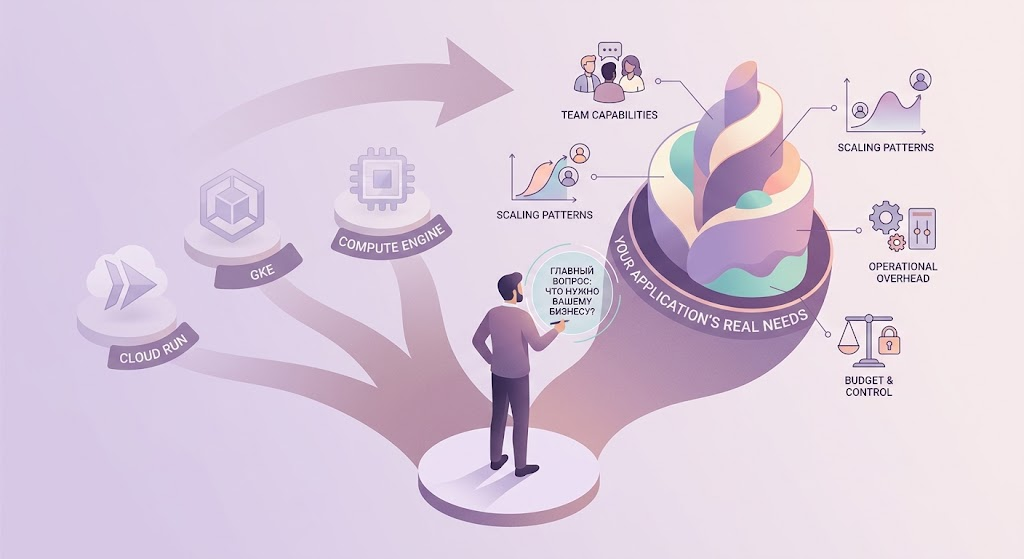
“Should I use Cloud Run or GKE?”
“Is Kubernetes better than virtual machines?”
“When should I move to Compute Engine?”
At first glance, these seem like sensible technical questions. After all, each of these services allows you to run applications in Google Cloud. Comparing them appears to be a natural part of designing a system.
It isn’t.
In fact, asking which service is “better” is very similar to asking whether a truck is better than a motorcycle or whether an airplane is better than a train. The question itself is flawed because it ignores the only thing that matters: what problem are you trying to solve?
This misunderstanding is responsible for an astonishing number of poor architectural decisions. Teams spend weeks comparing CPU performance, pricing tables and scaling limits while ignoring a much more important topic—the operational model behind each service.
The real decision has very little to do with containers or virtual machines.
It is about responsibility.
Every Computing Platform Solves the Same Problem
Strip away the marketing, remove the dashboards, ignore the product pages, and every computing platform exists for exactly one reason:
to execute your application reliably.
That is all.
Whether the application runs on a physical server in your office, inside a virtual machine, in a Kubernetes cluster or on Cloud Run does not change its purpose. Somewhere, a CPU executes instructions, memory stores data temporarily, disks persist information and a network connects users to the application.
The laws of computing remain exactly the same.
What changes is who is responsible for managing everything around your application.
This is the first major shift in thinking.
Engineers often compare services based on features.
Architects compare them based on responsibility.
The Evolution of Responsibility
To understand why Google Cloud offers multiple ways to run applications, we need to look briefly at how infrastructure has evolved over the past two decades.
Not because history is interesting for its own sake, but because every new platform was created to solve a problem introduced by the previous one.
Twenty years ago, running an application meant buying physical servers.
The process was slow, expensive and surprisingly stressful.
A company had to estimate how much traffic the application might receive over the next three or five years, purchase hardware accordingly, wait for delivery, install operating systems, configure networks, build monitoring systems and prepare backup strategies.
If the estimate was too conservative, users experienced outages because the hardware could not handle the load.
If the estimate was too optimistic, expensive servers spent years running at ten percent utilization.
Neither outcome was particularly satisfying.
Virtualization changed this completely.
Instead of purchasing physical machines for every application, companies could create virtual servers inside powerful hardware clusters.
Provisioning a server no longer required waiting weeks.
It took minutes.
Cloud providers later pushed this idea even further.
Instead of owning hardware, companies rented virtual machines on demand.
Infrastructure became elastic.
Costs became operational instead of capital expenses.
Everything looked perfect.
Until engineers realized they were still responsible for maintaining every virtual machine they created.
Virtual Machines Solved One Problem and Created Another
Virtual machines removed the pain of buying hardware, but they did not eliminate operational work.
Someone still had to update operating systems.
Someone had to install security patches.
Someone had to configure firewalls.
Someone had to monitor CPU utilization.
Someone had to investigate memory leaks.
Someone had to recover failed instances.
The cloud had removed the server room.
It had not removed system administration.
This distinction is often forgotten.
Many organizations proudly announced they had “moved to the cloud,” while continuing to manage infrastructure almost exactly as before.
They simply rented computers instead of owning them.
Containers Changed the Conversation
Then containers arrived and quietly changed the industry.
The idea was elegant.
Instead of treating the operating system as part of the application, package only what the application actually needs.
Its runtime.
Its libraries.
Its dependencies.
Nothing more.
This solved a problem developers had struggled with for years.
“It works on my machine.”
That sentence became less common because the application carried its environment with it.
Whether the container ran on a laptop, a testing server or Google Cloud, it behaved consistently.
Containers dramatically improved portability.
They also introduced a new challenge.
Running one container is easy.
Running thousands is not.
Kubernetes Was Never Designed to Make Your Life Easier
This is perhaps one of the most misunderstood technologies in modern software engineering.
Many engineers see Kubernetes as a more advanced way to deploy applications.
That is not why Kubernetes exists.
Kubernetes exists because manually managing thousands of containers is impossible.
Imagine operating a video streaming platform serving millions of users worldwide.
Hundreds of services.
Thousands of containers.
Constant deployments.
Hardware failures every day.
Traffic spikes every hour.
Without automation, keeping such a platform alive would require an army of operators.
Kubernetes automates that work.
It decides where containers should run.
It replaces failed instances.
It distributes workloads.
It manages deployments.
It continuously observes the health of the cluster.
Notice something important.
None of these features exists because developers wanted them.
They exist because operating systems at enormous scale becomes impossible without orchestration.
For companies like Google, Spotify or Airbnb, Kubernetes is almost unavoidable.
For a startup with two APIs and five thousand daily users?
Perhaps not.
The Kubernetes Trap
One of the funniest engineering jokes says:
“Nobody ever got fired for recommending Kubernetes.”
Like many jokes, it survives because it contains an uncomfortable amount of truth.
Kubernetes has become a symbol of technical maturity.
Teams sometimes adopt it not because they need it, but because successful technology companies use it.
This is similar to buying a Formula One pit crew to maintain a family sedan.
The mechanics are excellent.
The bill is unforgettable.
One of the most common architectural mistakes today is confusing future ambition with current requirements.
A startup dreams of becoming the next Netflix.
An engineering team designs infrastructure capable of supporting Netflix.
Two years later, the platform is still serving twenty thousand users, but now requires three DevOps engineers simply to keep Kubernetes healthy.
The application never became complex.
The infrastructure did.
By the time Kubernetes became the standard platform for container orchestration, something interesting had happened.
Engineers solved one problem and immediately discovered another.
Deploying applications became easier.
Operating Kubernetes clusters did not.
Anyone who has worked with Kubernetes long enough knows that the platform is both brilliant and demanding. It can automate enormous amounts of operational work, but only after someone invests significant time learning how Kubernetes itself works.
Pods.
Deployments.
ReplicaSets.
DaemonSets.
StatefulSets.
Ingress controllers.
Persistent Volumes.
Network Policies.
Horizontal Pod Autoscalers.
Node Pools.
The list grows quickly.
None of these concepts exists because engineers enjoy learning new terminology. They exist because Kubernetes solves extremely difficult operational problems at massive scale. Every abstraction represents years of engineering experience encoded into software.
The challenge is that every abstraction also introduces a learning curve.
For organizations running hundreds of microservices, that investment often makes perfect sense.
For smaller teams, the return on investment may never arrive.
Imagine opening a restaurant.
Buying an industrial kitchen capable of preparing ten thousand meals per day sounds impressive. Stainless steel everywhere, dozens of ovens, automated storage systems and specialized equipment. It would also be completely unnecessary if your restaurant serves fifty customers each evening.
The kitchen is not bad.
It is simply solving a problem you do not have.
Kubernetes often finds itself in exactly the same situation.
Why Google Created Cloud Run
Google understood this problem better than almost anyone else.
After all, Kubernetes originated inside Google. The company knew both its strengths and its weaknesses.
Many development teams wanted the benefits of containers without becoming Kubernetes experts. They wanted to deploy applications, not operate orchestration platforms.
Cloud Run was Google’s answer.
Its philosophy is surprisingly simple.
Bring your container.
Google will take care of everything else.
No nodes to manage.
No cluster upgrades.
No scheduling decisions.
No capacity planning.
No control plane maintenance.
No wondering whether your worker nodes require security patches this weekend.
For many applications, this feels almost magical.
Developers package their application into a container, deploy it and move on to solving business problems instead of infrastructure problems.
That last sentence is more important than it appears.
Cloud Run was never designed to replace Kubernetes.
It was designed to remove Kubernetes from projects that never needed Kubernetes in the first place.
Understanding the Hidden Contract
Every managed service comes with an invisible agreement.
Google accepts more operational responsibility.
You accept more operational limitations.
Cloud Run is no exception.
When deploying to Cloud Run, you agree that Google controls the infrastructure.
Google decides where your containers run.
Google decides how instances are created.
Google decides when instances disappear.
Google controls operating system updates.
Google manages scaling.
Google handles capacity planning.
In exchange, you no longer spend time thinking about those topics.
For many businesses, this is an excellent trade.
The engineering team focuses on product development instead of infrastructure maintenance.
However, every agreement has boundaries.
Cloud Run assumes that your application behaves in a particular way.
It should be stateless.
It should start relatively quickly.
It should tolerate instances appearing and disappearing at any moment.
It should not depend on local disk storage surviving between requests.
Notice something important.
These are not technical limitations.
They are architectural assumptions.
Applications designed around these assumptions thrive on Cloud Run.
Applications built around different assumptions often struggle.
The platform is not wrong.
The architecture simply disagrees with the platform’s operating model.
When Compute Engine Still Wins
After hearing all the advantages of managed platforms, many engineers ask a perfectly reasonable question.
“If Cloud Run removes so much operational work, why would anyone still choose virtual machines?”
Because some problems require direct control over the operating environment.
Imagine you are migrating an existing enterprise application that has been running for fifteen years.
The application depends on specialized software libraries.
It requires custom kernel modules.
It expects direct access to the operating system.
It performs background processing twenty-four hours a day.
Rewriting the application would cost millions of dollars and take several years.
In this situation, Compute Engine is not an outdated choice.
It is the correct choice.
Sometimes the fastest migration is not the most modern migration.
It is the migration that minimizes business risk.
There are many other examples.
High-performance scientific computing.
Specialized networking appliances.
Applications requiring GPU configurations unavailable elsewhere.
Commercial software licensed per virtual machine.
Legacy enterprise platforms that cannot easily be containerized.
These workloads are not common, but they are important.
The cloud is not about replacing every virtual machine.
It is about choosing the right operational model for each workload.
Three Services, Three Different Philosophies
At this point, it becomes easier to see that comparing Compute Engine, GKE and Cloud Run as if they compete with each other misses the bigger picture.
They represent three fundamentally different philosophies.
Compute Engine says:
“You control almost everything. Therefore, you are responsible for almost everything.”
Cloud Run says:
“Google manages almost everything. Therefore, you accept Google’s operational model.”
GKE stands in the middle.
It offers tremendous flexibility, but only if your team is willing to operate a Kubernetes platform successfully.
This explains why architecture discussions often become confusing.
Teams compare technical specifications instead of comparing responsibility models.
The specifications matter.
The responsibility model matters far more.
The Question Every Architect Should Ask
Imagine receiving a new project tomorrow morning.
Before thinking about Cloud Run, Kubernetes or virtual machines, pause for a moment and ask a different question.
“How much infrastructure do we actually want to own?”
Not purchase.
Own.
Who will monitor it?
Who will patch it?
Who will upgrade it?
Who will troubleshoot failures at three in the morning?
Who will explain next year’s cloud invoice?
Infrastructure ownership is rarely visible on architecture diagrams.
Yet it determines a significant portion of a project’s long-term cost.
Every platform removes some responsibilities and leaves others behind.
The role of the architect is not to eliminate responsibility.
It is to decide which responsibilities create business value and which should be delegated to the cloud provider.
That is a much more useful conversation than asking whether one service is “better” than another.
Because the answer is almost always the same.
It depends on what your team wants to own.
At this point, we have reached an important conclusion.
Cloud Run, GKE and Compute Engine are not competing products. They represent different operational models, different levels of responsibility and different assumptions about how applications should run.
The next logical question is obvious.
How should an architect actually choose between them?
The answer is not a checklist of technical features. It is a sequence of questions that gradually removes uncertainty until only one reasonable option remains.
Experienced architects rarely begin by selecting a cloud service. Instead, they begin by reducing the number of possible solutions.
Step One: Understand the Application, Not the Technology
The first discussion should never be about Google Cloud.
It should be about the application itself.
What kind of software is being built?
A public REST API behaves differently from an internal reporting system. A machine learning inference service has very different requirements from a video processing platform. A nightly ETL pipeline does not have the same operational profile as an online payment gateway.
Trying to choose infrastructure before understanding the workload is like selecting tires before deciding whether you are building a racing car or a tractor.
Ask simple questions.
Is the application request-driven, or does it perform continuous background work?
Does it process traffic throughout the day, or only during business hours?
Is demand predictable, or does it arrive in unpredictable bursts?
Does it need to maintain long-running network connections?
Can it tolerate being restarted at any moment?
The answers define the operational profile of the application. Only then does it make sense to discuss cloud services.
Step Two: Identify Operational Constraints
Many engineering teams focus entirely on technical requirements while overlooking operational reality.
Suppose the application could technically run on Kubernetes.
Who will maintain the cluster?
Who understands Kubernetes networking?
Who will investigate node failures?
Who is responsible for upgrades every few months?
Who responds to production incidents during holidays?
A sophisticated platform is valuable only if the organization can operate it confidently.
An architecture should reflect the capabilities of the team, not just the capabilities of the technology.
This is one of the most common reasons why identical applications receive completely different architectures in different companies.
The software is the same.
The teams are not.
Step Three: Estimate Growth Honestly
Almost every startup presentation contains a slide showing exponential user growth.
Almost every architecture meeting contains someone saying,
“We should prepare for millions of users.”
Planning for growth is responsible.
Designing exclusively for hypothetical growth is not.
A useful exercise is to separate expected growth from imagined growth.
If the business expects traffic to double within the next year, design for that scenario.
If there is no realistic evidence that traffic will increase one hundred times, avoid introducing infrastructure intended only for that possibility.
Cloud platforms are specifically designed to support gradual evolution.
There is no prize for solving tomorrow’s problems five years in advance.
In fact, doing so often delays solving today’s problems.
Step Four: Evaluate Operational Responsibility
This is the step that many technical comparisons completely ignore.
Every platform asks a simple question.
How much operational work are you willing to perform yourself?
Compute Engine assumes that you are comfortable managing operating systems, patches, networking, scaling strategies and infrastructure maintenance.
Cloud Run assumes that you would rather spend that time building application features.
GKE assumes that you need the flexibility of Kubernetes and are prepared to accept the operational complexity that comes with it.
Notice that none of these assumptions is inherently better.
They simply reflect different organizational priorities.
Step Five: Think About Failure Before Deployment
One useful habit separates experienced architects from inexperienced ones.
Before deploying anything, they imagine how the system will fail.
Not whether it will fail.
How.
Suppose a service instance suddenly disappears.
Does the application recover automatically?
Suppose a deployment introduces a faulty release.
How quickly can it be rolled back?
Suppose traffic unexpectedly increases by ten times.
Does the platform scale without manual intervention?
Suppose one dependency becomes unavailable.
Does the rest of the system continue functioning?
Failure scenarios often expose architectural weaknesses long before production users discover them.
A design that performs well only under ideal conditions is not a production architecture.
It is a successful demonstration.
A Practical Way to Think About the Three Platforms
Instead of memorizing feature lists, think about the three services as answers to three different questions.
Choose Cloud Run when your goal is to maximize developer productivity and minimize infrastructure management. It is particularly effective for APIs, web applications, event-driven services and containerized workloads that naturally fit a stateless execution model. For many modern business applications, this should be the starting point rather than the fallback option.
Choose Google Kubernetes Engine when your system has outgrown the assumptions of serverless computing and genuinely benefits from Kubernetes orchestration. This usually means managing many interconnected services, applying advanced deployment strategies, supporting specialized networking requirements or standardizing operations across a large engineering organization. Kubernetes should solve an operational problem you already have, not one you hope to have someday.
Choose Compute Engine when the workload requires deep control over the operating system, relies on legacy software that cannot be containerized without significant effort, or depends on specialized hardware and configurations that managed platforms cannot provide. Virtual machines remain the correct solution for many enterprise workloads because compatibility and stability are often more valuable than modernization for its own sake.
Seen this way, the decision becomes much clearer. You are not selecting between three products. You are selecting between three levels of operational ownership.
The Cost of Choosing Too Much Infrastructure
There is a pattern that appears repeatedly in cloud migrations.
Companies rarely regret starting with infrastructure that is too simple.
They frequently regret starting with infrastructure that is too complicated.
An overengineered platform consumes engineering time before it creates business value.
Clusters require maintenance before they serve users.
Monitoring systems require tuning before they prevent incidents.
Automation pipelines require support before they save effort.
Complexity behaves like compound interest.
Every unnecessary component increases the effort required to understand, test, document and modify the system.
This is why experienced architects treat complexity as a resource to be spent carefully, not a sign of technical sophistication.
Architect’s Checklist
Before selecting Cloud Run, GKE or Compute Engine, ask yourself:
- What problem are we solving today?
- Which operational responsibilities are we prepared to own?
- Does the chosen platform match the team’s actual expertise?
- What assumptions does this platform make about the application?
- Can the architecture evolve gradually as the business grows?
- Are we solving current requirements or imaginary future ones?
- If this system doubles in size next year, what changes first?
If these questions have clear answers, the platform often chooses itself.
Closing Thought
One of the biggest misconceptions in cloud architecture is that technical excellence comes from choosing the most advanced platform.
In reality, technical excellence comes from choosing the platform that solves today’s problem while creating the fewest unnecessary problems for tomorrow.
Cloud Run is not simpler because it is less powerful.
Compute Engine is not better because it offers more control.
GKE is not more professional because it is more complex.
Each platform represents a different agreement between your team and the cloud provider.
The best architects understand those agreements before they write the first line of infrastructure code.
Because in cloud architecture, every service answers the same question in a different way:
“Who should own the complexity?”