
First-Party Data Pipeline on GCP: Server-Side Architecture for High-Load Systems
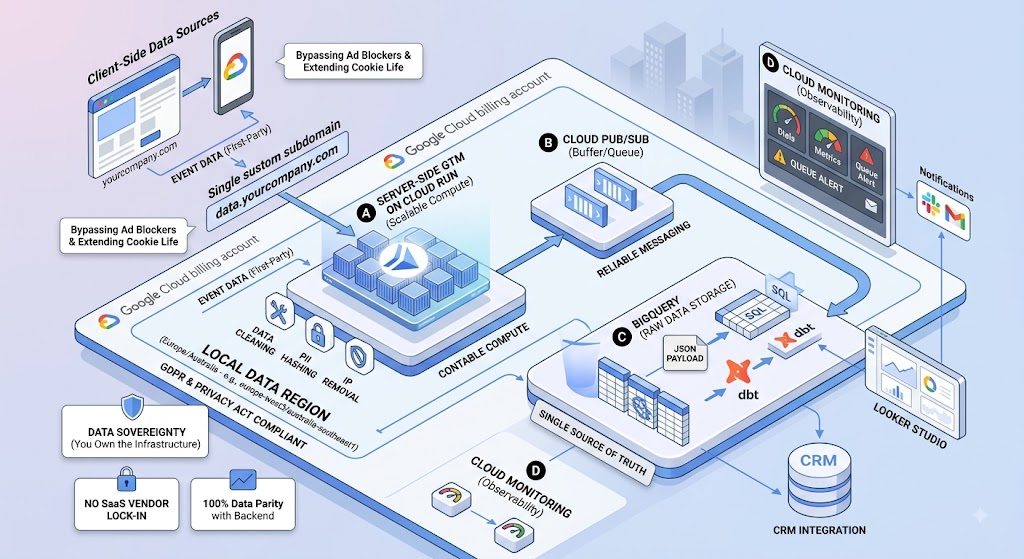
Modern data infrastructure faces a deterministic problem: standard client-side analytics tools are losing up to 35% of their accuracy. Intelligent Tracking Prevention (ITP), strict browser-level ad blockers, and evolving privacy legislations have deprecated the traditional client-side tracking model.
For mid-market systems processing 8 million to tens of millions of events per day, the solution is not integrating another third-party SaaS platform. The engineering standard is to deploy a dedicated First-Party Data Pipeline directly within a Google Cloud Platform (GCP) environment.
This document outlines the architecture, data sovereignty mechanics, engineering trade-offs, and the deployment workflow of a high-load Server-Side tracking system.
1. Data Sovereignty and Legal Compliance
The foundational principle of this architecture is absolute data sovereignty. Standard client-side analytics force the user’s browser to send data directly to third-party advertising servers (often located in the USA). Under GDPR (and precedents like Schrems II) or the Australian Privacy Act, transferring Personally Identifiable Information (PII) or raw IP addresses across borders without strict safeguards creates immediate legal exposure.
By deploying the pipeline within your GCP billing account, the infrastructure adheres to strict local data governance:
- Jurisdictional Isolation: The cluster is deployed exclusively in a legally compliant GCP region (e.g.,
europe-west3in Frankfurt oraustralia-southeast1in Sydney). The raw data physically remains within your local jurisdiction. - Pre-Egress Anonymization: Before any payload is forwarded to external US-based advertising APIs (Meta Conversions API, Google Ads), the server-side environment automatically hashes PII using SHA-256 algorithms and strips raw IP addresses. You control exactly what data leaves your secure perimeter.
- Infrastructure Ownership: The entire routing system exists inside your perimeter. You hold the IAM (Identity and Access Management) admin keys, not a third-party vendor.
2. Unifying the Stream via First-Party Subdomains
High-load systems typically suffer from fragmented data streams across web properties, iOS/Android apps, and backend CRMs. Merging these streams at the client level creates duplicate users and broken session stitching.
This architecture centralizes data ingestion. Both web tracking (via GTM) and mobile tracking (via Firebase SDKs) transmit payloads to a single endpoint hosted on a first-party subdomain (e.g., data.yourcompany.com). Because the DNS record is mapped directly to your primary domain, browsers identify the data stream as a native, secure, first-party request—effectively bypassing external ad blockers and extending cookie lifespans.
3. Core Architecture & GCP Technology Stack
The pipeline utilizes four native Google Cloud components, decoupling data ingestion from data storage to ensure fault tolerance during traffic spikes.
- Ingestion (Server-Side GTM on Cloud Run): Google Cloud Run provides a fully managed, stateless container environment. It automatically scales instances horizontally based on incoming Requests Per Second (RPS). Inside this environment, Server-Side GTM acts as the core router, cleaning payloads and structuring events before transmission.
- Buffer (Google Cloud Pub/Sub): Writing millions of events directly to a database during a marketing traffic spike guarantees timeout errors. Pub/Sub acts as an asynchronous message queue. Cloud Run pushes validated events to Pub/Sub, which guarantees at-least-once delivery with a 99.95% SLA. If the downstream database is locked, Pub/Sub retains the data until it can be safely written.
- Storage (BigQuery Data Warehouse): Pub/Sub streams the payload directly into a BigQuery dataset. The pipeline writes data in a raw, schema-agnostic JSON format. If your frontend engineers deploy a new parameter, the database will accept it without throwing a schema mismatch error. All data structuring and modeling occur post-ingestion via SQL.
- Observation (Cloud Monitoring): A high-load pipeline requires automated oversight. The operations suite tracks Cloud Run CPU/Memory utilization and monitors Pub/Sub unacknowledged message queues. If data is not written to BigQuery within a 5-minute threshold, the system triggers webhook alerts directly to your engineering team.
4. Production Benchmark: Infrastructure Migration
To quantify the impact, consider a recent deployment for a European mid-market E-commerce project processing 12 million events per day (9M Web, 3M Mobile App).
- The Problem: Due to browser updates and aggressive ad blockers, their analytics reported 30-35% less revenue than the backend CRM. They were utilizing a managed third-party SaaS routing solution that charged approximately $2,500/month based on event volume tiers.
- The Deployment: A dedicated GCP project was configured in
europe-west3. Cloud Run was deployed with a minimum instance count of 3 to prevent “cold start” latency during initial user connections. Traffic was routed through a load balancer connected to a dedicated first-party subdomain. - The Engineering Output: By removing the SaaS vendor and relying strictly on raw GCP compute costs, the monthly infrastructure bill stabilized at ~$350. The database achieved near-100% parity with backend transactional data.
5. Engineering Trade-offs: The Payment Gateway Constraint
We operate on engineering honesty. While this architecture resolves ad-blocking and compliance issues, it introduces specific technical complexities—most notably during cross-domain payment processes.
When implementing server-side tracking, the system defaults to utilizing secure, HTTP-only Server Cookies (FPID) to maintain user identity. By default, modern browsers assign a SameSite=Lax security policy to these cookies.
The Bottleneck: When a user initiates a transaction via a third-party payment gateway (e.g., Stripe, PayPal, or a 3D Secure bank redirect), they temporarily leave your domain. Upon successful payment, the gateway returns the user to your “Thank You” page via a cross-origin POST request. Browser security protocols strictly strip the SameSite=Lax server cookie during this POST redirect. The server loses the user’s identity, breaking the session. The transaction is recorded, but the marketing attribution source is lost (classified as “Direct” or “Not Set”).
The Compromise: For projects relying on external payment gateways, strict HTTP-only server cookies will break attribution. The architectural solution is to configure a hybrid identity model: falling back to JavaScript-managed first-party cookies for session stitching, while maintaining the secure server-side container for data routing and PII hashing. This ensures the transaction survives the POST redirect, preserving channel attribution data at the cost of a slightly shorter cookie lifespan.
6. The Deployment Pipeline and Handover
The integration of this architecture follows a strict, deterministic deployment cycle designed to transfer complete ownership to your internal team.
- Phase 1: Diagnostic Audit. We analyze current RPS volumes, identify the root causes of data fragmentation, and map existing client-side tags.
- Phase 2: Architecture Specification. Delivery of a technical blueprint detailing the exact GCP configuration, expected latency, and projected monthly cloud compute costs.
- Phase 3: Staging & Configuration. Deployment of the Cloud Run cluster, Pub/Sub topics, and BigQuery datasets. Client-side SDKs are re-routed to the new endpoint.
- Phase 4: Parallel Testing. The server-side pipeline runs concurrently with the legacy setup to validate data parity, test payment gateway redirects, and confirm payload structures.
- Phase 5: Full Handover. Transfer of absolute administrative rights (IAM). You receive the infrastructure keys, technical documentation, and SQL models. There is no vendor lock-in; the infrastructure operates autonomously within your environment.