
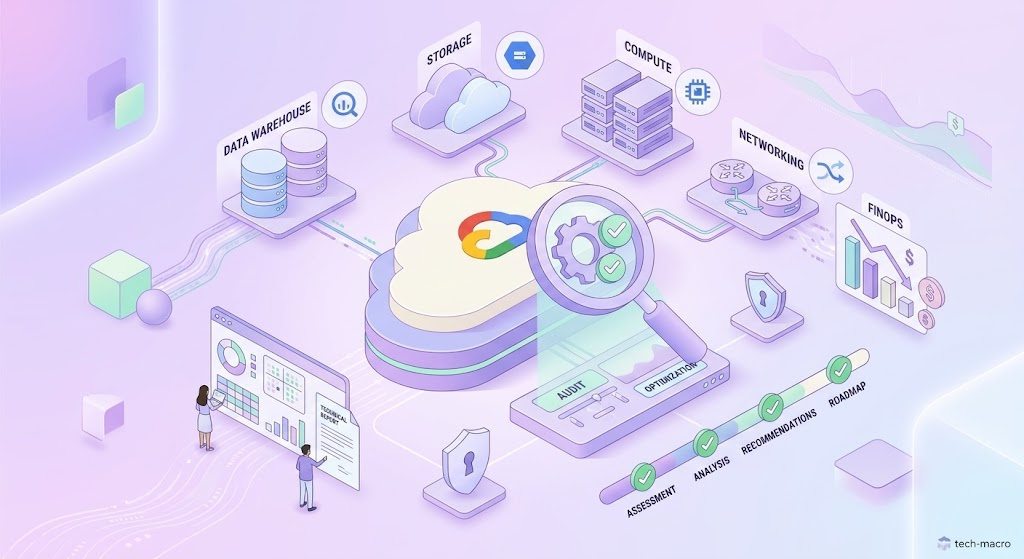
Introduction: The Cost of Scaling and Technical Debt
When migrating to Google Cloud, the baseline expectation for businesses is scalability and cost-efficiency. However, as the infrastructure grows, architectural complexity inevitably increases. Technical leaders (CTOs, Heads of Data) often face a typical pattern: cloud resource bills show unpredictable spikes, data pipelines in BigQuery start degrading in performance, and the engineering team spends hundreds of hours on operational troubleshooting of monolithic systems instead of developing new features.
Before investing budget in rewriting the platform or implementing new expensive tools, an objective engineering assessment is required. It is necessary to accurately map the current state (AS-IS) and identify fundamental bottlenecks. Below is a detailed methodology of how a professional GCP architecture audit is conducted, what data it relies on, and what concrete deliverables the business receives in the end.
1. What is a Google Cloud Architecture Audit?
An architecture audit is a systematic collection of technical data about the current state of the cloud platform and its analysis to identify:
- structural bottlenecks,
- financial losses,
- architectural risks,
- engineering standard violations,
- security issues,
- points of failure,
- inefficient data pipelines.
Fundamental rule: an audit is not a consultant’s personal opinion, but an evidence-based engineering diagnostic. All conclusions are based solely on objective platform metrics: execution plans, Information Schema tables, Cloud Logging, IAM policies, BigQuery Jobs execution statistics, architectural diagrams (C4), and FinOps telemetry.
2. What Exactly Can Be Audited? (Types of Diagnostics)
The GCP infrastructure is too broad for an abstract analysis. Depending on where the problem is localized, the audit is divided into five specialized areas:
Type 1: Full GCP Audit
Comprehensive diagnostics of key system components: from BigQuery and Cloud Storage to Cloud Run, Pub/Sub, VPC, IAM, CI/CD, Dataflow / Composer, and Server-side tracking. This type is applied when the system is unstable or generates abnormal costs, but the team lacks an understanding of where the root cause lies.
Type 2: BigQuery Audit (Performance & Cost Audit)
Deep focus exclusively on the analytical data warehouse. It analyzes slow queries, resource leaks due to cross-join operations, inefficient partitioning and clustering schemas, redundant tables, unmanaged scripts, and poor data ingestion patterns. It is used when financial or technical issues are localized in the analytics layer.
Type 3: Security & Access Audit (Security & IAM Audit)
Focus on infrastructure protection: analysis of IAM, over-provisioned service accounts, VPC Service Controls settings, network isolation, and compliance with data sovereignty and GDPR principles. Essential for companies minimizing data leak risks or undergoing compliance checks.
Type 4: FinOps Audit (Cost Optimization Audit)
Isolated search for financial losses. It examines cost allocation, idle resources, storage leaks, inefficient ingestion patterns, and cost anomalies of specific BigQuery Jobs. The direct goal is a mathematically justified reduction in monthly cloud bills.
Type 5: Data Architecture Audit
Focus on pipelines, data sources, transformations, and data models with subsequent rendering of C4 diagrams. Critically important when the system has grown chaotically, operates as a “black box,” and lacks up-to-date technical documentation.
3. What Are the Deliverables of the Audit?
The result of the diagnostic is a set of strict engineering deliverables ready for implementation:
- Technical Report (PDF + Diagrams): A document containing exhaustive evidence of problems: execution plans, architectural schemas, log exports, and system metrics.
- Root-Cause Analysis: Precise identification of root causes. Not just stating a fact, but answering why a specific node works slowly, costs a lot, or crashes regularly.
- Business Impact: Quantifying problems into business metrics. A clear calculation of how much money and engineering time is lost monthly, and what systemic risks exist.
- Modernization Roadmap: A step-by-step engineering remediation plan. Instructions on what needs to be rewritten, what to automate, which configurations to move to Infrastructure as Code (IaC), and what can be safely deleted.
- Priorities and Timelines: A formalized backlog of tasks with an estimation of their technical implementation complexity.
4. Execution Timelines
The time required for reverse engineering and data collection directly depends on the scale of the evaluated perimeter:
- BigQuery Audit: 1–2 weeks.
- FinOps Audit: 1–2 weeks.
- Security Audit: 1 week.
- Data Architecture Audit: 2–3 weeks.
- Full GCP Audit: 2–4 weeks.
5. Cost and Market Logic
In architecture-level consulting, a business does not buy an engineer’s hours, but the final outcome — identified budget leaks and risk reduction. The market for high-level architecture audits in Europe operates within the following ranges:
- BigQuery Audit: €2,500 – €5,000.
- Security Audit: €3,000 – €6,000.
- FinOps Audit: €4,000 – €8,000.
- Data Architecture Audit: €5,000 – €12,000.
- Full GCP Audit: €8,000 – €20,000.
The depth of expertise applied when breaking GCP down to its core allows for a guaranteed return on investment (ROI) through infrastructure optimization.
6. Diagnostic Toolkit
The audit is conducted using three categories of tools:
- GCP Native Tools: Cloud Logging, BigQuery Information Schema, Audit Logs, Cloud Monitoring, Security Command Center, IAM Analyzer, VPC Service Controls, Cloud Asset Inventory.
- Custom Tools: In-house developments, including BQ Omni-Monitor, F# scripts for pattern analysis, IaC scanners, and ingestion process analyzers.
- Modeling Tools: C4 Model, PlantUML, Mermaid, Draw.io for data flow visualization.
7. Process Automation
To ensure speed and accuracy, up to 60% of the audit processes are automated. Automation is used for aggregating BigQuery metrics, cost analysis, finding storage leaks, detecting IAM anomalies, batch collection of execution plans, and initial generation of reports with diagrams.
This approach turns the audit into a highly efficient semi-automated process: data and metrics are gathered automatically by scripts, after which the architect manually analyzes complex relationships and forms final conclusions.
8. Legal Requirements, Security, and GDPR
An architecture audit is inextricably linked to accessing infrastructure, logs, and settings. For the European and global enterprise sector, strict adherence to security protocols is critical. The client must be absolutely confident in the protection of their assets.
GDPR & Data Sovereignty Commitment:
- Metadata Only: Diagnostics do not require reading raw Personally Identifiable Information (PII). Only system structures and metrics are analyzed.
- Strictly Read-Only: All work is done exclusively using read-only roles (Viewer, Security Reviewer), physically eliminating the possibility of modifying the production environment.
- Zero Data Exfiltration: Logs and datasets never leave the perimeter of your infrastructure.
- Native Analysis: All processing is performed inside Google Cloud using the client’s native tools. Data stays where it was created.
9. Final Tech-Macro Architecture Audit Model
Summary matrix of infrastructure diagnostics:
- Audit Types: Full GCP Audit, BigQuery Audit, FinOps Audit, Security Audit, Data Architecture Audit.
- Deliverables: Technical Report, Root-Cause Analysis, quantified Business Impact, Modernization Roadmap.
- Execution Timelines: From 1 to 4 weeks depending on scale.
- Cost: From €2,500 to €20,000.
- Technologies: A combination of GCP native tools and proprietary custom analyzers.
- Efficiency: Up to 60% of routine data collection processes are automated.
- Legal Basis: Full GDPR compliance, SOC2-aligned practices, strict read-only access.