When migrating to Google Cloud, the baseline expectation is scalability and cost-efficiency. However, as infrastructure scales, architectural complexity inevitably increases. Monthly billing spikes occur without clear attribution, BigQuery data pipelines degrade in performance, and engineering hours are consumed by operational troubleshooting instead of feature development.
Before investing in new tooling or aggressive rewrites, an objective, professional audit is required to map the current state and identify structural bottlenecks.
Phase 0: Security, Compliance & Access Prerequisites Before any technical inspection begins, I establish a strict zero-trust framework to ensure compliance with your internal security policies (including GDPR and SOC2):
- NDA Execution: Signing a strict Non-Disclosure Agreement to protect your intellectual property.
- Least Privilege Access: I require strictly read-only permissions (Viewer / Security Reviewer roles). This allows me to inspect logs, IAM policies, and infrastructure configurations without any risk of modifying your production environment.
- No PII Access: The audit relies strictly on analyzing metadata, DDL statements, execution plans, and architecture configurations. I do not query or read your raw user data (Personally Identifiable Information).
- Zero Data Exfiltration: All auditing and logging analysis is performed entirely within your GCP perimeter using native tools (Cloud Logging, Information Schema, Security Command Center). No data is exported outside your environment.
Audit Methodology
1. FinOps & Performance Profiling
- Analyzing compute and storage resource allocation to map cost drivers.
- Identifying unoptimized queries, redundant storage, and idle resources.
- Optional: Deploying BQ Omni-Monitor within your environment to gather high-precision telemetry on BigQuery costs and data quality during the audit period.
2. Security & Data Governance
- Inspecting the infrastructure perimeter and evaluating IAM policies.
- Identifying over-provisioned service accounts and testing network isolation (e.g., VPC Service Controls).
- Auditing access control mechanisms to ensure data compliance.
3. Architecture Reverse Engineering
- Mapping existing data pipelines, unmanaged scripts, and integration points.
- Generating up-to-date data lineage and architecture models (using the C4 framework) to reflect the actual, undocumented state of the system.
4. Modernization & Automation Strategy
- Evaluating the transition of manual cloud configurations into Infrastructure as Code (IaC), such as Terraform.
- Designing a roadmap to migrate isolated scripts into managed, version-controlled pipelines, establishing “living documentation.”
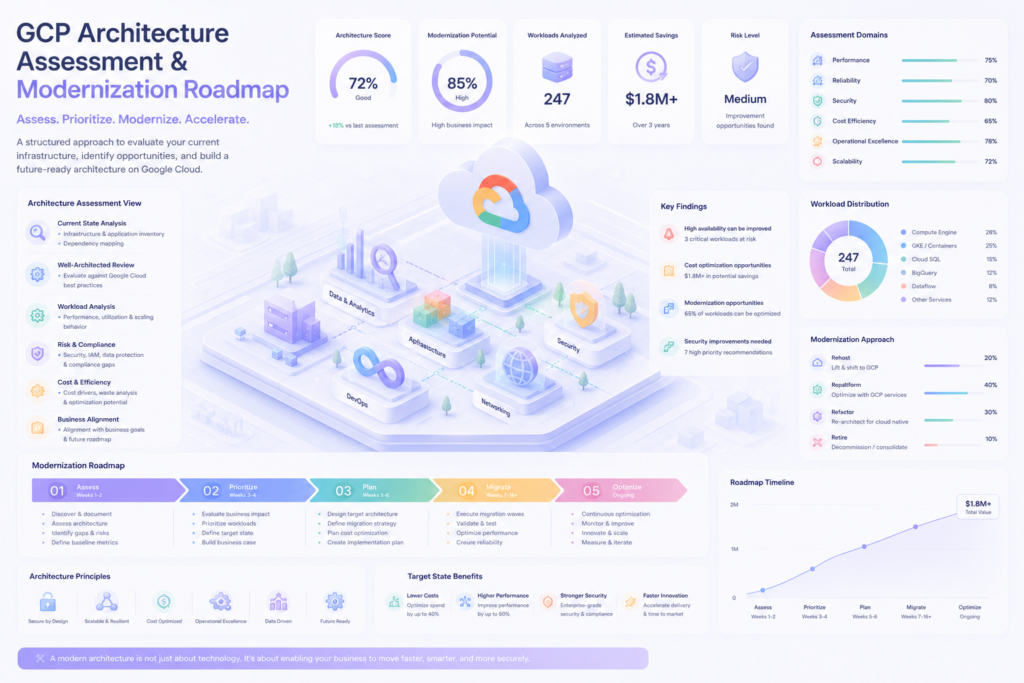
Deliverables: The Action Plan Depending on system scale, the audit requires 2 to 4 weeks. The final deliverable is a comprehensive technical document containing three core sections:
- Root-Cause Analysis: Objective evidence of systemic issues, backed by platform metrics, query execution plans, and configuration screenshots.
- Business Impact: Quantifiable metrics detailing exactly how these inefficiencies impact operational costs and processing latency.
- Remediation Roadmap: A prioritized, step-by-step engineering plan to resolve each vulnerability and bottleneck.
This roadmap can be executed by your internal engineering team, or the modernization workload can be delegated to me. The objective is to restore total technical and financial control over your GCP environment.
Project Boundaries (Out of Scope) To ensure stability, I do not make any write-level changes to your production code or cloud configurations during the audit phase. Penetration testing (ethical hacking) of your external web applications is also excluded, as the focus is purely on internal cloud architecture and data pipelines.
Architectural Trade-offs and Risks
- Engineering Time Investment: To thoroughly reverse-engineer undocumented logic, I will need context. This requires approximately 2 to 4 hours per week of sync time with your Lead Engineer.
- Security vs. Legacy Operations: Enforcing the Principle of Least Privilege in the modernization phase will likely break legacy automated scripts that currently operate with excessive administrative rights.
- Technical Debt Realization: Deep audits frequently expose structural flaws in foundational data models. Consequently, the remediation roadmap may require a fundamental rewrite of core logic, rather than superficial configuration adjustments.