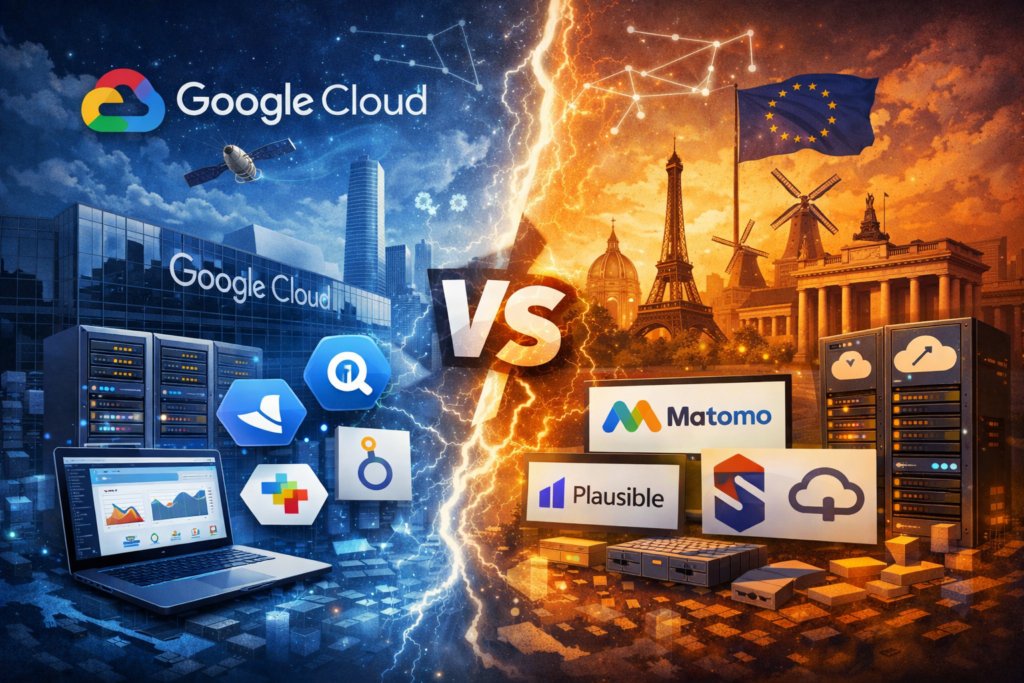
Comparison of the Google Stack (Server-Side Tag Manager, Cloud Run, BigQuery, Dataform, Looker Studio) with Leading European Solutions
Modern Marketing Attribution Architectures: A Comparative Analysis of the Google Stack and Leading European Solutions
Introduction
In the increasingly complex digital marketing environment in Europe, accurate marketing attribution is no longer just a requirement; it is critical for companies of any size. Omnichannel funnels, stricter privacy regulations, GDPR, the deprecation of third-party cookies, and data fragmentation across platforms demand new architectural approaches for collecting, processing, and analyzing user data. Complex technology stacks are emerging to solve this, combining server-side tag managers, cloud computing, scalable event data warehouses, ETL processes, and modern BI tools for visualization and decision-making.
This report provides a deep comparative analysis of the Google stack (Server-Side Tag Manager, Cloud Run, BigQuery, Dataform, Looker Studio) against three leading European solutions: Adobe Experience Platform (AEP), Snowflake + Segment (CDP) + BI (Looker/Tableau), and Tealium (EventStream + AudienceStream). It evaluates architectural features, targeted problems, real-world implementation cases, advantages and disadvantages, implementation timelines, costs, user feedback, target audiences, selection criteria, legal compliance, and integration risks.
Problem Statement: Modern Marketing Attribution Challenges in Europe
Omnichannel and Data Fragmentation
Modern marketing in Europe is highly omnichannel: users interact with brands via websites, mobile apps, emails, social networks, offline stores, call centers, and other channels. Each channel generates its own data, often in isolated formats and with different user identification logic. This causes data fragmentation and makes it difficult to map a unified customer journey.
Limitations of Traditional Attribution Models
Traditional rule-based models (last click, first click, linear, U-shaped, time decay) fail to reflect the actual contribution of channels, especially in long and complex sales funnels. They tend to overvalue “closing” touchpoints and ignore the impact of upper and middle funnel stages. This leads to inefficient marketing budget allocation and incorrect strategic decisions.
Stricter Privacy and Compliance Requirements
GDPR, ePrivacy, and local laws (e.g., in Germany, France, Ukraine) enforce strict rules on the collection, storage, and processing of personal data. Browsers actively block third-party cookies, and platforms (such as Apple and Google) introduce additional tracking restrictions. This forces businesses to transition to first-party data, server-side tracking solutions, and transparent user consent management.
The Need for End-to-End Analytics and a Data-Driven Approach
Businesses must look beyond basic conversions to understand which channels actually impact sales, Lifetime Value (LTV), Customer Acquisition Cost (CAC), and retention. This requires end-to-end data pipelines that integrate data from advertising platforms, CRM systems, ERPs, call tracking, and offline sources, with the ability to flexibly transform, model, and visualize the results in a unified dashboard.
Google Stack Architecture: Server‑side Tag Manager + Cloud Run + BigQuery + Dataform + Looker Studio
General Scheme and Logic
The Google stack is built on a modular, cloud-native architecture. Each component is responsible for a specific data processing stage:
- Server‑side Tag Manager (sGTM): A server-side container for collecting and routing events from websites, applications, and external sources.
- Cloud Run: A serverless platform for the scalable and fault-tolerant execution of containers (including sGTM).
- BigQuery: A cloud event data warehouse supporting partitioning, clustering, and SQL analytics.
- Dataform: A tool for building and orchestrating ETL/ELT processes, transforming raw data into analytical data marts.
- Looker Studio: A BI platform for visualization and building interactive attribution dashboards and reports.
Architectural Workflow:
- Events from a website or app are sent to the sGTM server container hosted on Cloud Run, rather than directly to an analytics system.
- sGTM processes, filters, enriches, and routes the data (e.g., sending part of the flow to Google Analytics 4 and part to BigQuery).
- BigQuery accumulates raw event-level data.
- Dataform pipelines process this data (aggregation, attribution calculations, and building data marts).
- The finalized data marts are connected to Looker Studio to build dashboards covering attribution models, LTV, CAC, ROI, etc.
Server‑side Tag Manager: Role, Advantages, and Limitations
- Role: sGTM acts as the central hub for event collection. It provides control over the data flow, enabling filtering, enrichment, and routing to required systems (GA4, BigQuery, third-party APIs).
- Advantages:
- Bypassing browser blocks and adblockers: Data is sent from the server, improving data collection completeness.
- Enhanced privacy: Enables PII filtering, data anonymization, and consent management directly on the server.
- Routing flexibility: Supports data transmission to any system (GA4, Facebook CAPI, CRM, etc.).
- Reduced client-side load: Fewer browser scripts result in better website performance.
- Limitations:
- Setup complexity: Requires DevOps and Data Engineering expertise to deploy and maintain.
- Cloud resource costs: High traffic volumes can lead to significant Cloud Run expenses.
- Limited out-of-the-box support: Some third-party integrations require custom clients or tags.
Cloud Run and the Compute Layer
Cloud Run provides horizontal scaling for sGTM containers, automated instance management, high availability, and a pay-as-you-go pricing model.
- Advantages: Autoscaling without manual infrastructure management; 99.95% SLA with multi-region support; pay strictly for allocated resources (CPU, RAM, requests).
- Cost Estimate: For 10 million requests per month (400ms average latency, 1 vCPU, 512 MB RAM), the cost is ~$13–18/month (excluding free tier limits). CPU-intensive tasks can range from $80–100/month.
BigQuery for Event Data
BigQuery is a fully managed, serverless warehouse for event data, supporting SQL analytics, partitioning, clustering, materialized views, and BI integration.
- Key Aspects: Strict data schemas (supporting nested RECORDS and REPEATED arrays), partitioning and clustering for query optimization, and petabyte scalability.
- Cost Structure: $0.02 per GB of storage and $5 per TB of scanned data (after free limits).
- Optimization Practices: Selecting only required columns (
SELECT ...), partition filtering, using materialized views, and running dry-runs for query cost estimation.
Dataform and Transformation Pipelines
Dataform builds, tests, and orchestrates SQL-based ETL/ELT processes in BigQuery.
- Capabilities: Declares table dependencies, writes transformations in SQLX (SQL with JavaScript support), automates data quality testing and versioning, orchestrates via Git and CI/CD, and visualizes dependency trees.
- It is highly effective for attribution pipelines: aggregating events, calculating touchpoint chains, applying models (last click, data-driven, Shapley, Markov), and preparing data marts for BI.
Attribution Models and Methodologies
The Google stack supports both standard rule-based models (last click, first click, linear, time decay, position-based) and advanced data-driven approaches:
- Data-driven attribution: Machine learning applied to actual user paths, evaluating the contribution of each channel based on conversion and non-conversion statistics.
- Incrementality: Geo-testing and audience splits to evaluate actual channel uplift.
- Media Mix Modeling (MMM): Regression analysis on historical data to account for offline channels, seasonality, and external factors.
Visualization and Reporting: Looker Studio
Looker Studio is a free BI platform for building interactive dashboards and visualizing data from BigQuery, Google Sheets, advertising platforms, and other sources.
- Advantages: Native BigQuery integration, drag-and-drop interface, automated data updates, granular access control, and Google Workspace integration.
- Limitations: Complex data marts and massive datasets require pre-aggregation in BigQuery; it lacks the advanced OLAP operations available in enterprise tools like Looker (Core) or Tableau.
Real-World Implementations of the Google Stack
Case 1: End-to-End Analytics for B2B/B2C Retail
- Problem: Inability to link call data, order records, and advertising expenditure to evaluate channel efficiency accurately.
- Solution: Deployment of an end-to-end analytics pipeline based on a cloud data warehouse (BigQuery or ClickHouse). Integration of data from advertising platforms, call tracking systems, CRMs, and ERPs. Execution of SQL scripts to merge datasets, build data marts, and visualize outputs in BI tools (Looker Studio, DataLens).
- Result: Transparent tracking across all funnel stages, an increased share of B2B leads, marketing spend optimization, and fully automated reporting.
Case 2: Attribution in Content Marketing
- Problem: Data fragmentation across multiple channels and the inability to assess the exact contribution of content to final conversions.
- Solution: Pipeline construction utilizing sGTM for event collection, BigQuery for raw data storage, Dataform for data transformation, and Looker Studio for visualization. Application of data-driven models to evaluate content efficiency.
- Result: Identification of the highest-performing channels and content types, data-backed budget reallocation, and measurable growth in conversions and ROI.
Comparison with Leading European Solutions
Brief Overview of Alternatives
| Solution | Description |
| Adobe Experience Platform (AEP) | A customer experience management platform covering real-time data collection, unification, segmentation, analytics, and activation. Features AI and MMM support, with native integration into the Adobe Marketing Cloud. |
| Snowflake + Segment + BI | A modular, best-of-breed architecture. Snowflake operates as the cloud DWH, Segment acts as the CDP for event routing, and Looker/Tableau serves as the BI layer. Provides high integration flexibility and supports complex pipelines. |
| Tealium (EventStream + AudienceStream) | An independent CDP platform designed for real-time data collection, unification, segmentation, and activation. Features robust server-side tracking, over 1,300 integrations, built-in ML modules, and a strict focus on privacy. |
Key Solution Characteristics
| Criterion | Google Stack (sGTM + Cloud Run + BQ + Dataform + Looker Studio) | Adobe Experience Platform (AEP) | Snowflake + Segment + BI (Looker/Tableau) | Tealium (EventStream + AudienceStream) |
| Architecture Type | Modular, cloud-native, utilizing open-source components | Unified platform, PaaS | Modular, best-of-breed | CDP + server-side tagging |
| Server-Side Tracking | sGTM (via Cloud Run) | Adobe Tags (Launch) | Segment, Tealium | EventStream |
| Event Storage | BigQuery | AEP Data Lake | Snowflake | Tealium Data Layer |
| ETL / ELT | Dataform (SQLX) | Data Prep, AI | dbt, custom SQL | Tealium Functions |
| Attribution Models | Rule-based, data-driven, ML, MMM | Rule-based, AI, MMM | Rule-based, ML, MMM | Rule-based, ML |
| Visualization | Looker Studio (free version), Looker (Core) | Adobe Analytics, Power BI | Looker, Tableau | Tealium Dashboards, BI |
| GDPR / Local Laws | Fully supported, EU data residency configuration | Built-in governance mechanisms | Highly configurable | Privacy by design |
| Cost Structure | Pay-as-you-go, includes free-tier components | Enterprise licensing, custom pricing | Pay-as-you-go DWH + SaaS licenses | Enterprise licensing, custom pricing |
| Implementation Timeline | 2–8 weeks | 2–6 months | 2–12 weeks | 2–6 weeks |
| User Feedback | 85% Positive / 15% Negative | 94% Positive / 6% Negative | 90% Positive / 10% Negative | 92% Positive / 8% Negative |
| Target Audience | SMB, mid-market, digital-native companies | Enterprise, large-scale brands | Mid-market, enterprise | Mid-market, enterprise |
| Primary Selection Drivers | Flexibility, low barrier to entry, open-source nature | Native integrations, AI capabilities, vendor support | Pipeline flexibility, massive scale, BI power | Data privacy, real-time activation, integration volume |
Detailed Analysis of Alternatives
1. Adobe Experience Platform (AEP)
- Architecture: A unified platform handling data collection, unification, segmentation, analysis, and activation. It incorporates a Data Lake, Real-Time CDP, AI/ML tools, MMM, and native integrations with Adobe Marketing Cloud and third-party BI solutions.
- Advantages:
- Single Source of Truth: All customer data is unified into real-time profiles.
- AI/ML Capabilities: Built-in tools for predictive analytics, MMM, and automated segmentation.
- Ecosystem Integration: Deep integration with Adobe Marketing Cloud for audience activation, personalization, and omnichannel campaigns.
- Data Governance: Advanced mechanisms for access control, privacy management, and auditing.
- Disadvantages:
- High Cost: Licensing, deployment, and maintenance costs restrict this strictly to the enterprise segment.
- Implementation Complexity: Requires a lengthy deployment cycle, specialized training, and complex integration setups.
- Closed Ecosystem: Limited flexibility when building custom data pipelines outside the Adobe infrastructure.
- Audience: Large brands and enterprise-level companies with mature marketing operations, significant budgets, and the need for a single centralized platform.
2. Snowflake + Segment (CDP) + BI (Looker/Tableau)
- Architecture: A modular, best-of-breed approach. Snowflake acts as the central cloud DWH, Segment functions as the CDP for event collection and routing, and Looker or Tableau provides the BI layer for visualization and analysis.
- Advantages:
- Flexibility: Allows the construction of pipelines of any complexity and the integration of virtually any data source.
- Scalability: Snowflake provides petabyte-scale processing, auto-scaling, and a strict pay-as-you-go model.
- Advanced Analytics: Looker and Tableau are market leaders supporting complex analytical models and custom data marts.
- Attribution Support: Capable of executing rule-based, data-driven, MMM, and ML models.
- Disadvantages:
- Integration Complexity: Demands heavy Data Engineering expertise to configure and maintain the pipelines.
- Cost Accumulation: The combined licensing costs for Snowflake, Segment, and enterprise BI tools can be prohibitive for SMBs.
- Responsibility Fragmentation: Utilizing multiple vendors complicates troubleshooting and integration management.
- Audience: Mid-market to enterprise companies with in-house Data Engineering teams requiring high flexibility and deep customization.
3. Tealium (EventStream + AudienceStream)
- Architecture: An independent CDP platform featuring server-side tracking, real-time data unification, segmentation, and activation. It includes over 1,300 out-of-the-box integrations, ML modules, and operates on a “privacy by design” framework.
- Advantages:
- Privacy by Design: Strong emphasis on compliance, fully supporting GDPR, CCPA, HIPAA, and ISO standards.
- Real-Time Processing: Instant profile updates and trigger-based campaign activation.
- Integration Flexibility: Connects to web, mobile, IoT, and offline sources via an extensive connector library.
- ML Modules: Built-in predictive analytics, scoring, and automated segmentation.
- Disadvantages:
- Cost: Enterprise-tier pricing for licenses and support.
- Configuration Complexity: Requires vendor-specific training, integration setup, and ongoing maintenance.
- Customization Limits: Complex custom ETL processes require significant workarounds compared to native SQL environments.
- Audience: Mid-market to enterprise companies with stringent data privacy requirements and a critical need for real-time data activation.
Advantages and Disadvantages of Solutions
| Solution | Advantages | Disadvantages |
| Google Stack | High flexibility, open-source foundations, low entry cost, rapid deployment, server-side support, high scalability, free BI layer. | Requires technical expertise, lacks a unified single-pane-of-glass interface, limited native support for complex MMM, support provided primarily through partners. |
| Adobe AEP | Single unified platform, advanced AI/ML capabilities, native MMM, deep ecosystem integration, built-in privacy tools, dedicated vendor support. | High overall cost, extended implementation timelines, architectural complexity, closed ecosystem. |
| Snowflake + Segment + BI | Exceptional flexibility, petabyte scale, powerful BI capabilities, native support for custom complex models. | High integration complexity, cumulative licensing costs, responsibility fragmentation across multiple vendors. |
| Tealium | Privacy by design, real-time activation, broad integration ecosystem, built-in ML capabilities. | Enterprise pricing, steep setup learning curve, limitations when customizing complex ETL/ELT pipelines. |
Implementation Timelines and Project Stages
| Solution | Implementation Stages | Estimated Timeline |
| Google Stack | 1. Data schema design 2. sGTM deployment (Cloud Run) 3. Website and mobile app integration 4. Dataform transformation setup 5. Dashboard development in Looker Studio 6. Testing and team training | 2–8 weeks (MVP) 1–3 months (Full deployment) |
| Adobe AEP | 1. Discovery and data audit 2. Enterprise architecture design 3. Data source integration 4. Data Lake, CDP, and AI module setup 5. Staff training and launch 6. Ongoing support and optimization | 2–6 months (MVP) 6–12 months (Full deployment) |
| Snowflake + Segment + BI | 1. Cloud DWH deployment 2. CDP setup and event routing 3. ETL/ELT pipeline construction 4. BI interface configuration 5. Testing and team training | 2–12 weeks (MVP) 2–6 months (Full deployment) |
| Tealium | 1. Data source integration 2. Server-side tracking setup 3. Segmentation and activation logic configuration 4. Visualization and reporting setup 5. Staff training and support enablement | 2–6 weeks (MVP) 1–3 months (Full deployment) |
Cost and Total Cost of Ownership (TCO)
| Solution | Licensing | Cloud Infrastructure Costs | Integration Expenses | Support & Maintenance | Estimated Annual TCO |
| Google Stack | Free (sGTM, Looker Studio), Dataform (Free tier / Cloud), BigQuery (Pay-as-you-go) | Cloud Run: $10–100/mo BigQuery: $0–500/mo (volume-dependent) | In-house technical resources or external agency | Subscription-based agency support | $2,000–$10,000 (SMB) $10,000–$50,000 (Mid-market) |
| Adobe AEP | Enterprise tier, custom contract (from $100,000/year) | Included in license | Included or managed via certified partners | Included in enterprise agreement | $100,000–$500,000+ |
| Snowflake + Segment + BI | Snowflake: $2K–$10K/yr Segment: $12K–$60K/yr Looker/Tableau: $3K–$30K/yr | Pay-as-you-go DWH execution costs | External integration partner | SaaS support subscriptions | $20,000–$100,000+ |
| Tealium | Enterprise tier, custom contract (from $50,000/year) | Included in license | Included or managed via certified partners | Included in enterprise agreement | $50,000–$200,000+ |
Reviews and Market Reputation
Google Stack
- Positive Sentiment (85%): (Based on G2, TrustRadius, and specialized engineering forums) Users highlight architectural flexibility, low cost barriers, rapid deployment, BigQuery processing capacity, and the accessibility of Looker Studio.
- Negative Sentiment (15%): Primary criticisms focus on deployment complexity, the necessity of strong in-house data engineering expertise, the absence of a single-vendor support desk, and functional constraints within free BI tier components.
Adobe Experience Platform (AEP)
- Positive Sentiment (94%): Praised for enterprise power, native AI/ML tooling, robust MMM capabilities, seamless Adobe cloud integrations, dedicated enterprise support, and built-in privacy mechanisms.
- Negative Sentiment (6%): Concerns center on high licensing costs, prolonged implementation cycles, and ecosystem rigidity (vendor lock-in).
Snowflake + Segment + BI
- Positive Sentiment (90%): Highly rated for design flexibility, petabyte-scale capacity, advanced BI customization, and native support for sophisticated attribution modeling.
- Negative Sentiment (10%): Users note high integration complexity, accumulating total software costs, and the ongoing operational necessity of an in-house data engineering team.
Tealium
- Positive Sentiment (92%): Strong reputation for its privacy-by-design framework, real-time data activation capabilities, extensive connector library, and built-in ML modules.
- Negative Sentiment (8%): Feedback points to steep enterprise pricing, complex initial setup procedures, and constraints when attempting to build custom, non-standard data transformations.
Target Audience and Selection Criteria
| Solution | Typical Client Profile | Primary Drivers for Selection |
| Google Stack | SMBs, digital-native companies, mid-market, agencies, startups | Architectural flexibility, low cost barrier, open-source integration, rapid deployment, vendor independence, complete data control. |
| Adobe AEP | Enterprise tier, large global brands, banking, retail, FMCG | Unified platform architecture, native AI/ML and MMM, dedicated enterprise support, robust privacy compliance, Adobe ecosystem integration. |
| Snowflake + Segment + BI | Mid-market, enterprise, technology companies, e-commerce | High flexibility, petabyte scalability, advanced BI capabilities, support for custom mathematical models, vendor independence. |
| Tealium | Mid-market, enterprise, organizations with strict privacy and real-time activation mandates | Privacy-by-design architecture, real-time processing, extensive connector library, built-in ML, robust server-side data routing. |
Legal Compliance: GDPR and Local Regulations
All evaluated solutions support EU data storage, retention policy configuration, data anonymization, Consent Management Platform (CMP) integration, and access auditing. Key engineering focal points include:
- Server-Side Tracking: Enables robust first-party data strategies, strict PII (Personally Identifiable Information) filtering, and server-side cookie management, isolating user data from browser vulnerabilities.
- Data Governance: Granular configuration of IAM roles, permissions, operational logging, and access auditing.
- Storage Localization: BigQuery, Snowflake, and Tealium natively support data residency in regions such as the EU, Germany, France, and Ukraine.
- CMP Integration: Native compatibility with Google Consent Mode and seamless integration with enterprise consent platforms like OneTrust and Cookiebot.
Migration and Integration Risks
Technical Risks:
- Complexity of migrating legacy data schemas and integrating with existing monolithic systems.
- The necessity for deep team upskilling and complete data pipeline re-engineering.
- Risk of data loss or corruption due to misconfigured ETL/ELT pipelines during the transition phase.
Organizational Risks:
- Internal resistance to change and the overhead of business process restructuring.
- Friction regarding the division of responsibility between IT, Data Engineering, and Marketing departments.
- Data silo creation and KPI misalignment inherent in decentralized data architectures.
Mitigation Practices:
- Execute pilot projects (MVP) and enforce a phased implementation strategy.
- Maintain strict documentation of data schemas and transformation logic, coupled with continuous team training.
- Deploy hybrid architectures (e.g., a centralized DWH feeding specialized local data marts) to balance control and flexibility.
Success Metrics and KPIs
Primary Metrics:
- Percentage of accurately attributed conversions and revenue.
- Attribution model accuracy (e.g., MAPE, $R^2$ for Media Mix Modeling).
- Data mart update latency.
- Measurable reduction in CAC, alongside growth in LTV and ROMI.
- Cross-channel data consistency and integrity.
- Total implementation time, Total Cost of Ownership (TCO), and system adoption rate.
Target Operational KPIs:
- Data pipeline latency (event collection to BI report availability) $< 1$ hour.
- Share of deterministically or statistically attributed conversions $> 90\%$.
- Reduction in manual data consolidation and reporting overhead $> 80\%$.
- ROI generated directly from data-driven budget reallocation $> 10\%$ within the first 6 months of deployment.
European Service Providers and Integration Agencies
- Google Partners: Jellyfish, Incubeta, Precis Digital, Artefact, Making Science.
- Adobe Partners: Accenture, Deloitte, Cognizant, Capgemini.
- Snowflake/Segment Partners: Slalom, Data Reply, Datalytyx, DataArt.
- Tealium Partners: Merkle, Dentsu, iProspect.
These integrators provide full-cycle engineering services: infrastructure audits, deployment, team training, custom attribution model development, and CRM/BI integration.
Architectural Patterns
- Centralized Approach: Utilizes a single core platform (BigQuery, Snowflake, or AEP). Ensures strict schema unification, standardized attribution logic, centralized data quality control, and highly transparent KPIs.
- Decentralized Approach: Relies on autonomous subsystems segmented by region or channel. Employs local models and federated interfaces. Offers high operational flexibility at the cost of complex data consolidation.
- Hybrid Approach: Combines a centralized core DWH with localized data marts. This is the industry standard for large-scale operations managing multiple regional markets and disparate marketing channels.
Conclusion and Engineering Recommendations
The Google Stack (sGTM + Cloud Run + BigQuery + Dataform + Looker Studio) represents the optimal architectural choice for SMBs, digital-native companies, mid-market entities, and agencies prioritizing infrastructure flexibility, rapid deployment speed, low entry costs, and data sovereignty. It facilitates the construction of end-to-end attribution pipelines, enforces server-side tracking, scales dynamically to handle varying workloads, and integrates natively with modern BI and external APIs. The primary constraints are the prerequisite for solid Data Engineering expertise, the lack of centralized vendor support, and the functional limits of free-tier BI components.
Adobe Experience Platform is strictly an enterprise-grade solution. It targets organizations requiring a unified platform with out-of-the-box AI/ML, native MMM, and deep ecosystem integration. The substantial financial investment and extended deployment cycles are justified only for large brands managing massive budgets and highly complex, global sales funnels.
Snowflake + Segment + BI delivers a best-of-breed modular architecture. It is suited for organizations possessing robust in-house Data Engineering teams that demand maximum pipeline flexibility, support for custom mathematical modeling, and enterprise-grade BI analytics without vendor lock-in.
Tealium is the optimal deployment for companies operating under strict privacy compliance frameworks (e.g., highly regulated industries) that require immediate real-time data activation and extensive out-of-the-box integration capabilities.
Deployment Directives:
- Initiate deployment with a tightly scoped MVP; expand the architecture iteratively.
- Mandate server-side tracking as the default data collection method to ensure data completeness and enforce privacy controls.
- Implement SQL-based orchestrators (Dataform or dbt) to automate ETL/ELT workflows and enforce strict data quality testing.
- Allocate resources for continuous team upskilling and mandatory technical documentation.
- Evaluate solutions based on TCO, system agility, and robust privacy compliance, rather than isolated licensing costs.
- For enterprise deployments, default to hybrid architectures that bridge a centralized DWH with agile local data marts.
Future marketing attribution architectures mandate flexible, scalable, privacy-first engineering. The integration of server-side data routing, cloud-native DWHs, automated transformation pipelines, and advanced BI layers (supported by AI/ML and MMM) is the technical baseline. The selection of a specific stack must align strictly with the organization’s technical maturity, operational scale, available engineering resources, and strategic data objectives.
We build, migrate, and optimize cloud data pipelines on Google Cloud Platform. From BigQuery query optimization to custom ingestion architectures, explore our Data Engineering on GCP services.