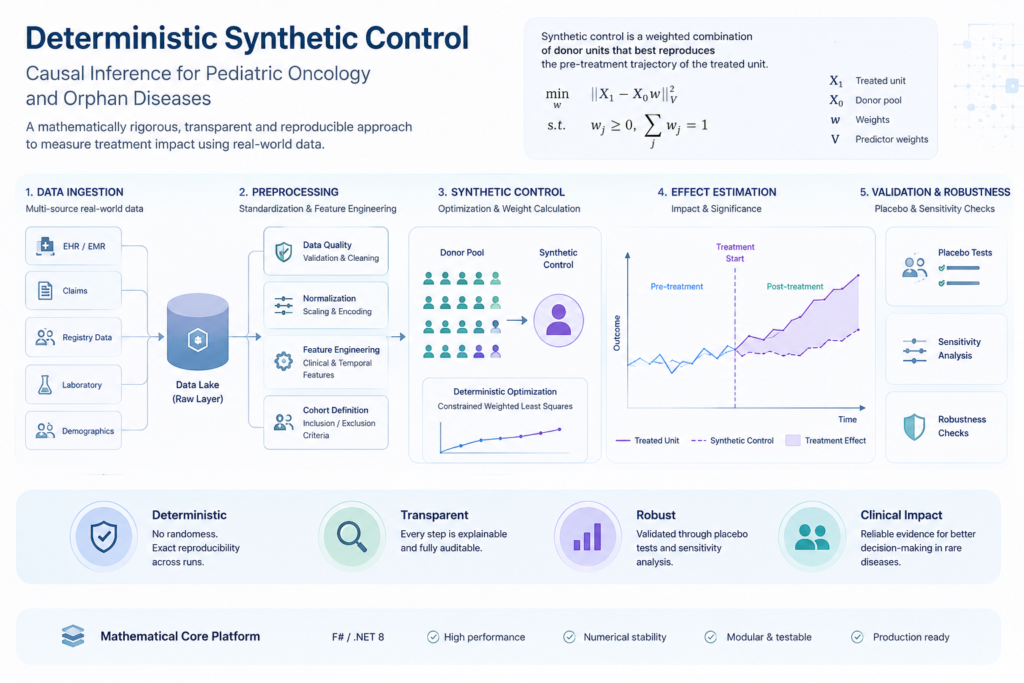
The pharmaceutical industry requires mathematically rigorous, FDA-compliant analytical engines to generate Real-World Evidence (RWE). Traditional solutions rely heavily on manual R/SAS scripting by internal biostatisticians or opaque, service-heavy Contract Research Organizations (CROs). Both approaches introduce human error, prolonged timelines, and compliance risks.
Tech Macro has engineered a paradigm shift: a functionally pure, deterministic Synthetic Control Arm (SCA) mathematical engine built on F#. However, unlike rigid SaaS platforms, our primary advantage is bespoke customization. We do not just sell software; we deliver a fully tailored analytical pipeline designed exclusively for your Google Cloud Platform (GCP) environment. Operating on a Bring-Your-Own-Data (BYOD) model, this solution delivers computational reproducibility, automated data ingestion, and seamless SAS interoperability, all without ever compromising your data perimeter.
1. The Algorithm & Absolute Regulatory Compliance
The core of our product is the SCA.Core engine, architected under our Strict Mode v4.0 framework. By utilizing F# (a functional-first language), the engine is immutable, stateless, and entirely deterministic.
- Mathematical Precision: It relies on a tiered Dynamic Flow Management Engine (DFME). The primary algorithm, Overlap Weights (OW), guarantees exact covariate balance without the extreme variance common in Inverse Probability of Treatment Weighting (IPTW).
- Execution Speed: Compiled functional code replaces slow, interpretive scripts, compressing complex statistical balancing into millisecond execution times.
- Regulatory Superiority (FDA/EMA): The engine is built from the ground up to satisfy the strictest regulatory frameworks, including FDA 21 CFR Part 11 (electronic records and audit trails) and GAMP 5 validation principles. By eliminating stochastic non-determinism and network calls during runtime, it prevents “p-hacking.” If provided the same random seed and dataset, it will produce bit-for-bit identical hazard ratios a decade later, directly aligning with the latest EMA guidelines on Real-World Data reproducibility.
2. The End-to-End Data Pipeline: From Raw EHR to UI-Agnostic Reporting
We have engineered a seamless data conveyor that connects the chaos of clinical data to any modern BI interface. The pipeline operates entirely within your GCP ecosystem:
- Phase A: Automated Ingestion via Healthcare API. Clinical data is locked in unstructured formats like FHIR, HL7v2, or DICOM. We natively integrate the Google Cloud Healthcare API to ingest, standardize, and automatically de-identify this data (stripping PHI for immediate HIPAA/GDPR compliance), streaming flattened resources directly into Google BigQuery.
- Phase B: Data Preparation & Emulation. Within BigQuery, custom dbt/SQL pipelines clean the data, resolving zero-time alignment and formatting it into a Strict Mode matrix.
- Phase C: Millisecond Execution. The F# engine, hosted in Cloud Run, consumes the matrix, performs the causal inference balancing, and returns the enriched results.
- Phase D: UI-Agnostic Consumption. The final output (weights, metrics, flags) is written back to BigQuery. Because BigQuery serves as the single source of truth, you can connect any UI/UX interface—whether it is Looker, Tableau, or a custom-built web application via the BigQuery API. This architecture allows your teams to execute infinite re-runs, build dynamic dashboards, and generate clinical reports using the visualization tools they already know.
3. Therapeutic Focus & Scalability
The engine is universally applicable to any Time-to-Event (survival) causal inference study.
- Target Domains: While architected to solve extreme biostatistical challenges in rare diseases and pediatric oncology, it is highly effective across neurology, cardiology, and immunology.
- Sample Size Capacity: It handles minimum thresholds of $N = 20$ (deterministically triggering a Bayesian HMC/NUTS fallback) up to cohorts exceeding $N = 100,000+$ patients in milliseconds, thanks to the $O(N)$ asymptotic complexity of the OW algorithm.
4. Architectural Trade-offs & Operational Limitations
Engineering integrity requires acknowledging system constraints. This engine is a strict mathematical pipeline, not a general-purpose AI.
- The Data Quality Gate (DQG): The engine enforces a strict “Garbage In, Fail Fast” policy. It does not perform predictive imputation for missing critical variables. If data matrices contain missing critical covariates, the engine halts immediately and issues a Remediation Log, demanding perfectly clean data to guarantee FDA-compliant output.
- Endpoint Constraints: The engine is exclusively optimized for Time-to-Event (Survival) data and is currently not designed for continuous outcome analysis (e.g., measuring linear blood pressure reduction).
5. Upgrade Roadmap: 6 Selectable Application Modules
While the mathematical core remains structurally frozen for compliance, clients can choose to purchase and integrate any combination of six specialized Explainable AI (XAI) modules to extend the engine’s capabilities:
- SAS Interoperability & Verification Module: Designed for traditional biostatistics teams. This module automatically generates native SAS scripts alongside the JSON output. It allows your internal teams to independently validate the F# core’s deterministic weights mathematically within their familiar SAS environment, bridging the gap between modern architecture and legacy compliance.
- Synthetic Twin Explainer: Utilizes Gower and Mahalanobis distances to identify the top 3–5 geometrically matched historical patients for each trial subject, displaying human-readable clinical profiles.
- Regulatory Transparency Dashboard: Provides full traceability by visualizing the DFME cascade, CoreErrors, Diagnostic Flags, and the exact Random Seed injected for FDA/EMA audits.
- RMST Clinical Narrator: Automatically translates complex survival metrics (sRMST, HR) into natural clinical language (e.g., “Risk of progression reduced by 28%”).
- Uncertainty & Robustness Panel: Consolidates metrics like Effective Sample Size (ESS) and Proportional Hazards (PH) diagnostic status to provide an honest picture of statistical reliability.
- Patient-Level Impact Explorer: Executes leave-one-out sensitivity analysis, proving to regulators that the trial’s success is deeply grounded in the cohort and not driven by a single outlier.
6. The Procurement Cycle: Fixed-Fee Customization & Total IP Transfer
We completely reject the traditional SaaS model that locks your data into third-party servers, as well as the unpredictable “Time & Material” billing of consulting agencies. Our Go-To-Market model is built on risk elimination and absolute client ownership:
- Phase 1: Free Proof of Concept (PoC). You provide an obfuscated sample dataset. We run the engine to prove execution speed, validation behavior, and output quality at zero cost.
- Phase 2: Bespoke Project Customization. We customize the entire pipeline—from BigQuery ETL scripts to engine parameters—specifically for your unique clinical data structures.
- Phase 3: In-VPC Deployment & Total Handover. We deploy the customized containerized engine directly into your GCP VPC. Upon project completion, all rights, documentation, and operational keys are fully transferred to you. * Transparent Fixed Pricing: The entire setup is executed under a negotiated, fixed-fee contract. Once deployed, the project operates entirely within your own cloud resources with zero external dependencies and no recurring subscription fees to us.
This model guarantees that you are paying for a bespoke technological asset, achieving mathematical precision, total infrastructure autonomy, and unmatched Time-to-Market.