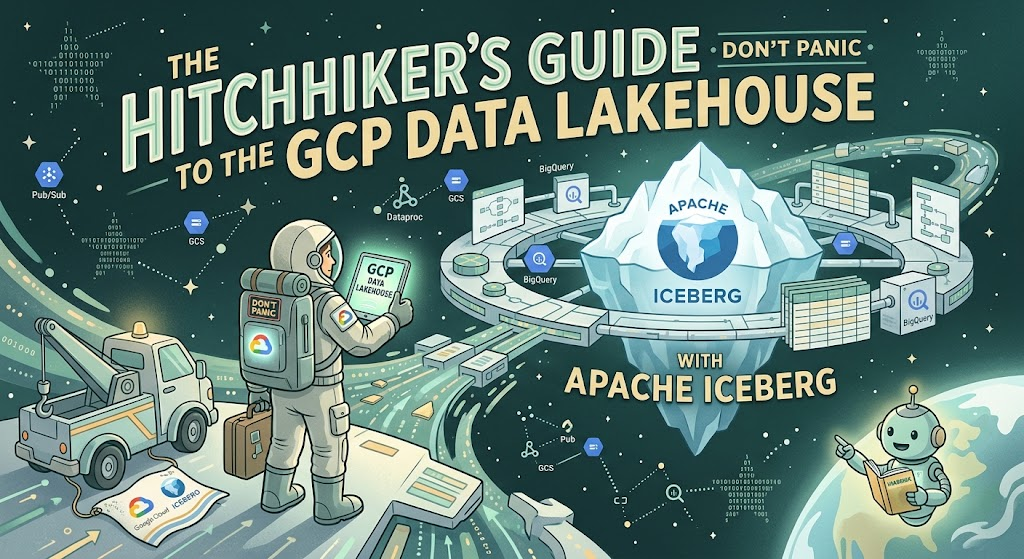
The Hitchhiker’s Guide to the GCP Data Lakehouse (Apache Iceberg)
Let’s call a spade a spade: “AI-Native Borderless Lakehouse” is a sexy marketing slogan. In plain engineering terms, it means Google Cloud Storage (GCS) + Apache Iceberg + BigQuery (BigLake) + Vertex AI.
Historically, you had two choices. You could use a Data Warehouse (BigQuery)—like a high-end restaurant: the food is strictly categorized, the service is incredibly fast, but the bill will make you cry. Or, you could use a Data Lake (Cloud Storage)—like a massive landfill: it costs pennies, you can throw anything in there, but finding a specific item requires a search party.
The Data Lakehouse is the golden middle. It’s a food court with a strict health inspector. You keep the dirt-cheap storage of a Data Lake, but you bolt on the transactional guarantees (ACID), schema enforcement, and SQL capabilities of a Data Warehouse.
1. How the Magic Actually Works (Under the Hood)
To understand the Lakehouse, you must understand its brain: Apache Iceberg.
Iceberg is not a storage engine; it is an open-source table format. Imagine you have petabytes of raw Parquet files scattered across GCS buckets. Normally, BigQuery would have to scan everything to find what it needs (costing you a fortune).
Iceberg solves this by introducing a Metadata Layer.
- Snapshots: Every time you write data, Iceberg creates a snapshot.
- Manifest Lists & Manifest Files: These are basically highly detailed maps. They tell the compute engine exactly which Parquet files belong to which table version, and they hold statistics (e.g., “File A contains dates from Jan 1 to Jan 31”).
The Causal Chain of Performance:
Because BigQuery reads the Iceberg metadata map first, it can perform Data Pruning. It simply ignores 99% of the files that don’t match your SQL WHERE clause. You get blindingly fast queries on cheap object storage without loading the data into BigQuery’s native, expensive storage.
2. When to Use It (The Sweet Spots)
Do not use this architecture just because it is trendy. Use it when logic dictates it.
- The Multi-Cloud Reality (Zero-ETL): Your company acquired a startup that uses AWS. Their data is in S3. Instead of building fragile data pipelines to copy terabytes of data over the internet to GCP (and paying massive egress fees), you use BigQuery Omni. It sends the SQL query to AWS, computes it there, and brings back only the result. You leave the data where it lives.
- The ML Beast (AI-Native): Data Scientists hate SQL; they love Python. Instead of copying data from BigQuery into Pandas dataframes (creating a security nightmare and hitting memory limits), Vertex AI connects directly to Iceberg tables via the Storage Read API. The neural network eats the data directly from the bucket at high-throughput gRPC speeds.
- The Data Mesh Architecture: You have 50 different departments. You want them to own their data in their own GCS buckets, but you need a central place to control who sees what. You wrap the Iceberg tables in Dataplex (GCP’s governance tool) to enforce row-level and column-level security across the whole company.
3. Anti-Patterns (When to Run Away)
- Transactional Applications (OLTP): If you are building a backend for a mobile app where thousands of users are inserting 1-row updates every millisecond, Iceberg will die. It is for analytical processing (OLAP), not for your web-store checkout system. Use Cloud SQL or Spanner.
- Sub-second Latency Dashboards: If your CEO wants a dashboard that refreshes in 100 milliseconds, Iceberg on GCS is the wrong tool. Network latency and metadata parsing take time. For this, you need native BigQuery tables or an in-memory database like Redis.
- Tiny Datasets: If your entire database is 50 GB, please stop over-engineering. Just load it into native BigQuery. The overhead of managing Iceberg metadata on small data is like hiring a logistics corporation to deliver a single pizza.
4. Strengths vs. Weaknesses (The Brutal Truth)
| The Good (Strengths) | The Ugly (Weaknesses) |
| No Vendor Lock-in: Iceberg is open-source. If Google makes you angry, you can point AWS Athena or Snowflake at the exact same GCS buckets tomorrow. | Performance Penalty: It will always be slightly slower than native BigQuery storage (Capacitor format), which is physically optimized on Google’s SSDs. |
Time Travel: Someone accidentally dropped a table? Iceberg keeps snapshots. You can run SELECT * FROM table FOR SYSTEM_TIME AS OF 'yesterday'. | The Maintenance Tax: Iceberg is not completely “set it and forget it.” It requires background maintenance (compaction) to keep it healthy. |
| Schema Evolution: You can add, drop, or rename columns without rewriting the entire petabyte-scale table. | Complexity: You are introducing more moving parts. You need to understand Dataplex, BigLake connections, and Iceberg metadata concepts. |
5. FinOps: The Cost and Management Reality
In the cloud, every architecture is a financial decision. Here is the math behind the Lakehouse:
Where you save money:
- Storage: GCS is significantly cheaper than native BigQuery active storage.
- Egress: BigQuery Omni prevents you from paying AWS/Azure data-transfer-out fees because the data never leaves their region.
Where you bleed money (The Hidden Costs):
- BigLake Compute: You still pay BigQuery compute costs (per TB scanned or per slot) when querying Iceberg tables.
- Omni Premium: Running BigQuery compute inside AWS/Azure (Omni) is more expensive per slot than running it natively in GCP.
- Automated Maintenance: Google offers “Managed Iceberg,” which automatically cleans up your tables. It’s brilliant, but Google charges you compute time for these background jobs. If your tables are highly mutable (lots of small updates), your maintenance bill will skyrocket.
6. The Arena: Comparing the Titans
Let’s put the GCP Iceberg Lakehouse next to its main rivals.
| Feature | GCP Lakehouse (BigLake + Iceberg) | Databricks (Delta Lake) | Snowflake |
| Core Philosophy | Serverless SQL & Open Storage | Code-first (Python/Spark) & Delta | All-in-one SaaS Blackbox |
| Primary Persona | Data Analyst / SQL Engineer | Data Engineer / ML Scientist | Business Analyst |
| Storage Format | Apache Iceberg (Open) | Delta Lake (Linux Foundation, but Databricks controlled) | Proprietary (Micro-partitions) |
| Management | Mostly Serverless (Fully managed compute) | Requires cluster tuning (unless using Serverless SQL) | Fully managed (Zero tuning) |
| Cost Predictability | High (if using Slot pricing) | Low (DBU + VM costs + Spot instances tuning) | Medium (Credits burn fast) |
| Best For… | Heavy SQL users deep in the Google ecosystem. | Complex ETL pipelines, streaming, heavy Python. | Companies that want zero infrastructure management. |
7. Battle-Tested Scenarios: From Theory to Practice
How do we actually build this? Let’s look at three standard business cases.
Scenario A: The Multi-Cloud Log Aggregator
The Problem: Your ad-tech platform generates 10 TB of logs daily. European traffic goes to AWS S3, US traffic goes to GCP GCS. You need a unified daily report.
The Implementation:
- Do NOT move the AWS data.
- Create an AWS IAM role and link it to GCP.
- Create a BigLake Omni connection in BigQuery pointing to the S3 bucket.
- Define both datasets as external Apache Iceberg tables in BigQuery.
- Write a standard SQL
JOINorUNION ALLacross both tables.The Result: BigQuery distributes the compute. The AWS part of the query runs in AWS, the GCP part runs in GCP. Only the final aggregated numbers cross the ocean.
Scenario B: The GDPR Deletion Nightmare
The Problem: You have 5 years of user events in a Data Lake (Parquet files). Under GDPR, a user asks you to delete their data. In traditional Parquet, you have to rewrite entire files (gigabytes of data) just to delete one row.
The Implementation:
- Upgrade the raw Parquet tables to Iceberg tables via BigQuery.
- When the GDPR request comes in, execute a simple
DELETE FROM my_iceberg_table WHERE user_id = 123;in BigQuery.The Result: Iceberg performs a “Merge-on-Read”. It doesn’t rewrite the massive historical file immediately. It simply writes a tiny “delete file” noting that row 123 is dead. The query engine logically hides that row going forward. You save thousands of dollars on compute.
Scenario C: The Feature Store for Vertex AI
The Problem: Data scientists are complaining that downloading data from BigQuery to train their TensorFlow models takes 4 hours.
The Implementation:
- Data engineers use dbt to transform raw data and materialize the final clean features as an Iceberg table on GCS.
- Data scientists use Vertex AI Notebooks.
- Using the
google-cloud-bigquery-storagePython client, they read the Iceberg table directly into a PyArrow table.The Result: Because they bypass the standard BigQuery REST API and use the Storage API (which streams data via gRPC directly from the storage nodes), data loading drops from 4 hours to 15 minutes.
8. Welcome to Hell: Standard Errors and Bugs
Nothing is perfect. When you build this, you will step on rakes. Here are the most common ones and how to survive them.
Trap #1: The “Small Files” Nightmare
- The Bug: You are streaming data into Iceberg every minute. After a week, your queries become incredibly slow.
- The Cause: Iceberg has created tens of thousands of tiny 50KB files. BigQuery spends more time opening and closing files than actually reading data.
- The Solution: You must run Compaction. In BigQuery, set up a scheduled query:
ALTER TABLE my_table SET OPTIONS (endpoint_compaction = true);. This tells Google to automatically merge tiny files into optimal 100MB+ chunks in the background.
Trap #2: Ghost Storage (The Exploding Bill)
- The Bug: You delete a lot of data from your Iceberg tables, but your Cloud Storage bill keeps growing.
- The Cause: Time Travel! Iceberg keeps every old snapshot and old data file just in case you want to query the past.
- The Solution: Vacuuming. You need to tell Iceberg to forget history older than X days. Run the SQL command:
CALL BQ.VACUUM_TABLE('dataset.my_table', 168);(This deletes files no longer needed by snapshots older than 168 hours / 7 days).
Trap #3: BigLake Connection Permission Denied
- The Bug: You create an external table, but users get an “Access Denied” error when querying, even though they have the
BigQuery Data Viewerrole. - The Cause: BigLake tables use a “Service Account delegation” model.
- The Solution: You must grant the BigLake Connection’s service account read access to the GCS bucket. Do not grant access to the individual users. The users only need access to the BigQuery table; BigQuery acts as the proxy to storage.
9. Conclusion: The Tech Macro Verdict
The GCP Borderless Lakehouse is not a silver bullet, but it is one of the most elegant architectural shifts of the last decade. It forces a healthy separation of concerns: storage is cheap and open (GCS + Iceberg), compute is scalable and serverless (BigQuery), and governance is centralized (Dataplex).
My practical recommendations for your pipeline:
- Do not migrate everything blindly. If a table is highly structured, strictly relational, and under a few terabytes, leave it as a native BigQuery table.
- Default to Iceberg for logs and telemetry. If data is machine-generated, append-heavy, and massive in scale, Iceberg on GCS is your best friend.
- Automate the janitor work. The moment you deploy an Iceberg table in production, immediately configure automated Compaction and Vacuuming. If you rely on humans to clean up metadata, your system will eventually collapse under its own weight.