
Firestore: Understanding a Distributed Document Database Through Real Engineering Principles
Section 1 — Why Firestore Deserves a Serious Look
Firestore is often introduced as a “simple NoSQL database for mobile apps,” but this description hides the true nature of the system. Behind its friendly API and serverless model lies a distributed, strongly consistent, multi‑region database built on top of Google’s internal storage technologies. Many developers use Firestore without understanding how it behaves under load, how it stores data, how it scales, and why certain operations cost more than expected. This lack of understanding leads to inefficient architectures, unpredictable pricing, and performance bottlenecks that could have been avoided with a deeper look.
The goal of this article is to build a complete mental model of Firestore. We will start with the basics and gradually move toward the internal mechanisms that define its behavior. Each section builds on the previous one, forming a chain of ideas that leads to a clear understanding of how Firestore works and how to use it effectively. By the end, you will see Firestore not as a “JSON store,” but as a distributed system with strict rules, predictable patterns, and specific strengths and weaknesses.
Firestore’s design is shaped by several core principles: strong consistency, automatic indexing, hierarchical document modeling, synchronous replication, and serverless scaling. These principles make Firestore ideal for real‑time applications, collaborative tools, and global products. At the same time, they impose constraints that must be respected to avoid performance issues. Understanding these principles is the foundation for everything that follows.
Section 2 — The Data Model: Simple on the Surface, Structured in Depth
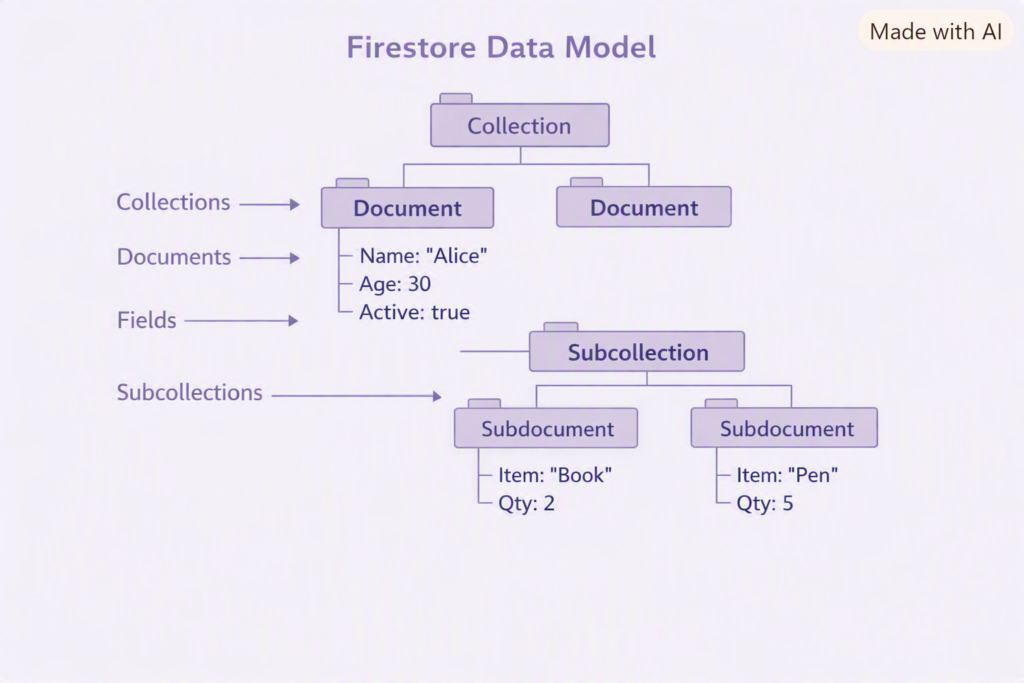
Firestore organizes data into collections and documents. A document is a structured object with typed fields, and a collection is a container for documents. This model looks simple, but its behavior under load is shaped by strict rules. A document cannot exceed one megabyte. Every field is indexed unless explicitly disabled. Nested objects generate multiple index entries. Arrays behave differently from maps. Subcollections form independent namespaces that do not automatically participate in queries.
These rules create a predictable environment. A document update is atomic. A read always returns the latest committed version. A query is fast because indexes exist for every field. But these rules also create constraints. A large document becomes expensive to write because each field triggers index updates. A deeply nested structure becomes slow to update because Firestore must maintain indexes for every nested path. A subcollection does not automatically join with its parent, which means developers must design their hierarchy carefully.
The hierarchical model is powerful when used correctly. A user document can contain a subcollection of orders, and each order can contain a subcollection of items. This structure avoids oversized documents and keeps write operations small. But if the hierarchy becomes too deep, queries become difficult to manage, and indexing cost grows. Firestore encourages shallow hierarchies, not because deep ones are forbidden, but because shallow ones scale better and cost less.
Understanding the data model is essential because it directly influences performance, pricing, and scalability. The next sections will show how these structural decisions affect storage, replication, and indexing.
Section 3 — Storage Internals: What Happens When You Write a Document
Although Firestore hides its internal storage engine behind a serverless API, its behavior reveals a lot about how it works. Firestore stores documents in immutable segments backed by SSDs. When a document is updated, Firestore does not modify the existing segment. Instead, it writes a new segment and marks the old one for compaction. This approach is typical for systems built on Log‑Structured Merge Trees (LSM trees), which are optimized for sequential writes and predictable latency.
LSM‑based storage explains several Firestore behaviors. Writes are fast because they append new segments. Reads are predictable because indexes point directly to the latest segment. Storage grows over time because old segments accumulate until compaction removes them. Compaction can temporarily affect performance because it merges segments and reorganizes indexes. These characteristics are not unique to Firestore; they appear in Bigtable, LevelDB, Cassandra, and RocksDB. Firestore inherits these patterns because it is built on similar foundations.
Indexes are stored separately from documents. When a document is written, Firestore updates multiple index entries. A document with ten fields generates ten index updates. A nested object generates index updates for each nested path. An array generates index updates for each element. This explains why Firestore writes are more expensive than reads and why large documents can cause unexpected pricing spikes.
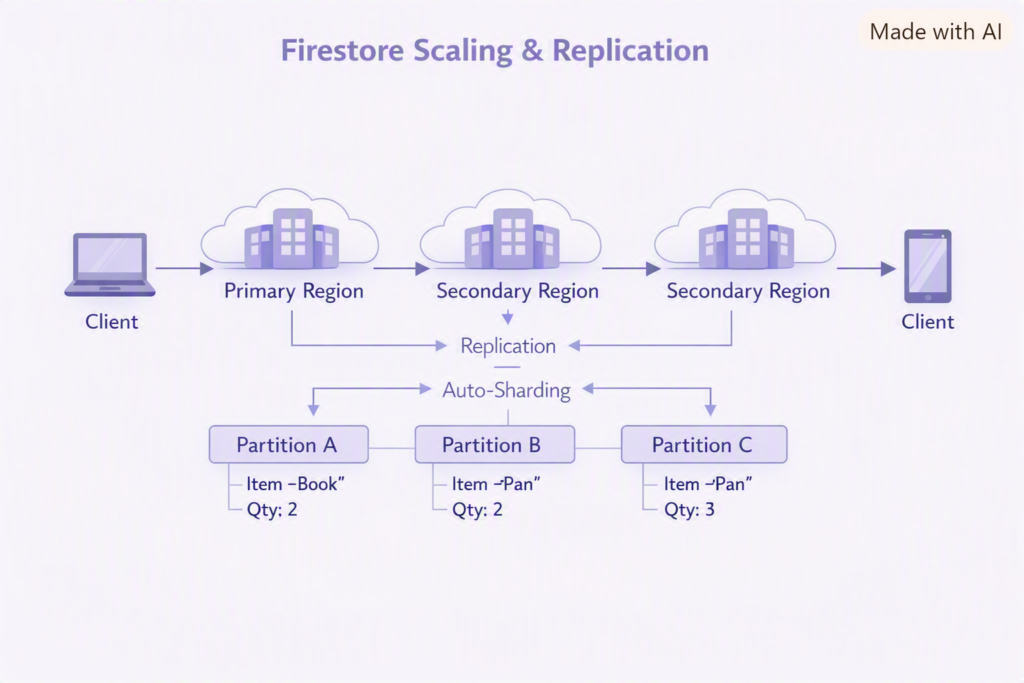
Replication adds another layer of complexity. Firestore provides strong consistency across multiple regions. When a write occurs, Firestore synchronously replicates the write to secondary regions before acknowledging it. This ensures durability and consistency but increases write latency compared to eventually consistent systems. It also means that write throughput is limited by replication speed.
Understanding storage internals helps explain why Firestore behaves the way it does. It also prepares us for the next section, where we examine how Firestore scales and how replication affects performance.
Section 4 — Scaling and Replication: The Real Behavior Under Load
Firestore scales horizontally by distributing documents across partitions. Developers do not control partition keys; Firestore determines partition boundaries automatically based on document ID patterns and write frequency. This automatic partitioning is convenient, but it also means developers must understand how their ID patterns influence performance.
Sequential IDs create hotspots because they land in the same partition. Randomized IDs distribute load evenly. Hotspots occur when too many writes target the same document or collection path. Hotspots lead to increased latency, throttling, and write failures. These issues are not caused by Firestore being “slow,” but by the nature of distributed systems. Any database with synchronous replication and strong consistency will exhibit similar behavior.
Real‑time listeners add another dimension. When many clients subscribe to the same document or collection, Firestore must push updates to all clients. This increases backend load and network traffic. Real‑time features are powerful, but they must be used carefully in high‑load systems.
Firestore’s multi‑region architecture ensures high availability and disaster recovery. Each multi‑region deployment includes a primary region and multiple secondary regions. Writes are replicated synchronously. Reads are served from the nearest region. This architecture is ideal for global applications but increases write latency compared to single‑region databases.
Understanding scaling and replication is essential for designing systems that remain stable under load. The next sections will explore pricing, comparisons with other databases, practical cases, anti‑patterns, and common problems.
Section 5 — Pricing: The Economic Logic Behind Firestore’s Behavior
Understanding Firestore’s pricing is not about memorizing numbers. It is about understanding why certain operations cost more than others and how Firestore’s internal architecture shapes its economic model. Firestore’s pricing is built around three pillars: document reads, document writes, and storage. Everything else — network, indexes, listeners — is derived from these three fundamental operations.
The first thing to understand is that Firestore charges for operations, not for CPU time or memory usage. When you read a document, Firestore charges for a read. When you write a document, Firestore charges for a write. When you store a document, Firestore charges for storage. This model is simple, but the internal mechanics make it more nuanced.
A read is not just a lookup. Firestore must check indexes, validate security rules, and return the latest replicated version of the document. A write is not just an update. Firestore must validate the write, update indexes, replicate the write across multiple regions, and commit it atomically. Storage is not just bytes on disk. Firestore stores documents in immutable segments, maintains multiple index structures, and keeps replicated copies across regions.
This explains why writes are more expensive than reads. A write triggers index updates and replication. A read does not. It also explains why large documents are expensive to write. A large document contains many fields, and each field triggers index updates. A deeply nested document is even more expensive because nested paths generate additional index entries. Firestore’s pricing is not arbitrary; it reflects the cost of maintaining strong consistency and automatic indexing.
To illustrate this, consider a simple example. A document with five fields costs less to write than a document with fifty fields, even if both documents are small in size. The difference is not in storage but in indexing. Firestore must update fifty index entries for the second document, which increases the cost. This is why Firestore encourages small, flat documents. It is not a stylistic preference; it is an economic one.
Another important aspect is real‑time listeners. When a client subscribes to a document or a query, Firestore must push updates to the client whenever the data changes. This means that a single write can generate multiple read operations if many clients are listening. Developers often underestimate this effect. A chat application with thousands of connected clients can generate thousands of read operations per message. This is not a bug; it is how real‑time synchronization works.
Storage pricing is also shaped by Firestore’s internal architecture. Because Firestore uses immutable segments, storage grows over time until compaction removes old segments. This means that frequent updates increase storage usage temporarily. Developers sometimes notice that storage grows even when documents are small. This is normal. It reflects the cost of maintaining multiple versions until compaction occurs.
To make pricing more predictable, Firestore provides detailed usage metrics. But metrics alone are not enough. Developers must understand how their data model affects pricing. A poorly designed schema can multiply costs by ten. A well‑designed schema can reduce costs dramatically without changing functionality.
The next section will compare Firestore with DynamoDB, MongoDB, and Cassandra to show how different architectural choices lead to different pricing models. This comparison will help you understand when Firestore is the right choice and when another database might be more suitable.
6. Practical Cases
Case 1: Real‑Time Chat Application
A chat application uses Firestore to store messages and deliver them in real time. Each message is a small document, and clients subscribe to the message collection. Firestore performs well because documents are small, writes are distributed, and real‑time listeners are efficient. The main challenge is pricing: each message triggers multiple reads for connected clients.
Case 2: E‑Commerce Order System
An e‑commerce platform stores orders in a collection and items in subcollections. This structure avoids oversized documents and keeps write operations small. Firestore performs well because the hierarchy is shallow and indexing is predictable. The main challenge is query design: Firestore cannot join orders and items automatically.
Case 3: IoT Device State Tracking
An IoT system stores device states in Firestore. Each device updates its state frequently. Firestore performs well if documents are small and updates are distributed. The main challenge is write cost: frequent updates generate many index operations.
Case 4: Collaborative Document Editing
A collaborative editing tool uses Firestore to store document states and deliver updates in real time. Firestore performs well because it supports real‑time synchronization and strong consistency. The main challenge is hotspotting: many clients write to the same document.
7. Anti‑Patterns
Anti‑Pattern 1: Deeply Nested Documents
Developers sometimes store large nested objects in a single document. This increases indexing cost, slows down writes, and makes queries difficult. The correct approach is to use subcollections and shallow structures.
Anti‑Pattern 2: Sequential Document IDs
Sequential IDs cause hotspots because they land in the same partition. This leads to throttling and write failures. The correct approach is to use randomized IDs.
8. Common Problems and Solutions
Problem 1: Slow Writes
Cause: too many index updates. Solution: flatten documents, disable unnecessary indexes.
Problem 2: Hotspots
Cause: sequential IDs or frequent updates to the same document. Solution: random IDs, sharding patterns.
Problem 3: Expensive Queries
Cause: large collections with complex filters. Solution: manual composite indexes, better data modeling.
Problem 4: High Read Costs
Cause: many real‑time listeners. Solution: reduce listener count, use pagination.
Problem 5: Storage Growth
Cause: immutable segments and frequent updates. Solution: reduce update frequency, split documents.
Conclusions
Firestore is a powerful distributed database with strong consistency, automatic indexing, and real‑time synchronization. Its architecture makes it ideal for global applications, collaborative tools, and mobile apps. But its convenience comes with constraints: indexing increases write cost, replication increases latency, and automatic partitioning requires careful ID design. Understanding Firestore’s internal logic is essential for building efficient, scalable systems.
Practical Recommendations
Design shallow hierarchies. Keep documents small and flat. Use randomized IDs. Disable unnecessary indexes. Avoid frequent updates to large documents. Use subcollections to split data logically. Limit real‑time listeners. Monitor pricing metrics. Choose Firestore for real‑time, global, low‑ops applications, and choose alternatives for analytics or high‑throughput workloads.